
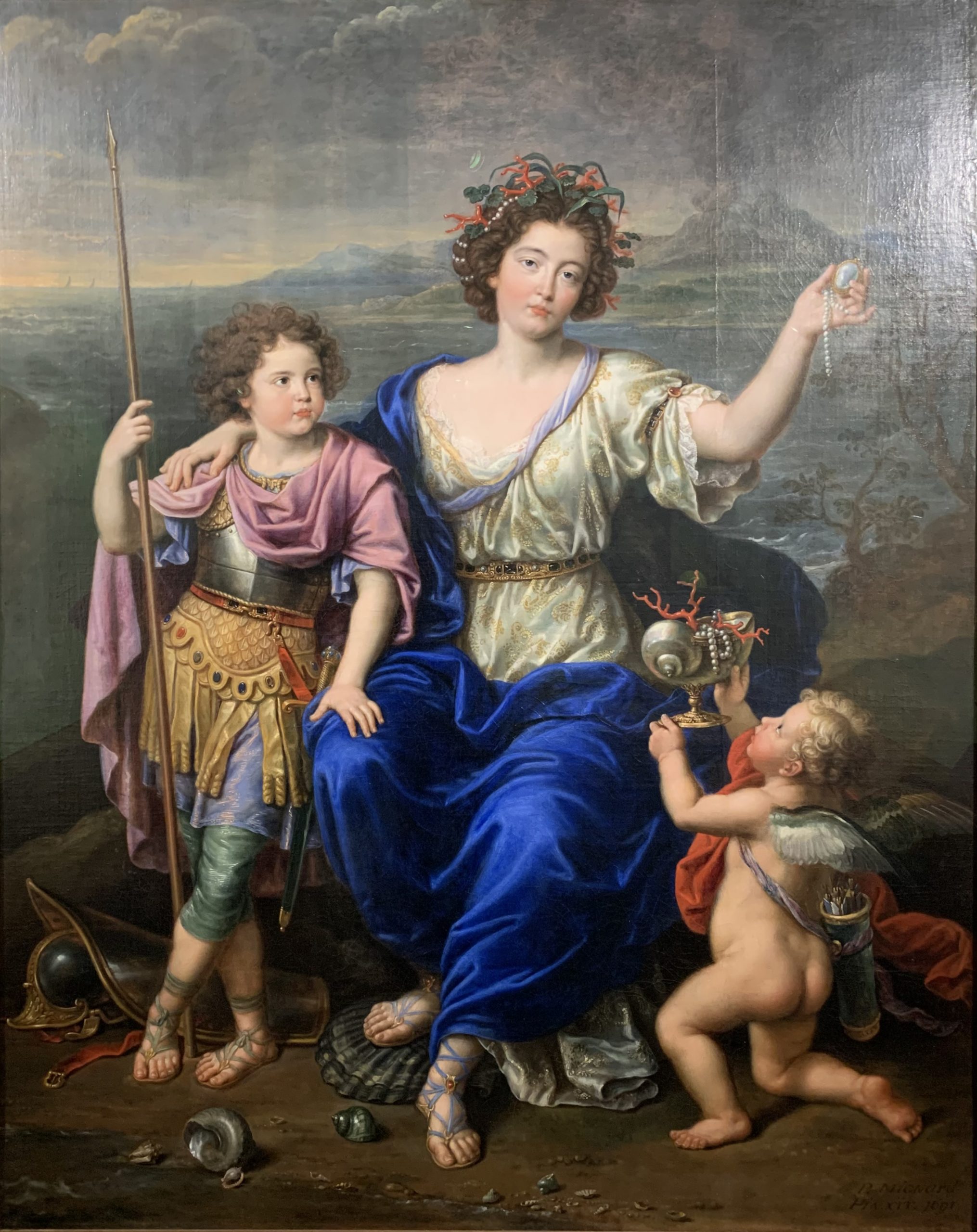
The Marquise de Seignelay by Pierre Mignard, the star of “The National Gallery Masterpiece Tour, Mignard: The Power of Posing” at South Shields Museum and Art Gallery
From the National Gallery Website:
In this portrait, the recently widowed Catherine-Thérèse de Goyon de Matignon-Thorigny, Marquise de Seignelay (1662–1699) is depicted as the sea-goddess Thetis. Pierre Mignard expresses this through the coral, reeds and pearls woven in her hair and the scallop shell at her feet. Her sumptuous robe is painted using ultramarine, a highly expensive blue pigment, as a show of her fortune and power. Her eight-year-old son Marie-Jean Baptiste (1683–1712) is dressed as the Greek hero Achilles – Thetis’ son by the mortal Peleus (Pelée in French).
At the Marquise’s side, Cupid offers up a shell cup overflowing with pearls and coral. Along with the exotic shells at her feet, these are used to celebrate her husband’s career in the French royal navy and the wealth gained through his exploits in the French colonies of the West Indies. It has recently been suggested that Mignard situates the figures on the shores of Martinique, an island in the West Indian ocean which was purchased for the French crown by the late Marquis’ father in 1664. The smoking volcano in the background – Mount Pelée – is an ingenious reference to Catherine-Thérèse’s deceased husband.
In this imposing portrait, Pierre Mignard transforms Catherine-Thérèse de Goyon de Matignon-Thorigny, the Marquise de Seignelay (1662–1699), into the sea-goddess Thetis. A luminous blue robe cascades in folds over her gold-embroidered gown. The generous use of ultramarine – an expensive and high-quality blue pigment – was unusual for the period. It, like the portrait, is a deliberate display of wealth, status and power.
At the Marquise’s side stands a young boy dressed as Achilles, who, according to Greek legend, was the son of Thetis and the mortal Peleus and the greatest warrior of the Trojan War. He wears ornate armour and holds a spear, with a shield and helmet lying at his feet. This is likely Catherine-Thérèse’s eldest son, Marie-Jean Baptiste (1683 – 1712) who was eight years old at the time. This is a striking choice because Achilles is usually depicted as a mature warrior. It has been suggested that the winged Cupid might be her youngest son, Théodore-Alexandre (1690? – 1695?), although this seems unlikely given his nudity.
Catherine-Thérèse was the widow of Jean-Baptiste-Antoine Colbert (1651–1690), the Marquis de Seignelay, who died a year before this portrait was painted. The Marquis had been appointed Secretary of State for the Navy upon the death of his father, Jean-Baptiste Colbert (1619–1685), who held the position before him. Due to their naval profession, the Colbert family had strong ties to the French colonies in the Americas. Both father and son were responsible for drafting the Code Noir (Black Code, 1685), which regulated the commerce and discipline of enslaved people in the French colonial empire.
Although once thought to depict a Mediterranean volcano, perhaps Vesuvius, the background of this portrait has recently been identified as Martinique, an island in the West Indian ocean, which was purchased for the French crown by the Marquise’s father-in-law in 1664. The wealth of the island lay in sugar production. This was exploited by the French who used enslaved labour from the Senegalese coast to work the plantations. As the source of Seignelay family’s wealth and power, Martinique would have been deemed a fitting location for the figures.
The topographical accuracy of the landscape in the background suggests that Mignard worked from contemporary engravings or sketches to complete the scene. The volcano has been identified as Mount Pelée – the French translation of Peleus, Thetis’s husband. Mignard thus inventively alludes to Catherine-Thérèse’s recently deceased husband through the smoking volcano in the distance.
One of the most striking elements of the picture is the elaborate shell cup supported by gold mounts which overflows with pearls and coral, offered up by Cupid to the Marquise. Such cups were prized novelties in sixteenth and seventeenth-century Europe. Its inclusion in the painting speaks to France’s position as a global power and to the Marquis de Seignelay’s naval exploits. More shells are scattered at the water’s edge, originating from across the globe, commemorating her husband’s career in the French royal navy and his famed collection of rare objects. Together with the coral, pearls, and cup, the shells are materials of empire used to celebrate the status of the sitter and the riches gained through trade. The same iconography is used in Mignard’s earlier portrait of Louise de Kéroualle, the Duchess of Portsmouth, painted in 1682 (National Portrait Gallery, London).
Provenance: Collection of Quintin Craufurd (1743–1819), his posthumous sale, Paris, 20–21 November 1820, Delaroche & Paillet (lot 162, 299.95 francs(?) to Dalbatre); collection of Sir Richard Wallace (1818–90) of Paris and London by 1874, probably after 1870; by inheritance to Lady Amélie Julie Charlotte Wallace (née Castelnau) (1819–97) in 1890 when recorded at no. 2 rue Laffitte, Paris; inherited from her by Sir John Edward Arthur Murray Scott (1843–1912), who bequeathed NG 2967 (among other paintings all then in Paris) to the National Gallery, which was advised of the bequest in 1914 and accepted it that year, agreeing to pay French Mutation Duty of 7780 francs.
Object description
Type: Easel Painting
Location: South Shields Museum, Tyne & Wear
Material: Oil on canvas
Artist: Pierre Mignard (1612-1695)
Date: 1691
Image Details
Date: 31 August 2026
Camera body: iPhone Xs
Lens: Wide Camera 26mm ƒ/1.8
Focal Length: 26mm
Aperture: ƒ/1.8
Shutter Speed: 1/50s
ISO: 200
Licensing: Image of a National Gallery asset. This image cannot be licensed.