
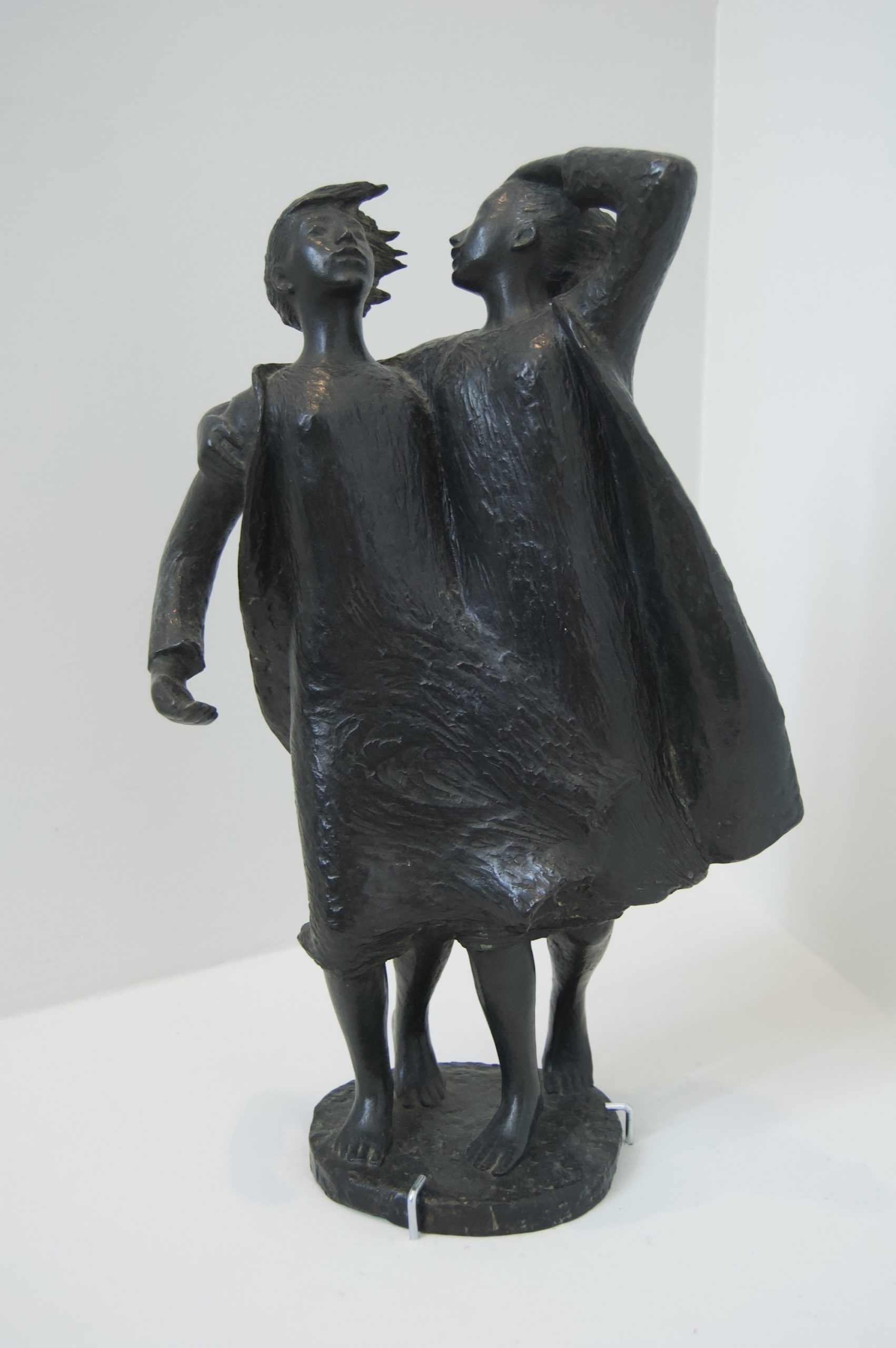
Girls in the Wind by Betty Rea at the Towner Eastbourne, East Sussex.
From Wikipedia:
Betty Rea was born in London in 1904. Her father was Dr. Arthur Bevan and her mother’s maiden name was Barnardo; Dr.Thomas John Barnardo was her great-uncle.
She was educated at Downe House School (in Kent at that time) and began to study painting at the Regent Street Polytechnic in 1922, almost at once changing to sculpture and transferring her studies to the Royal College of Art in 1924.[1] Her teacher there was Ernest A. Cole. Henry Moore was a student teacher at the RCA at that time, and became a friend.
In 1926 she married law student James Russell Rea (1902–1954), whose father became Baron Rea, a Liberal peer. Together they had two sons, Nicolas and Julian, who were born in 1928 and 1931. The couple divorced in 1942.
During the 1930s, partly influenced by her friendship with Professor John Desmond Bernal, Betty Rea was greatly involved in anti-fascist, leftwing politics. She was a founding member of Artists’ International Association (AIA),[4] and served as secretary from 1934 to 1936. Founded in 1933, the AIA sought to oppose imperialism, fascism and colonialism through art.
Rea was also an active member of the Communist Party Artists group, the Artists’ Refugee Committee, as well as Chair of the Arts Peace Campaign.
Communal care for children and their education was one of Rea’s socialist interests. In 1934, following a trip to the Soviet Union, she published an article, ‘Children and Art in Soviet Russia’, which praised the educational advances being made in Russia.
In 1937 she worked upon a mural in the Unofficial Peace Pavilion at the Paris World Fair.
At the outset of the Second World War, Rea’s personal life eclipsed her role as an exhibiting artist. For most of the war, Rea taught painting and model-making in evacuated children’s homes in Huntingdon and other villages in the surrounding Cambridgeshire countryside. She set up home with her colleague, Nan Youngman, first in a caravan in the grounds of Hinchingbrooke House, then in Godmanchester, and in 1946 at ‘Papermills’ in Cambridge. The children’s paintings from this time were included in several British Council exhibitions sent abroad and some are illustrated in Herbert Read’s “Education Through Art”.
It was not until 1942 that Rea would return to creating sculpture, when the members of the AIA, encouraged by the British government, staged the exhibition For Liberty to increase wartime propaganda and raise the public’s spirits. Rea’s sculpture New World was displayed in a section of the exhibition under the thematic title of ‘this is how we are fighting’; the other two sections of the exhibition investigated the themes ‘this is what will happen if we lose the war’ and ‘this is what we are fighting for’.
From 1949 Rea taught sculpture at Homerton College, continuing this part-time until 1964, she also worked for some years as craft examiner for the Cambridge Local Examinations Syndicate.
Betty Rea died in April 1965. At the time of her death she was working on a clay sculpture commissioned for Hockerill College, to be cast in bronze.
Object description
Type: Sculpture
Location: Towner Eastbourne, East Sussex
Material: Bronze
Artist: Betty Rea (1904-1965)
Date: c.1956
Image Details
Date: 1 July 2026
Camera body: Nikon D50
Lens: Nikkor AF-S DX 18-55mm ƒ3.5-5.6G ED
Focal Length: 26mm
Aperture: ƒ/4
Shutter Speed: 1/50s
ISO: 800
Licensing: Image of a Towner Eastbourne asset. This image cannot be licensed.