
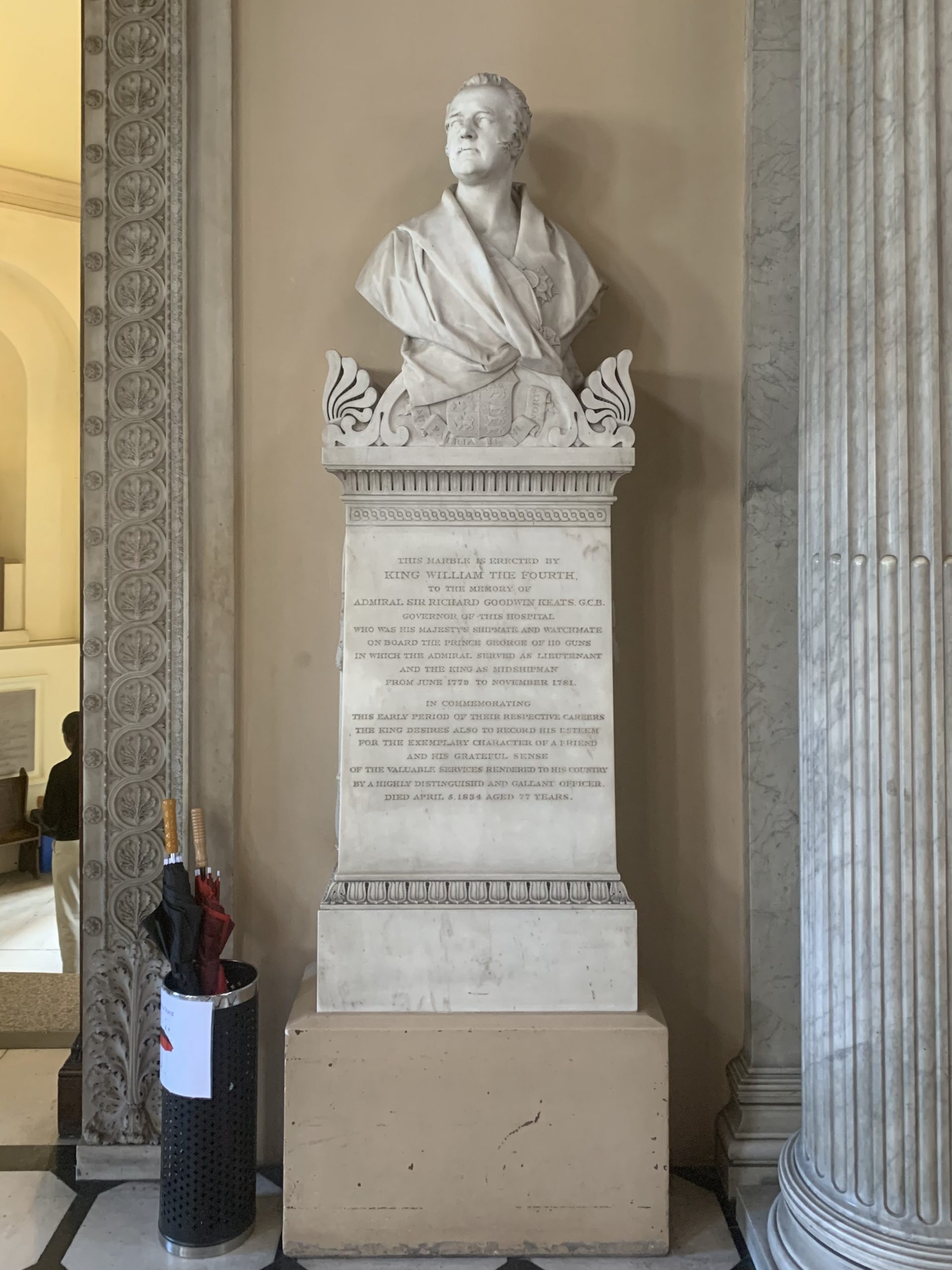
The monument to Sir Thomas Masterman Hardy, Old Royal Naval College, Greenwich, London
From The Victorian Web:
Sir Thomas Masterman Hardy (1769-1839),” by William Behnes (1795-1864). 1843. Marble. The Chapel, Old Royal Naval College, Greenwich, London SE10. One of a pair of busts on tall pedestals beside the main chapel entrance, both of naval heroes who became Governors of the Greenwich Hospital (as it then was). This one pays tribute to Sir Thomas Masterman Hardy (1769-1839), most famous now and perhaps even then for having been with Nelson at his last hour. After his distinguished naval career, Hardy was appointed Governor of the Greenwich Hospital in 1834, having left the Admiralty in despair at recent economies. He proved an enlightened administrator there. One of his most welcome reforms was probably his abolition of the practice of making those naval pensioners who got drunk on Sundays wear specially garish coats as a mark of shame (see Laughton and Lambert).
Hardy looks genial, and the monument as a whole is pleasing, the drapery here more successful than in some of his larger sculptures — see Benedict Read, who discusses his lack of “flow and continuity” elsewhere (169). Fronting the decorative top of the pedestal is a medallion relief of Nelson in profile, and a scroll echoing Nelson’s last inspiring signal at the Battle of Trafalgar; “England expects every man to do his duty.”
From Wikipedia:
Vice-Admiral Sir Thomas Masterman Hardy, 1st Baronet, GCB (5 April 1769 – 20 September 1839) was a Royal Navy officer who served in the French Revolutionary and Napoleonic Wars. He took part in the Battle of Cape St. Vincent in February 1797, the Battle of the Nile in August 1798 and the Battle of Copenhagen in April 1801 during the French Revolutionary Wars. Hardy served as flag captain to Vice-Admiral Lord Nelson, and commanded HMS Victory at the Battle of Trafalgar in October 1805 during the Napoleonic Wars. Nelson was shot as he paced the decks with Hardy, and as he lay dying, Nelson’s famous remark of “Kiss me, Hardy” was directed at him. Hardy went on to become First Naval Lord in November 1830 and in that capacity refused to become a Member of Parliament and encouraged the introduction of steam warships.
Object description
Type: Sculpture
Location: Old Royal Naval College, Greenwich, London
Material: Marble
Artist: William Behnes (1795-1864)
Date: 1843
Image Details
Date: 17 June 2026
Camera body: iPhone Xs
Lens: Wide Camera 26mm ƒ/1.8
Focal Length: 26mm
Aperture: ƒ/1.8
Shutter Speed: 1/60s
ISO: 320
Licensing: Image of an Old Royal Naval College asset. This image cannot be licensed.