
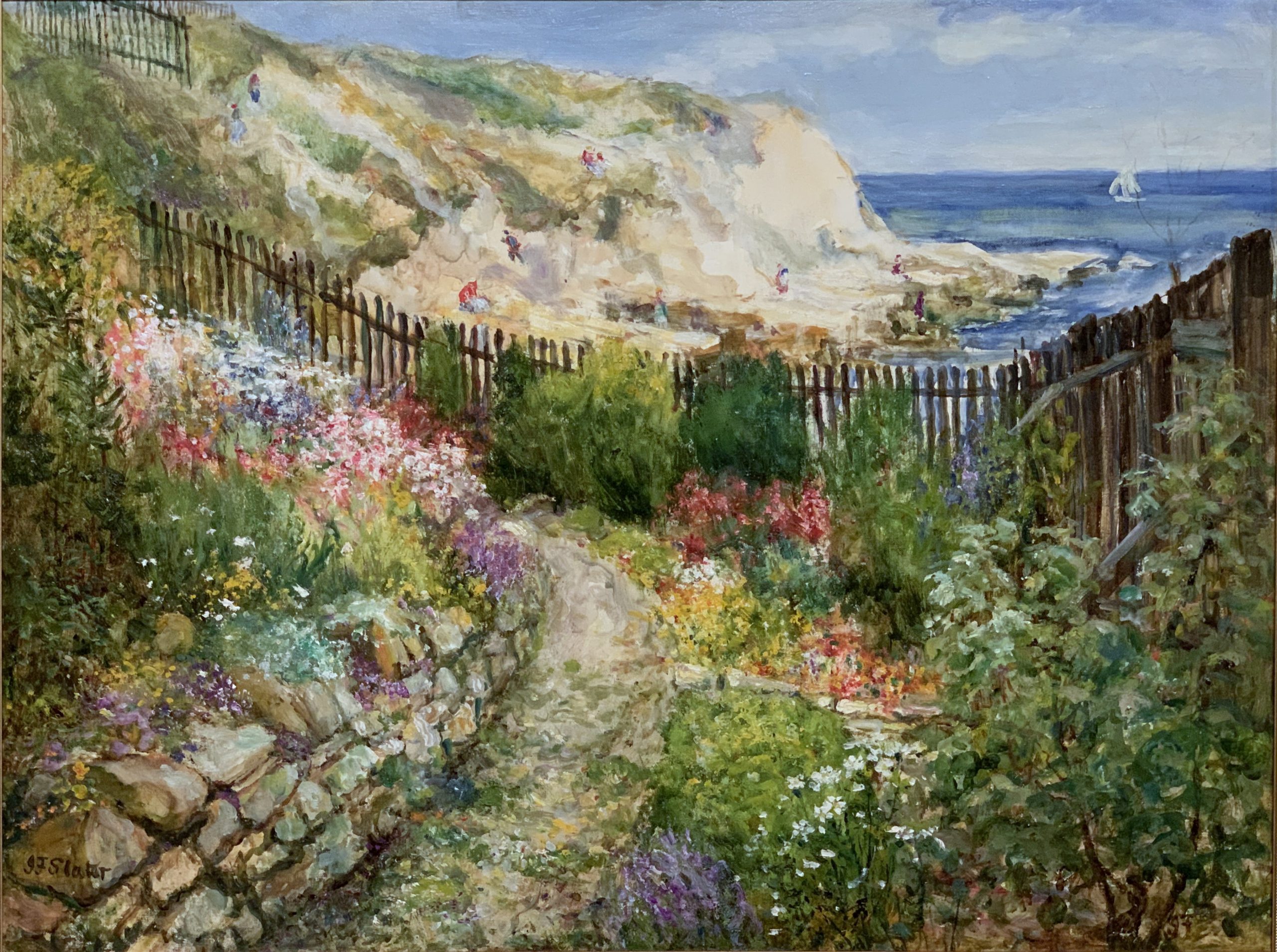
John Falconar Slater was born in Newcastle upon Tyne and developed an early interest in drawing and painting. He initially worked as a book-keeper in his father’s corn mill, then ran a shop in the diamond mining region of South Africa. By his mid-twenties he was back in Tyneside, at Forest Hall, and, encouraged by his mother, had decided to pursue a career as an artist. By 1883 he was exhibiting his work in fine art exhibitions, and in 1889 at the Royal Academy in London, where he regularly exhibited work until 1935.
Slater spent time living in North Shields and Whitley Bay, before settling in Cullercoats. He painted a wide range of subjects including landscapes, seascapes, portraits, animals and flowers, and was skilled in a variety of techniques from oil and watercolour to etching and lithography. He worked on his pictures outside, often in challenging weather conditions, and became known as The Weatherproof Artist.
At first glance this scene looks empty of people, but various figures can be seen in the background, on the shore and the cliffs.
It has been suggested that Slater actually met Claude Monet, but there is no evidence for this, and, as he did not mention it in his extensive writings about his art, this notion can be discounted as a myth. However, the two artists were contemporaries and did pursue a similar artistic vision. Slater has been recognised as one of the earliest British artists to adopt the Impressionist approach to painting, though he himself described his work as ‘expressionist’.
Provenance: Laing Art Gallery collection
Object description
Type: Easel Painting
Location: South Shields Museum, Tyne & Wear
Material: Oil on board
Artist: John Falconar Slater (1857-1937)
Date: unknown
Image Details
Date: 4 May 2026
Camera body: iPhone Xs
Lens: Telephoto Camera 52mm ƒ/2.4
Focal Length: 52mm
Aperture: ƒ/2.4
Shutter Speed: 1/50s
ISO: 250
Licensing: Image of a North East Museums asset. This image cannot be licensed.