
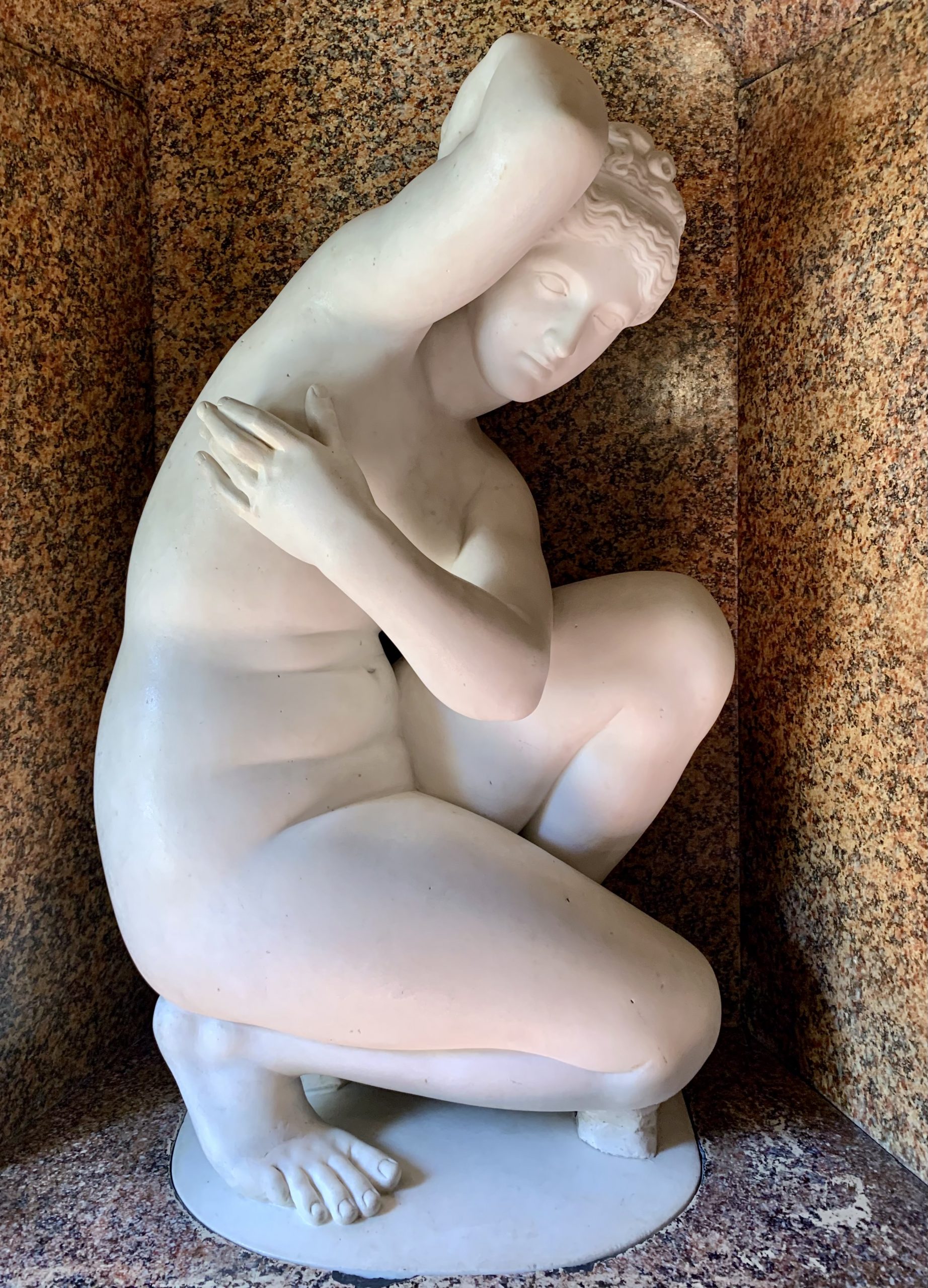
Marble sculpture; a bathing woman; after Giambologna (Giovanni Bologna, 1529-1608); probably Italian, c. 1850-75. A large marble figure of a crouching bathing woman, who lifts up her right arm to place her hand delicately above her head, whilst her left arm passes across her front, concealing her breasts. A nineteenth-century copy after a bronze statuette by Giovanni Bologna (1529-1608).
A marble figure of a naked crouching woman, depicted as if in the act of bathing. She almost kneels, her right thigh pressed upon her leg which is raised just above the ground, whilst her left leg is raised higher. The woman twists her body to her right and raises her right arm, so that her hand hovers over her head; her left arm passes across her front, with the hand likewise held just above the surface of the woman’s skin. Her hair is elaborately dressed. On an integral marble base. The sculpture essentially copies a bronze statuette of a bathing woman by the Italo-Flemish sculptor Giovanni Bologna (Giambologna). Born in Flanders, Giambologna spent almost the whole of his career in Florence, where he worked as court sculptor to the Medici dukes, making sculptures in a range of materials and sizes. Giambologna is best known for the small bronze sculptures which he was able, in his efficient and highly productive workshop, to make in multiple versions. His bronzes were sent by the Medici as diplomatic gifts to courts across Europe, further helping to cement Giambologna’s international reputation. One of the themes that preoccupied the sculptor throughout his career was the figure of a bathing woman, of which he made both standing and crouching models. Two types of crouching woman are known through bronze versions, one larger and the other smaller (Charles Avery and Anthony Radcliffe (eds.), Giambologna 1529–1608: Sculptor to the Medici (Royal Scottish Museum, Edinburgh and Victoria and Albert Museum, London), London 1978, nos. 19-22). The Cragside figure is partly based on Giambologna’s larger model, the best version of which is the signed bronze in the Museo Nazionale del Bargello, Florence, from the Medici collections. The head with its elaborately dressed hair, the upper torso and the gestures of the arms all derive from Giambologna. However, in the Cragside figure the position of the woman has been reversed so that she faces to the right, making the lower part of the sculpture much closer to the antique source for Giambologna’s figure, a once celebrated composition of Aphrodite Crouching by the third century B.C. Greek sculptor Doidalsas. The original is long lost, but numerous copies of this influential sculpture were known from the Renaissance onwards, including the so-called Lely Venus in the Royal Collection (on long-term loan to the British Museum). The somewhat meaningless gesture with the woman’s left hand in the Cragside sculpture comes from the fact that the towel that the woman in Giambologna’s bronze model uses to dry herself has here been omitted. The sculpture, which perhaps was made in Italy, fits very well within its niche on the staircase at Cragside, so it seems entirely possible that it was commissioned for this position, in which the woman looks across towards John Bell’s Daughter of Eve. Jeremy Warren March 2022
Provenance: Armstrong collection. Transferred by the Treasury to The National Trust in 1977 via the National Land Fund, aided by 3rd Baron Armstrong of Bamburgh and Cragside (1919 – 1987).
Text from the National Trust website
Object description
Type: Sculpture
Location: Cragside, Rothbury, Northumberland
Material: Marble
Artist: after Doidalsas of Bithynia
Date: c. 1850-1875
Image Details
Date: 21 April 2026
Camera body: iPhone Xs
Lens: Wide Camera 26mm ƒ/1.8
Focal Length: 26mm
Aperture: ƒ/1.8
Shutter Speed: 1/60s
ISO: 100
Licensing: Image of a National Trust asset. This image cannot be licensed.