
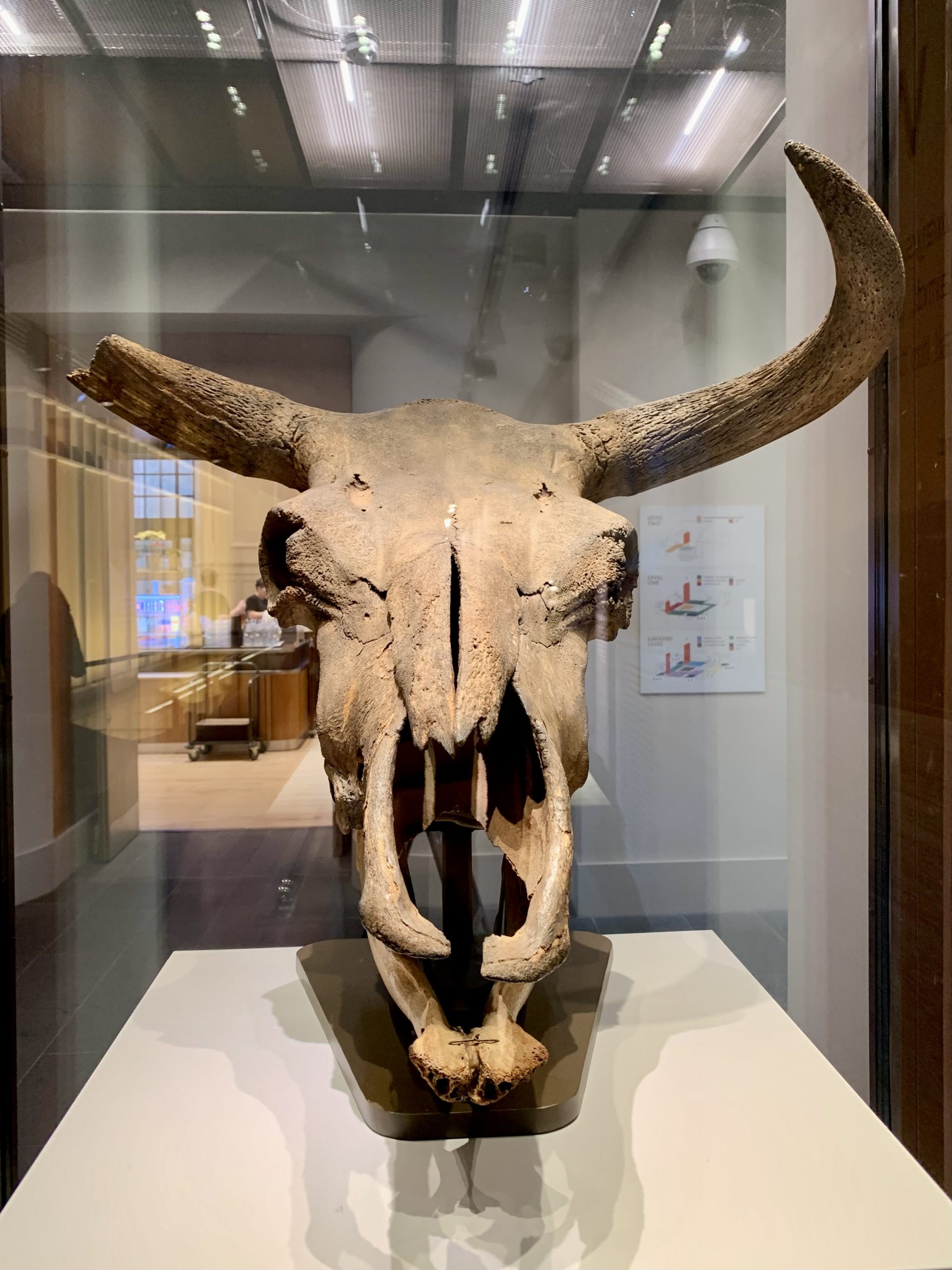
Auroch skull in Perth Museum, Perth, Scotland.
Aurochs are the wild ancestor of domestic cattle. Destruction of forests and hunting over thousands of years led to their extinction. The species survived in Britain until the Bronze Age.
This skull was found at Chapleton Moss, east of Forfar, Angus in 1790.
From Wikipedia:
The aurochs (Bos primigenius; /ˈɔːrɒks/ or /ˈaʊrɒks/; pl.: aurochs or aurochsen) is an extinct species of bovine, considered to be the wild ancestor of modern domestic cattle. With a shoulder height of up to 1.8 m (5 ft 11 in) in bulls and 1.55 m (5 ft 1 in) in cows, it was one of the largest herbivores in the Holocene; it had massive elongated and broad horns that reached 80 cm (31 in) in length.
The aurochs was part of the Pleistocene megafauna. It probably evolved in Asia and migrated west and north during warm interglacial periods. The oldest-known aurochs fossils date to the Middle Pleistocene. The species had an expansive range spanning from Western Europe and North Africa to the Indian subcontinent and East Asia. The distribution of the aurochs progressively contracted during the Holocene due to habitat loss and hunting. The last known fossil remains were found in Bulgaria that date to the late 17th or early 18th century.
There is a long history of interaction between aurochs and humans, including archaic hominins like Neanderthals. The aurochs is depicted in Paleolithic cave paintings, Neolithic petroglyphs, Ancient Egyptian reliefs and Bronze Age figurines. It symbolised power, sexual potency and prowess in religions of the ancient Near East. Its horns were used in votive offerings, as trophies and drinking horns.
Two aurochs domestication events occurred during the Neolithic Revolution. One gave rise to the domestic taurine cattle (Bos taurus) in the Fertile Crescent in the Near East that was introduced to Europe via the Balkans and the coast of the Mediterranean Sea. Hybridisation between aurochs and early domestic cattle occurred during the early Holocene. Domestication of the Indian aurochs led to the zebu cattle (Bos indicus) that hybridised with early taurine cattle in the Near East about 4,000 years ago. Some modern cattle breeds exhibit features reminiscent of the aurochs, such as the dark colour and light eel stripe along the back of bulls, the lighter colour of cows, or an aurochs-like horn shape.
Image details
Date: 31 January 2026
Camera body: iPhone Xs
Lens: Wide Camera 26mm ƒ/1.8
Focal Length: 26mm
Aperture: ƒ/1.8
Shutter Speed: 1/50s
ISO: 100
Licensing: Image of a Perth Museum asset. This image cannot be licensed.