
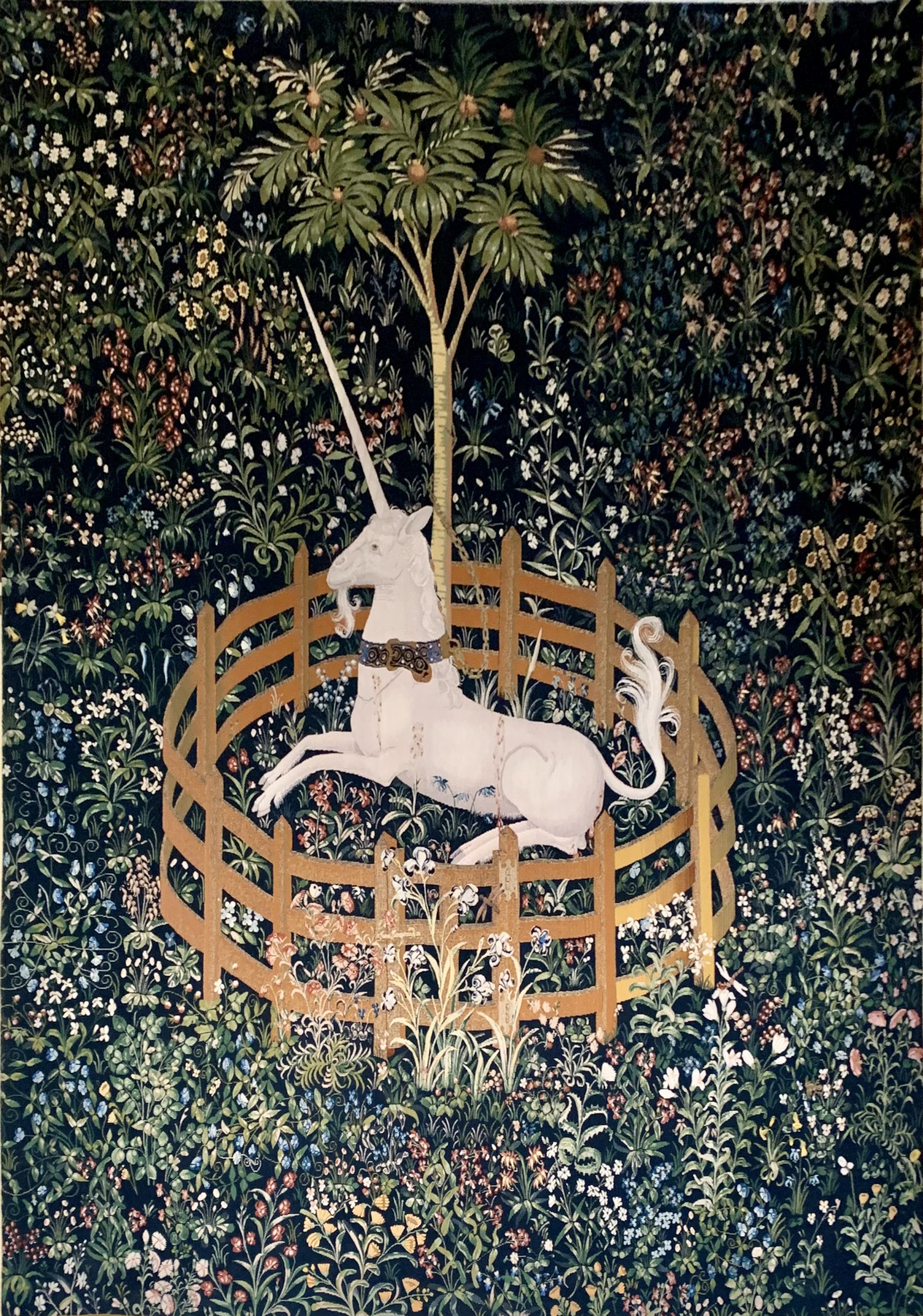
The Unicorn Tapestries in Stirling Castle, Stirling, Scotland
From Wikipedia:
The Unicorn Tapestries or the Hunt of the Unicorn (French: La Chasse à la licorne) is a series of seven tapestries made in the Southern Netherlands around 1495–1505, and now in The Cloisters in New York City. They were possibly designed in Paris and woven in Brussels. They depict a group of noblemen and hunters in pursuit of a unicorn through an idealised French landscape. The tapestries were woven in wool, metallic threads, and silk. The vibrant colours, still evident today, were produced from dye plants: weld (yellow), madder (red), and woad (blue). First recorded in 1680 in the Paris home of the Rochefoucauld family, the tapestries were looted during the French Revolution. Rediscovered in a barn in the 1850s, they were hung at the family’s Château de Verteuil. Since then they have been the subject of intense scholarly debate about the meaning of their iconography, the identity of the artists who designed them, and the sequence in which they were meant to be hung. Although various theories have been put forward, currently nothing is known of their early history or provenance. Their dramatic but conflicting narratives have inspired multiple readings, from chivalric to Christological. Variations in size, style, and composition suggest they come from more than one set, linked by their subject matter, provenance, and the mysterious AE monogram which appears in each. One of the panels, “The Mystic Capture of the Unicorn”, survives as just two fragments.
Image details
Date: 1 February 2026
Camera body: iPhone Xs
Lens: Wide Camera 26mm ƒ/1.8
Focal Length: 26mm
Aperture: ƒ/1.8
Shutter Speed: 1/25s
ISO: 400
Licensing: Image of a National Library of Scotland asset. This image cannot be licensed.