
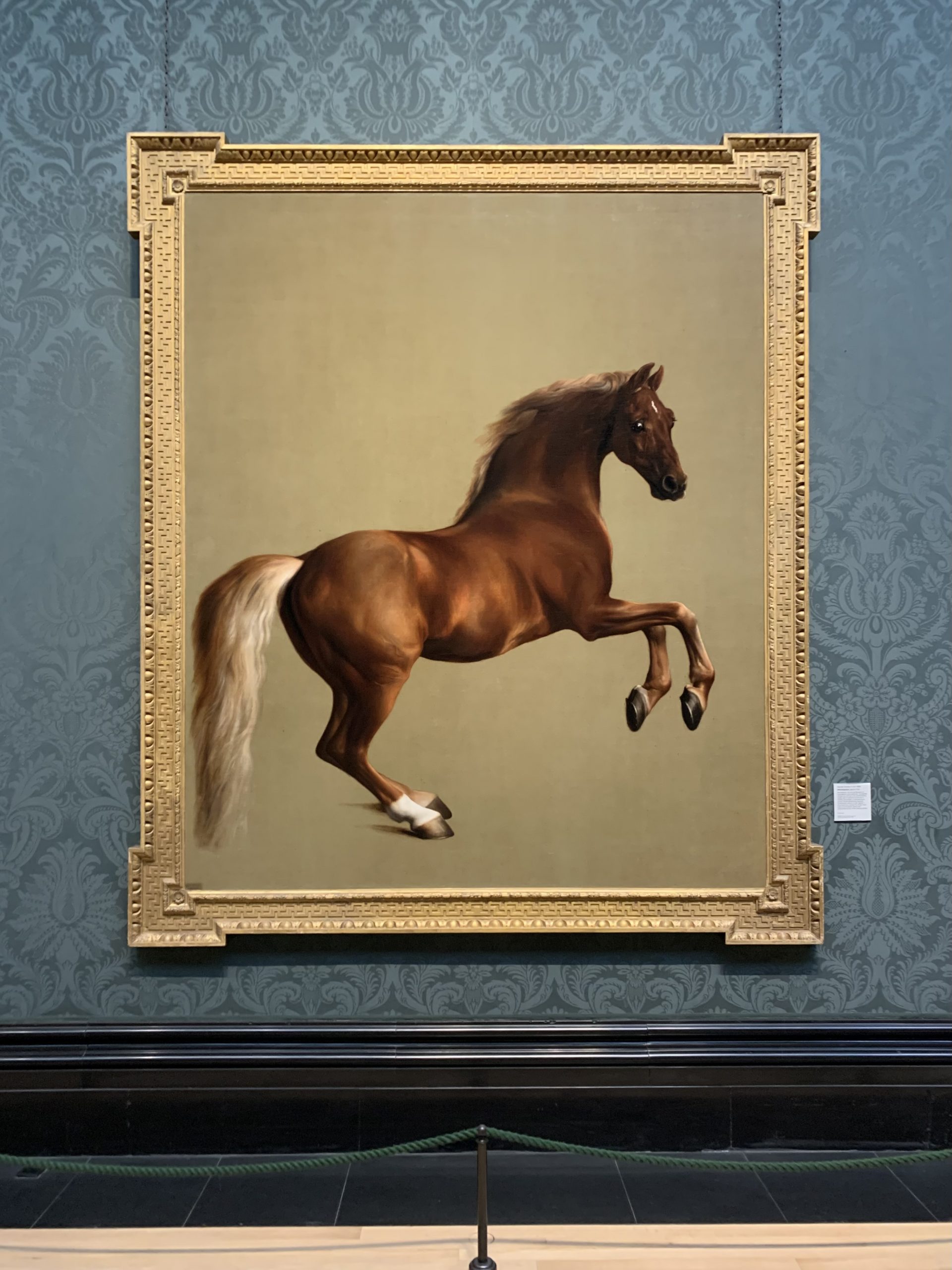
One of the most important British paintings of the eighteenth century, Whistlejacket is probably the most well-known portrait of a horse. It is also widely acknowledged to be George Stubbs’s masterpiece. The Arabian chestnut stallion had won a famous victory at York in 1759, but by 1762 had been retired from racing. He belonged to the 2nd Marquess of Rockingham, who commissioned Stubbs to paint a commemorative life-size portrait of his prize horse on a scale that was more appropriate for a group portrait or historical painting.
Stubbs excludes any reference to a rider, riding equipment or location, painting the magnificent rearing horse against a neutral background of pale gold. Despite suggestions that a rider was originally planned, Whistlejacket was always meant to be unmounted. Free from human control, the riderless horse is the embodiment of unrestrained natural energy, a free spirit that prefigures Romanticism’s celebration of nature.
Provenance: Commissioned by Charles Watson Wentworth, 2nd Marquess of Rockingham (d.s.p. 1782); his nephew and principal heir, William Wentworth-Fitzwilliam, 2nd Earl Fitzwilliam, then by descent to the 10th Earl Fitzwilliam (d. 1979); Trustees of the Rt. Hon. Olive, Countess Fitzwilliam’s Chattels Settlement, from whom purchased with the support of the Heritage Lottery Fund and private donations by the National Gallery 1997.
Text from The National Gallery
Object description
Type: Easel painting
Location: The National Gallery, London
Material: Oil on canvas
Artist: George Stubbs (1724 – 1806)
Date: about 1762
Image Details
Date: 10 April 2025
Camera body: iPhone Xs
Lens: Wide Camera 26mm ƒ/1.8
Focal Length: 26mm
Aperture: ƒ/1.8
Shutter Speed: 1/31s
ISO: 320
Licensing: Image of a National Gallery asset. This image cannot be licensed.
