
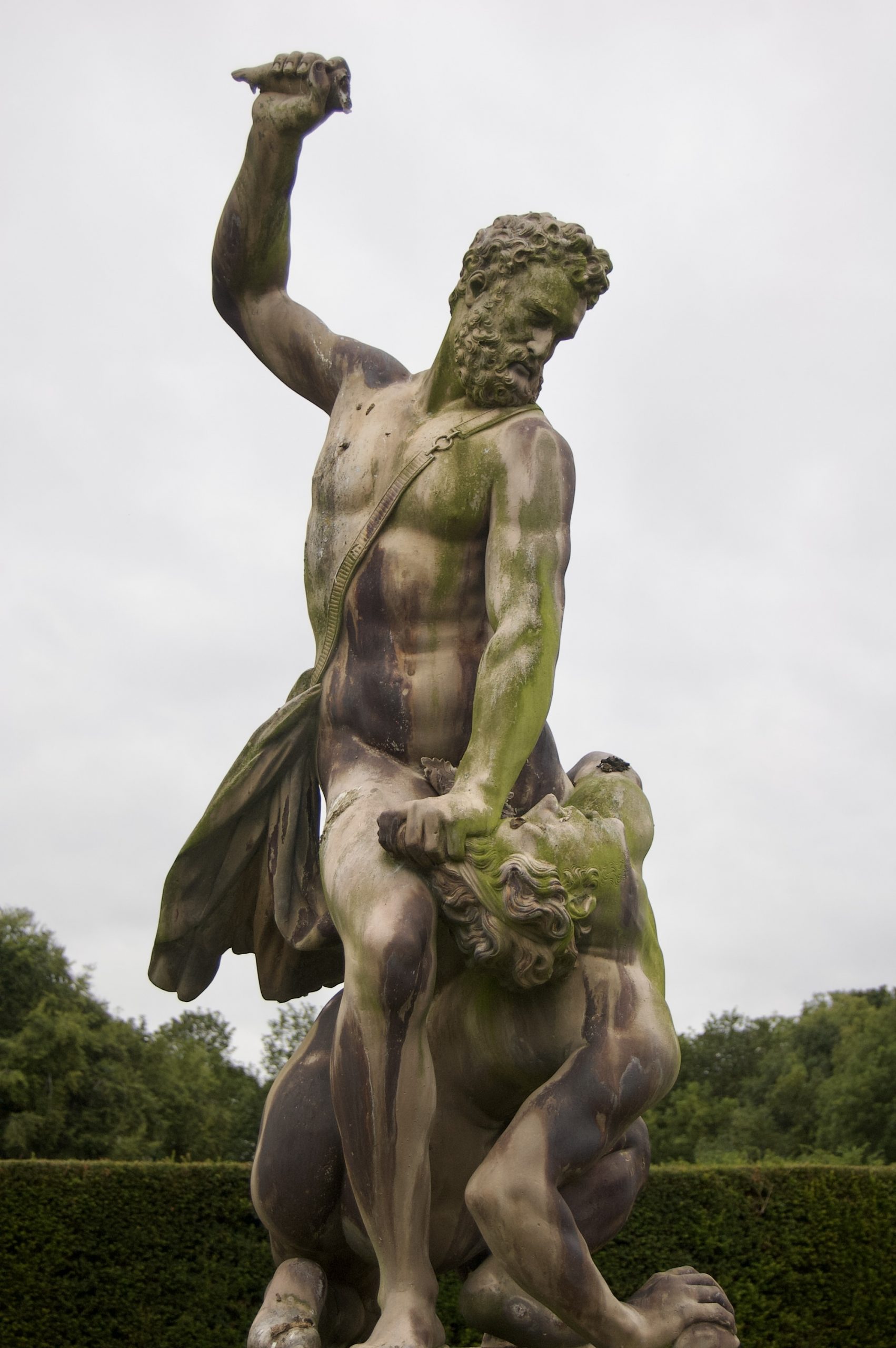
Lead, Samson Slaying a Philistine, John Nost I (Mechelen c.1655 – London 1710) or Andrew Carpenter (c.1677 – London 1737) or John Cheere (London 1709 – London 1787), after Giambologna (Douai 1529 – Florence 1608), 1700-70. A monumental group cast in lead depicting Samson slaying a Philistine with the jawbone of an ass, an episode from the Book of Judges. After the original marble by Giambologna of c. 1562 (inv.no. A.7-1954, Victoria and Albert Museum, London). Painted white by the National Trust; mounted on a stone pedestal commissioned in c. 1951 to match one at Harrowden Hall, Northants., supporting a cast of Samson Slaying a Philistine attributed to Nost I.
Lead, Samson Slaying a Philistine, John Nost I (Mechelen c.1655 – London 1710) or Andrew Carpenter (c.1677 – London 1737) or John Cheere (London 1709 – London 1787), after Giambologna (Douai 1529 – Florence 1608), 1700-70. A monumental group cast in lead depicting Samson slaying a Philistine with the jawbone of an ass, an episode from the Book of Judges. After the original marble by Giambologna of c. 1562 (inv.no. A.7-1954, Victoria and Albert Museum, London). Painted white by the National Trust; mounted on a stone pedestal commissioned in c. 1951 to match one at Harrowden Hall, Northants., supporting a cast of Samson Slaying a Philistine attributed to Nost I.
The original marble, the first of Giambologna’s great interlocking groups, was carved in Florence circa 1560-62 for Grand Duke Francesco I de’ Medici to crown an ornamental fountain. It is the only monumental marble sculpture by Giambologna ever to have left Florence and has been in England for over 300 years. The idea for it was based on two unrealised compositions by Michelangelo which Giambologna saw when he was working as court sculptor to the Medici in Florence. There he also saw the Hellenistic sculpture The Wrestlers (Uffizi), another major influence on his Samson group, which depicts two young men furiously engaged in the pankration. Samson Slaying a Philistine served twice as a diplomatic gift. In 1601 it was sent to Spain as a present from the Medici to the Duke of Lerma, Philip III’s chief-minister, and then, in 1623, given by Philip IV to the Prince of Wales (later Charles I) who was visiting Spain in prospect of marriage. Charles, in turn, gave the statue to his favourite George Villiers, the Duke of Buckingham, who installed it at York House, London, by June the following year. By 1714 the statue had been moved to Buckingham House, which was acquired by George III in 1762, and finally given as a gift by the Hanoverian king to his Surveyor-General, Thomas Worsley (1710-78) of Hovingham Hall. It remained in Yorkshire until 1954, when it was purchased by the V&A. At seven feet tall and carved of a single block of marble, undercut with such technical virtuosity that the two figures balance on just five points of contact with the base, the sculpture has been universally celebrated ever since its arrival in England in the 17th century. The spiralling motion of Giambologna’s composition provides multiple viewpoints from which to admire the figures, accentuating the contortion of the Philistine’s body and the torsion of Samson’s as he prepares to deliver the deathblow to his tormentor. The statue became known as ‘Cain and Abel’ from around 1635, probably because the ass’s jawbone was by then lost in the original marble. The weapon was eventually restored but the statue continued to be known by its alternative title until well into the 18th century. Lead copies produced in large numbers by manufacturers like Nost and Cheere were thus marketed as ‘Cain and Abel’. The first recorded lead replica of the group was supplied to Chatsworth in 1691, possibly by Richard Osgood who is known to have produced a copy for Sutton Court in 1695 as well as other lead ornaments for Chatsworth. John Nost the Elder also supplied leadwork to Chatsworth and must have known the original marble sculpture because of his commissions for Buckingham House (c. 1703). An early 18th century cast of the Samson group attributed to Nost I is at Harrowden Hall (reproduced Country Life 1908, Jackson Stops 1974) and a ‘Cain and Abel, of John de Bellone, lead’ was one of the sculptures sold at Nost’s end-of-life sale in 1712 (O’Connell 1987). His moulds were evidently reused by John Nost II and the firm’s apprentice and later competitor, Andrew Carpenter (c. 1677-1737), as a Cain and Abel was sent by Nost II to Hopetoun House in 1718, whilst the Chiswick House cast of c. 1725 (now at Chatsworth) and the Stowe cast (installed by 1738; sold in 1922, now at Trent Park) are attributed to Carpenter (Bevington 1994, p. 114). We can be certain that Carpenter produced copies of Giambologna’s group because a Cain and Abel is recorded on the price list sent to Charles Howard, 3rd Earl of Carlisle (1669-1738), in 1723 (Roscoe 2009, A Biographical Dictionary of Sculptors in Britain, 1660-1851, ‘Andrew Carpenter’). The sculpture appears again in the repertoire of John Cheere, Carpenter’s successor, who supplied a Cain and Abel made from Nost or Carpenter moulds to Portugal in 1755-6 as part of a massive commission for Queluz Palace (Neto and Grillo 2006, pp. 5-18). This cast still exists, along with others at Seaton Delaval (NT 1276673), Wimpole (NT 207395), Drayton House (reproduced Tipping 1912), Southill Park (bought by Samuel Whitbread at Cheere’s estate sale, 1812; reproduced Hussey 1930) and the Yale Center for British Art (inv.no. B2012.3; previously with Tomasso Brothers). Lord Fairhaven appears to have acquired his Samson around 1951, when, in November of that year, he received a letter from his friend Sir Albert Richardson enclosing a photograph of the Harrowden cast on its pedestal and a pencil drawing of a proposed plinth for the Anglesey Samson based on the Harrowden example. Richardson, himself a celebrated collector, sourced statuary and other works of art for Lord Fairhaven including the Cheere lion and lioness on Temple Lawn (NT 515157–515158) and may also have found the Anglesey Samson, or simply advised on its plinth. Alice Rylance-Watson 2019
Provenance: Purchased by Huttleston Rogers Broughton, 1st Lord Fairhaven (1896-1966), c. 1951; bequeathed to the National Trust by Lord Fairhaven in 1966 with the house and the rest of the contents.
Object description
Type: Sculpture
Location: Seaton Delaval Hall, Northumberland
Material: Stone, lead
Artist: by or after John Nost I (1660–1710-1713), after Giambologna (1529-1608)
Date: 1700 – 1770
Image Details
Date: 8 September 2018
Camera body: Nikon D50
Lens: Nikkor AF-S DX 18-55mm ƒ3.5-5.6G ED
Focal Length: 38mm
Aperture: ƒ/5
Shutter Speed: 1/1,000s
ISO: 400
Licensing: Image of a National Trust asset. This image cannot be licensed.