
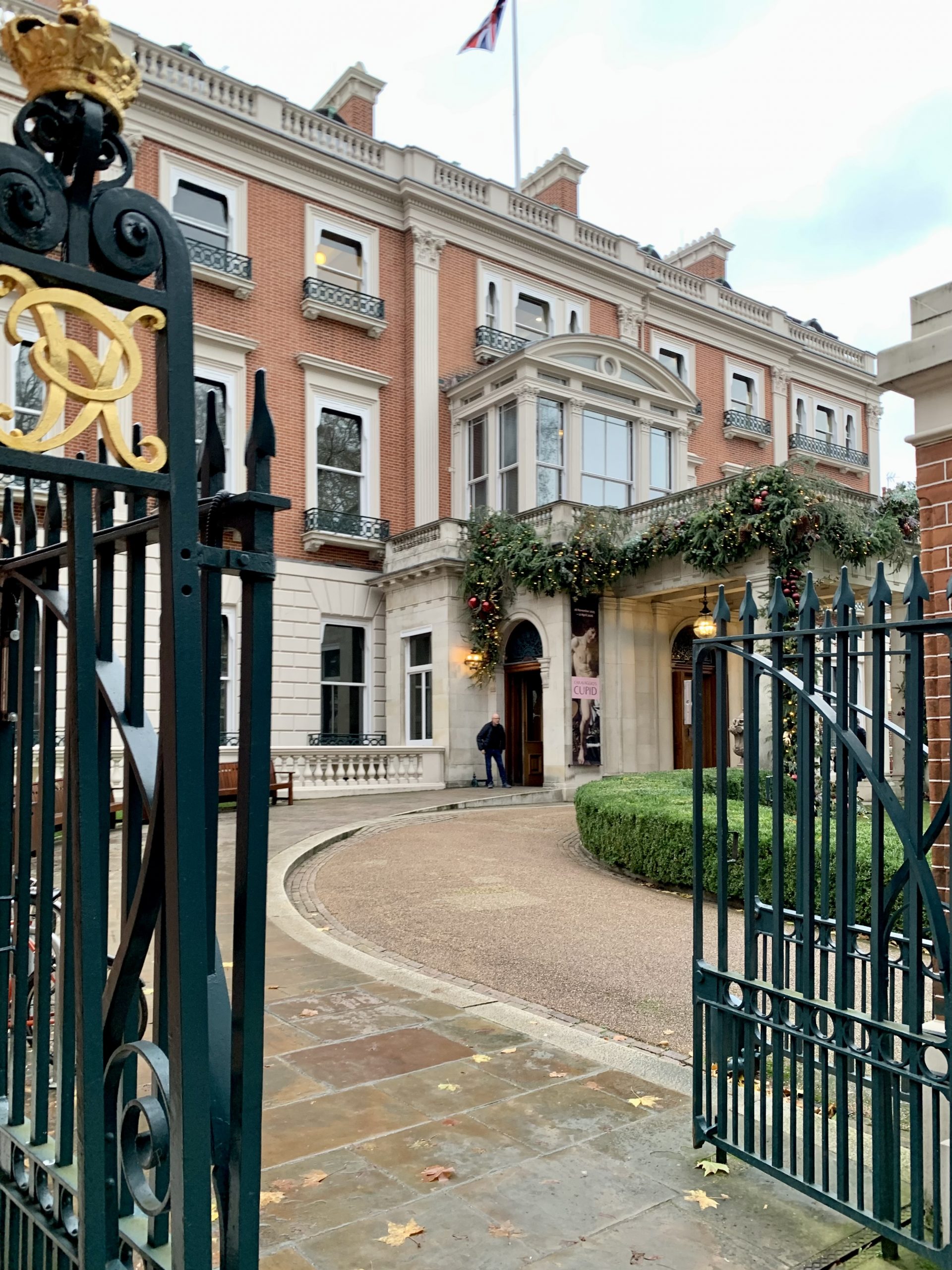
The Wallace Collection, Marylebone, London, England
From Wikipedia:
The Wallace Collection is a museum in London occupying Hertford House in Manchester Square, the former townhouse of the Seymour family, Marquesses of Hertford. It is named after Sir Richard Wallace, who built the extensive collection, along with the Marquesses of Hertford, in the 18th and 19th centuries. The collection features fine and decorative arts from the 15th to the 19th centuries with important holdings of French 18th-century paintings, furniture, arms and armour, porcelain and Old Master paintings arranged into 25 galleries. It is open to the public and entry is free.
It was established in 1897 from the private collection mainly created by Richard Seymour-Conway, 4th Marquess of Hertford (1800–1870), who left both it and the house to his illegitimate son Sir Richard Wallace (1818–1890), whose widow Julie Amelie Charlotte Castelnau bequeathed the entire collection to the nation. The collection opened to permanent public view in 1900 in Hertford House, and remains there to this day. A condition of the bequest was that no object should ever leave the collection, even for loan exhibitions. However in September 2019, the board of trustees announced that they had obtained an order from the Charity Commission for England & Wales which allowed them to enter into temporary loan agreements for the first time.
The United Kingdom is particularly rich in the works of the ancien régime, purchased by wealthy families during the revolutionary sales, held in France after the end of the French Revolution. The Wallace Collection, Waddesdon Manor and the Royal Collection, all three located in the United Kingdom, are some of the largest, most important collections of French 18th-century decorative arts in the world, rivalled only by the Musée du Louvre, Château de Versailles and Mobilier National in France. The Wallace Collection is a non-departmental public body and the current director is Xavier Bray.
The Wallace Collection is a museum which displays works of art collected in the 18th and 19th centuries by five generations of a British aristocratic family – the first four Marquesses of Hertford and Sir Richard Wallace, the illegitimate son of the 4th Marquess. In the 19th century, the Marquesses of Hertford were one of the wealthiest families in Europe. They owned large properties in England, Wales and Ireland, and increased their wealth through successful marriages. Politically of lesser importance, the 3rd and 4th Marquess and Sir Richard Wallace became leading art collectors of their time.
The Wallace Collection, comprising about 5,500 works of art, was bequeathed to the British nation by Lady Wallace in 1897. The state then decided to buy Hertford House to display the collection and it was opened as a museum in 1900. As a museum the Wallace Collection’s main strength is 18th-century French art: paintings, furniture, porcelain, sculpture and gold snuffboxes and 16th- to 19th-century paintings by such as Titian, Van Dyck, Rembrandt, Hals, Velázquez, Gainsborough and Delacroix, a collection of arms and armour and medieval and Renaissance objects including Limoges enamels, maiolica, glass and bronzes. Paintings, furniture and porcelain are displayed together in the manner of private collections of the 19th century.
Hertford House
The present House in Manchester Square was the townhouse of a later junior branch of the family. It was built in 1776 by George Montagu, 4th Duke of Manchester who owned and developed the surrounding estate.[8] It dominates the north side of the Square, where it occupies an island site, and was originally named “Manchester House”. After being used as the Spanish Embassy 1791–1795 (evidenced by “Spanish Place” the street to the east of the building) the lease was acquired in 1797 by Francis Ingram-Seymour-Conway, 2nd Marquess of Hertford (1743–1822), who in 1814 held there the Allied Sovereigns’ Ball after the first defeat of Napoleon in 1814. Francis Seymour-Conway, 3rd Marquess of Hertford (1777–1842), the family’s first great art collector, lived mainly at his other London residences, Dorchester House in Mayfair and St Dunstan’s Villa in Regents Park, now the site of the residence of the US Ambassador. Between 1836-51 Hertford House was let for use as the French Embassy. His son Richard Seymour-Conway, 4th Marquess of Hertford (1800–1870), who expanded his father’s art collection, lived most of his life in Paris, and rarely visited Hertford House, used “largely as a store for his ever-expanding art collection”. He is said never to have visited his principal English country seat of Ragley Hall in Warwickshire. The 4th Marquess died in 1870, aged 70 in Paris, unmarried and without legitimate issue, and his titles and entailed estates, including the lease of Hertford House, passed to his distant cousin Francis Seymour, 5th Marquess of Hertford (1812–1884).
The 4th Marquess’s illegitimate son and heir of his unentailed estate, Sir Richard Wallace, 1st Baronet (1818–1890), inherited his art collection, French and Irish estates, and re-purchased Sudbourne Hall in Suffolk and, in 1871, the lease of Hertford House from the 5th Marquess, and returned from Paris with much of the art collection to take up residence in England, following the unstable political climate in France following the Prussian Siege of Paris (1870–1871). Wallace in turn expanded the art collection, adding medieval and Renaissance objects and European arms and armour.
Between 1872–1882 the house was much altered by Sir Richard Wallace, who added a rear extension to house his art collection with a smoking room lined with Minton tiles in Turkish style. Under the architect Thomas Ambler a new front portico was added in the form of a porte-cochère, with large Doric pilasters, storeys were added to both wings and the stables and coach house were converted to galleries by the addition of top-lit roofs. The whole building was given a red brick facade and the windows were altered. Wallace bequeathed all his assets to his wife, who in turn, and most probably according to his wishes, bequeathed the main part of her husband’s art collection to the nation, thus forming the “Wallace Collection”, the rest, including the French properties and Hertford House, going to the couple’s secretary Sir John Murray Scott, 1st Baronet. Scott sold the lease of Hertford House to the UK Government, as a suitable home for the Wallace Collection, after which he was rewarded with a baronetcy, and the Government acquired the freehold from the Portman Estate. Hertford House first opened as a museum on 22 June 1900.
In 2000, the inner courtyard was given a glass roof and a restaurant was opened named “Cafe Bagatelle” after the Château de Bagatelle in Paris purchased in 1835 by Francis Seymour-Conway, 3rd Marquess of Hertford, later part of Scott’s inheritance. The museum display does not aim to reconstruct the state of the house when Sir Richard and Lady Wallace lived here.
Image details
Date: 8 December 2025
Camera body: iPhone Xs
Lens: Wide Camera 26mm ƒ/1.8
Focal Length: 26mm
Aperture: ƒ/1.8
Shutter Speed: 1/78s
ISO: 100
Licence: Creative Commons Attribution-NonCommercial-NoDerivatives 4.0 International