
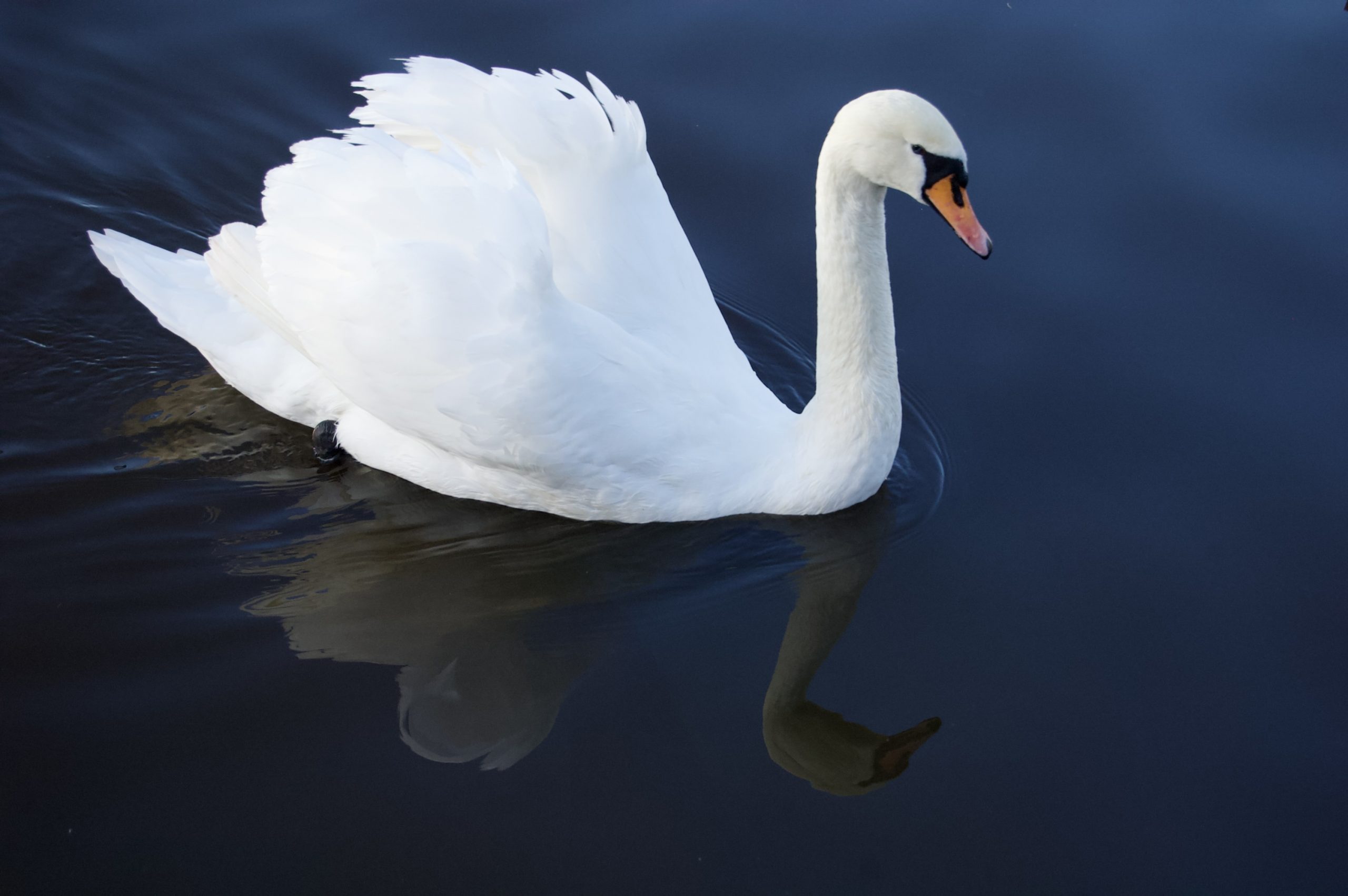
Mute swan on the Leeds & Liverpool Canal, Skipton, North Yorkshire, England
From Wikipedia
The Leeds and Liverpool Canal is a canal in Northern England, linking the cities of Leeds and Liverpool.
Over a distance of 127 miles (204 km), crossing the Pennines, and including 91 locks on the main line. The Leeds and Liverpool Canal has several small branches, and in the early 21st century a new link was constructed into the Liverpool docks system.
In the mid-18th century the growing towns of Yorkshire, including Leeds, Wakefield and Bradford, were trading increasingly. While the Aire and Calder Navigation improved links to the east for Leeds, links to the west were limited. Bradford merchants wanted to increase the supply of limestone to make lime for mortar and agriculture using coal from Bradford’s collieries and to transport textiles to the Port of Liverpool. On the west coast, traders in the busy port of Liverpool wanted a cheap supply of coal for their shipping and manufacturing businesses and to tap the output from the industrial regions of Lancashire. Inspired by the effectiveness of the wholly artificial navigation, the Bridgewater Canal opened in 1759–60. A canal across the Pennines linking Liverpool and Hull (by means of the Aire and Calder Navigation) would have obvious trade benefits.
A public meeting took place at the Sun Inn in Bradford on 2 July 1766 to promote the building of such a canal. John Longbotham was engaged to survey a route. Two groups were set up to promote the scheme, one in Liverpool and one in Bradford. The Liverpool committee was unhappy with the route originally proposed, following the Ribble valley through Preston, considering that it ran too far to the north, missing key towns and the Wigan coalfield. A counter-proposal was produced by John Eyes and Richard Melling, improved by P.P. Burdett, which was rejected by the Bradford committee as too expensive, mainly because of the valley crossing at Burnley. James Brindley was called in to arbitrate, and ruled in favour of Longbotham’s more northerly route, though with a branch towards Wigan, a decision which caused some of the Lancashire backers to withdraw their support, and which was subsequently amended over the course of development. In 1768 Brindley gave a detailed estimate of a distance just less than 109 miles (175 km) built at a cost of £259,777 (equivalent to about £32.67 million as of 2014).
From Wikipedia
The mute swan (Cygnus olor) is a species of swan and a member of the waterfowl family Anatidae. It is native to much of Eurasia and (as a rare winter visitor) the far north of Africa. It is an introduced species in North America, home to the largest populations outside of its native range, with additional smaller introductions in Australasia and Southern Africa. The name “mute” derives from it being less vocal than other swan species. Measuring 125 to 160 cm (49 to 63 in) in length, this large swan is wholly white in plumage, with an orange beak bordered with black. It is recognisable by its pronounced knob atop the beak, which is larger in males.
Image details
Date: 24 December 2022
Camera body: Nikon D50
Lens: Nikkor AF-S DX 18-55mm ƒ3.5-5.6G ED
Focal Length: 52mm
Aperture: ƒ/5.6
Shutter Speed: 1/500s
ISO: 800
Licence: Creative Commons Attribution-NonCommercial-NoDerivatives 4.0 International