
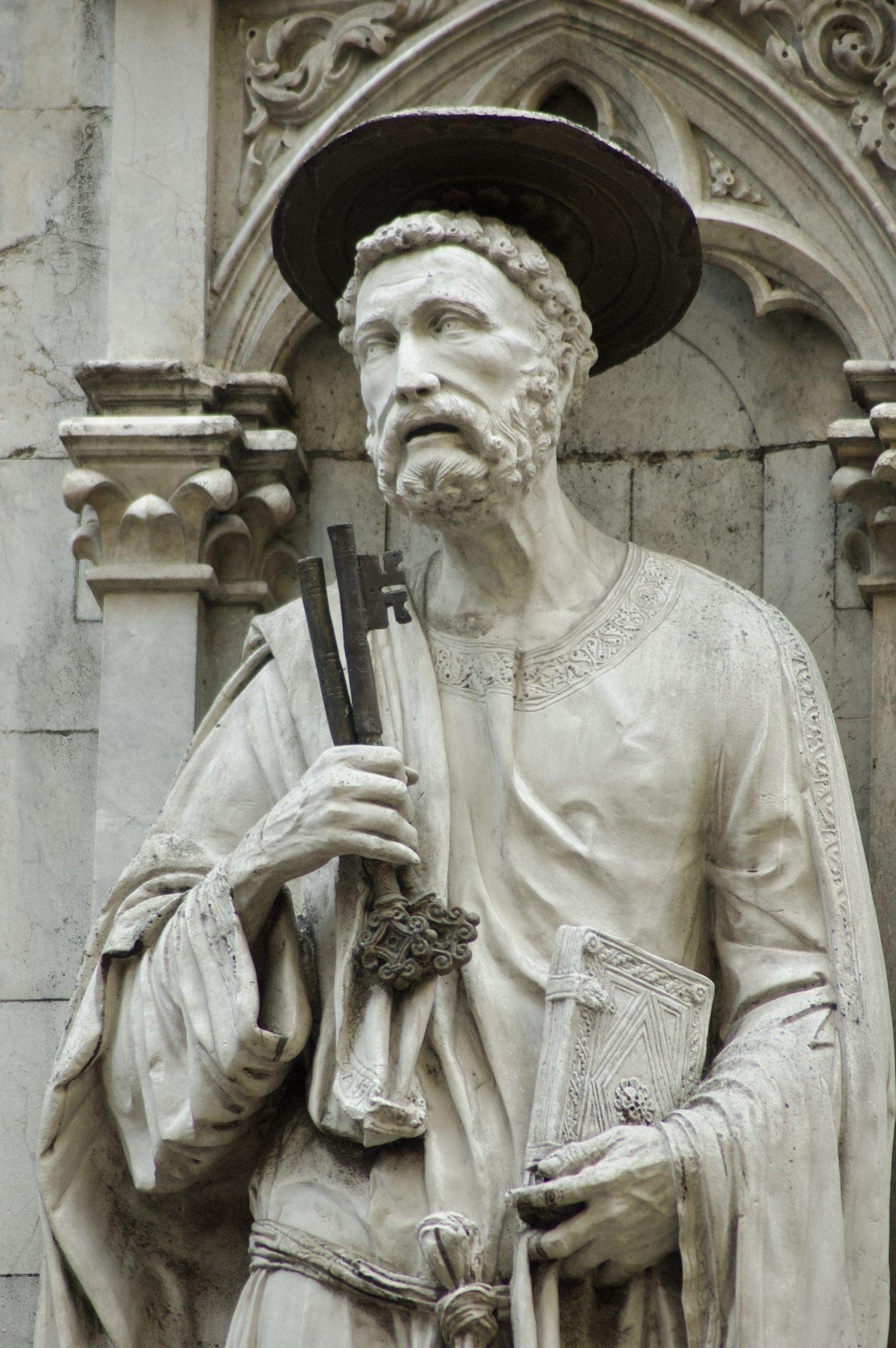
Statue of St Peter on the Loggia della Mercanzia, Siena, Italy
From Wikipedia
The Loggia della Mercanzia (also known as the Loggia dei Mercanti or Loggia di San Paolo) is located in Siena, behind Piazza del Campo, in the so-called Croce del Travaglio (Cross of Travail) between Via Banchi di Sopra and Via Banchi di Sotto (through which the Via Francigena passed), and Via di Città.
The Loggia was built as an expansion and embellishment and is the seat of the Arte della Mercanzia (Art of Merchandise) of the Republic of Siena. Designed by Sano di Matteo, it was constructed between 1417 and 1428 under his direction, and then from 1428 to 1444 under Pietro del Minella, in a transitional style between Gothic and Renaissance. The five statues date back to the second half of the same century. The cross vaults were built and decorated in the 16th century, while the upper floor on the Croce del Travaglio (Cross of Travail) was added in the 17th century.
In 1764, the building became the property of the Signori Uniti del Casino, who made it the headquarters of the Circolo degli Uniti, which had existed since 1657 and is still active there. During that period, the loggia underwent substantial modifications, primarily to the rear section, overlooking Piazza del Campo, which was given a new façade designed by Ferdinando Fuga, on the site of the destroyed church of Saints Peter and Paul.
In the 19th century, the loggia underwent renovations, particularly to the decorations and frescoes of the vaults.
The loggia is composed of three arches supported by richly decorated pillars, with their sides bearing tabernacles with statues. The two statues on the outer pillars of the loggia depict Saints Peter and Paul and are by Vecchietta (1458-1462); the other three statues depict three of the four ancient patron saints of the city, Saint Savino, Saint Ansanus, and Saint Victor, and are by Antonio Federighi (1458-1459).
The short sides are closed by two marble benches, of particular interest among which is the one on the right, by Federighi, with figures from Roman history (1459-1464), while the one on the left is by Urbano da Cortona (circa 1462).
The vaults feature stuccoes and decorative frescoes, restored and remodeled in the 19th century. The first on the left is the work of Pastorino dei Pastorini (1549-1552), the second and third by Lorenzo Rustici (1553-1563).
The hall on the upper floor features a monochrome by Luigi Ademollo, dated 1793-1794.
Image Details
Date: 14 September 2022
Camera body: Nikon D50
Lens: Tamron 70.0-300.0 mm f/4.0-5.6
Focal Length: 220mm
Aperture: ƒ/5
Shutter Speed: 1/500s
ISO: 450
Licence: Creative Commons Attribution-NonCommercial-NoDerivatives 4.0 International