
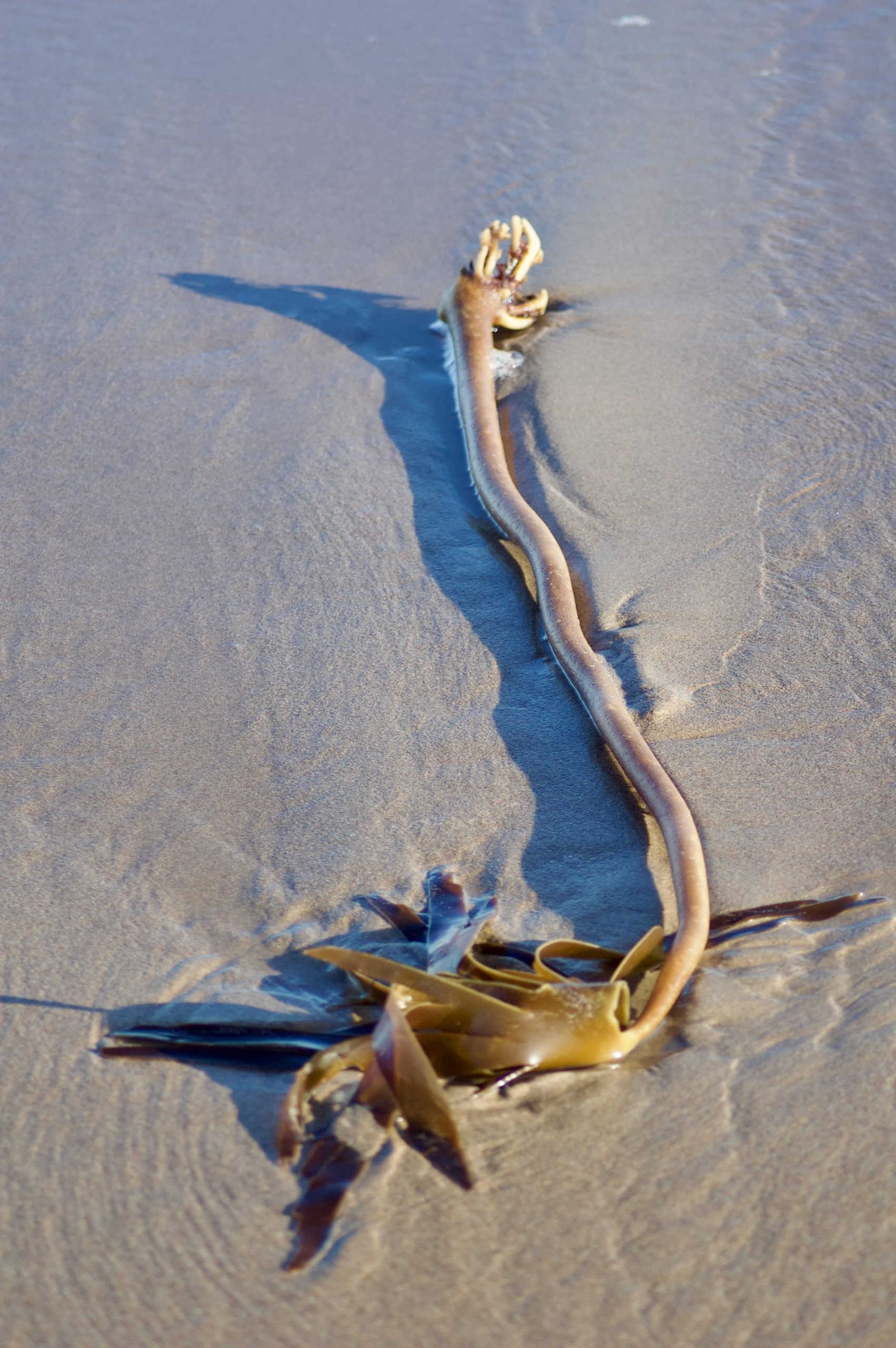
Kelp on the beach at Druridge Bay, Northumberland, England
From Wikipedia
Kelps are large brown algae or seaweeds that make up the order Laminariales. There are about 30 genera. Despite its appearance and use of photosynthesis in chloroplasts, kelp is not a plant but a stramenopile (a group containing many protists).
Kelp grows from stalks close together in very dense areas like forests under shallow temperate and Arctic oceans. They were previously thought to have appeared in the Miocene, 5 to 23 million years ago based on fossils from California. Kelps were present in the northeastern Pacific Ocean by at least 32 million years ago. These organisms require nutrient-rich water with temperatures between 6 and 14 °C (43 and 57 °F). They are known for their fast growth —the genera Macrocystis and Nereocystis can grow as fast as half a metre a day (that is, about 20 inches a day), ultimately reaching 30 to 80 metres (100 to 260 ft).
Through the 19th century, the word “kelp” was closely associated with seaweeds that could be burned to obtain soda ash (primarily sodium carbonate). The seaweeds used included species from both the orders Laminariales and Fucales. The word “kelp” was also used directly to refer to these processed ashes.
From Wikipedia
Druridge Bay is a 7-mile (11 km) long bay on the North Sea in Northumberland, England, stretching from Amble in the north to Cresswell in the south.
Druridge Bay Country Park is situated on the bay, and part of the bay (the section near the farmstead of Druridge, in the centre of the bay) is owned by the National Trust. Coastal areas on the bay are set aside as nature reserves.
Image Details
Date: 22 January 2022
Camera body: Nikon D50
Lens: Tamron 70.0-300.0 mm f/4.0-5.6
Focal Length: 100mm
Aperture: ƒ/4.2
Shutter Speed: 1/800s
ISO: 400
Licensing: Image of a copyrighted work. This image cannot be licensed.