
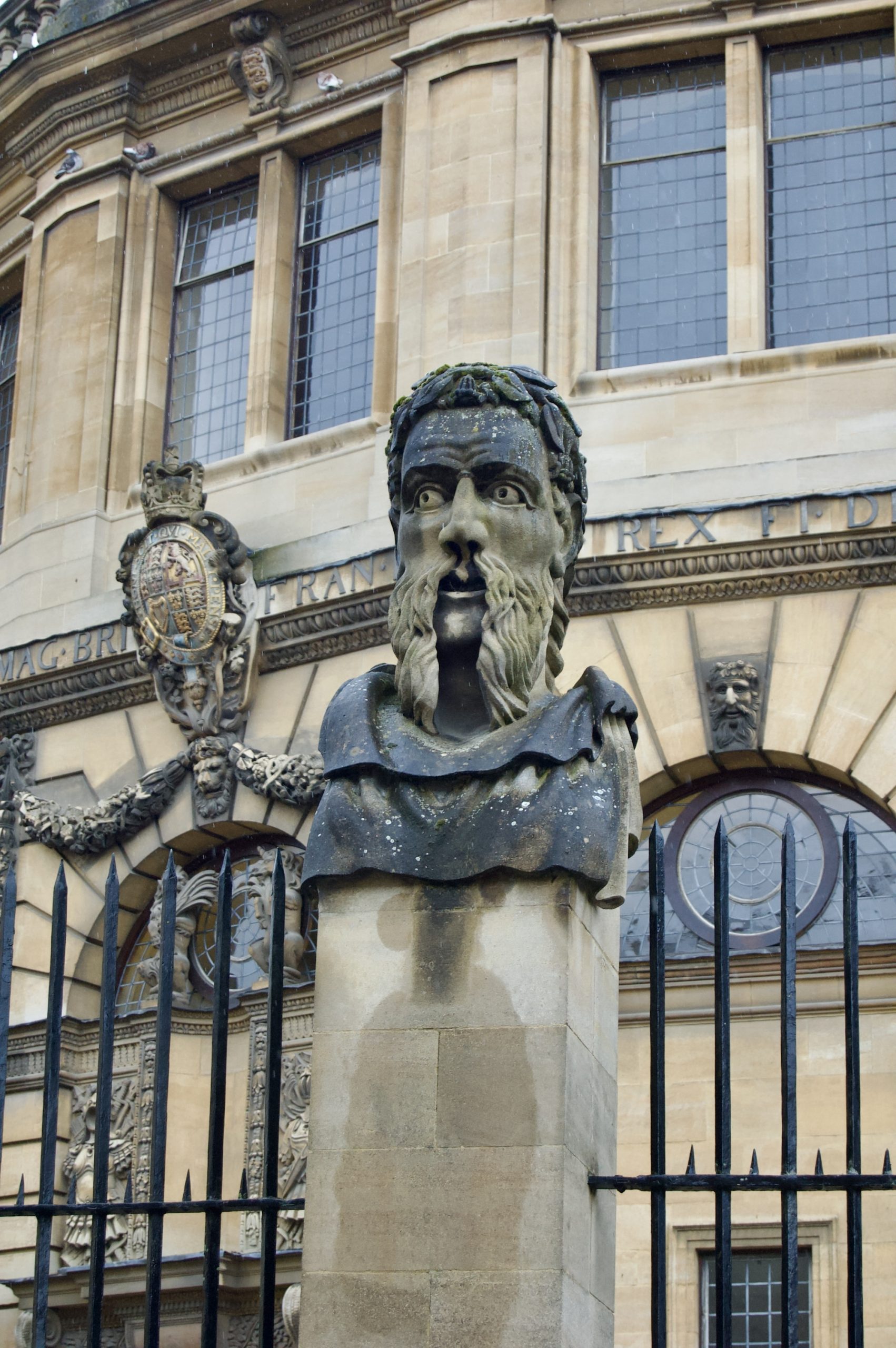
A bust of a Roman emperor on the screen of the History of Science Museum in Oxford, England
From Wikipedia
The History of Science Museum in Broad Street, Oxford, England, holds a leading collection of scientific instruments from Middle Ages to the 19th century. The museum building is also known as the Old Ashmolean Building to distinguish it from the newer Ashmolean Museum building completed in 1894. The museum was built in 1683, and it is the world’s oldest surviving purpose-built museum.
Built in 1683 to house Elias Ashmole’s collection, the building was the world’s first purpose-built museum building and was also open to the public. The original concept of the museum was to institutionalize the new learning about nature that appeared in the 17th century and experiments concerning natural philosophy were undertaken in a chemical laboratory in the basement, while lectures and demonstration took place in the School of Natural History, on the middle floor. Ashmole’s collection was expanded to include a broad range of activities associated with the history of natural knowledge.[citation needed] In 1924, Lewis Evans donated his collection of historic scientific instruments, creating the Lewis Evans Collection. In 1935, with more donations, the museum’s name was changed to the Museum of the History of Science. In 2018, the museum was renamed the History of Science Museum.
The History of Science Museum is a Grade I listed building, the highest grade reserved for “buildings of exceptional interest”. The screen fronting the building, with busts of Roman Emperors in a continuance of the north screen of the Sheldonian Theatre, has a separate Grade I listing.
Image Details
Date: 28 March 2024
Camera body: Nikon D50
Lens: Nikkor AF-S DX 18-55mm ƒ3.5-5.6G ED
Focal Length: 55mm
Aperture: ƒ/5.6
Shutter Speed: 1/500s
ISO: 720
Licensing: Image of a copyrighted work. This image cannot be licensed.