
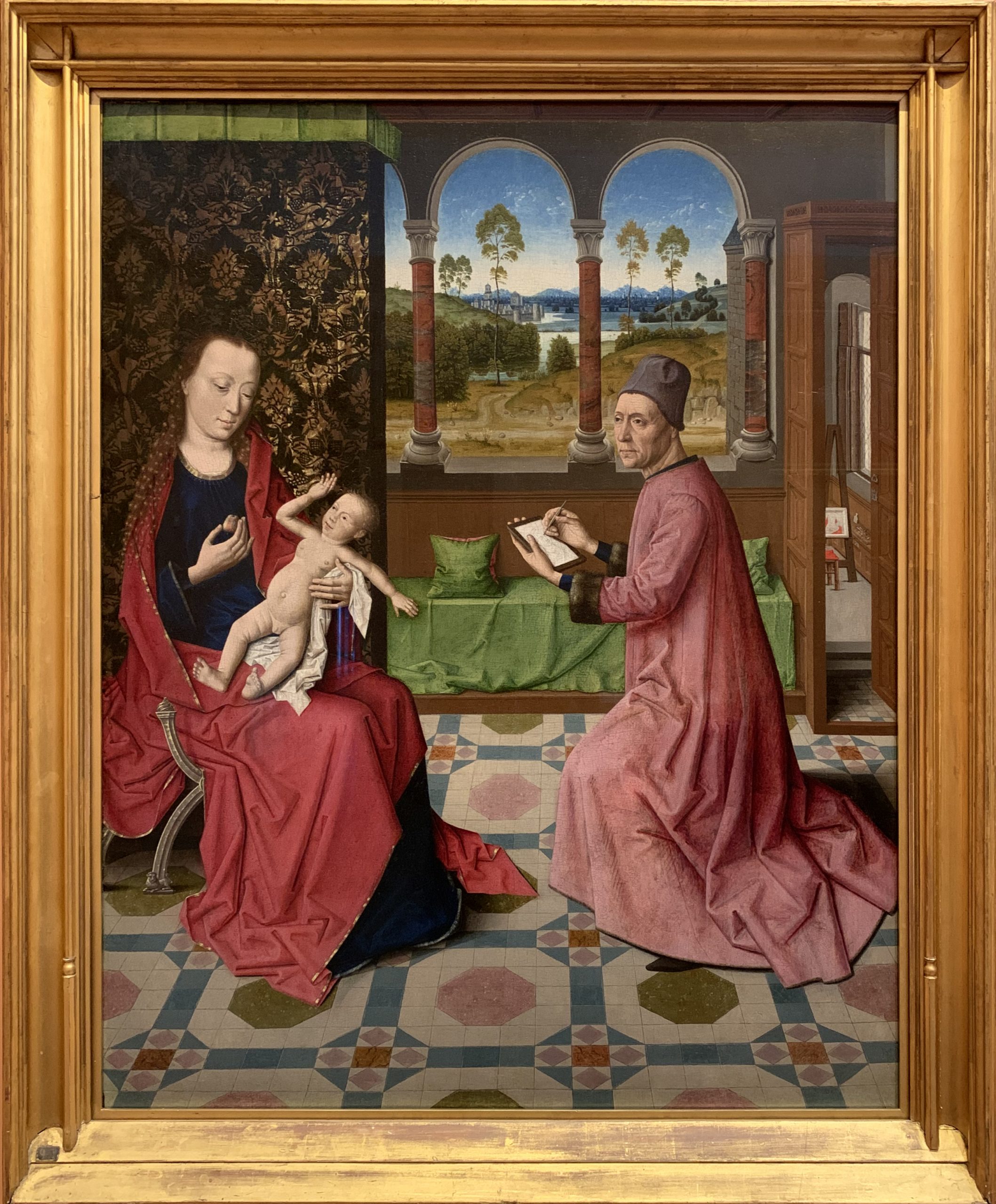
Dieric Bouts is regarded as one of the leading 15th century Netherlandish painters. In the Northern European Renaissance, he was a pioneer in the technique of oil painting and renowned for his rendering of landscape. He was also the first of his contemporaries to use single-point perspective; a drawing method that shows how things appear to get smaller as they get further away, converging towards a single ‘vanishing point’ on the horizon line. Examples of his work are extremely rare in British collections.
The painting offers a glimpse of the artist’s studio, seen through a doorway on the extreme right. It provides valuable evidence of artists’ methods and materials during this period, and proclaims a confidence in their social status. This is further confirmed by the placing of the artist himself (as St Luke) at centre stage in the composition.
The view of the studio shows an easel, placed by a large window to take advantage of the natural light and, in some detail, the materials used for preparing the paint. This was a laborious and time-consuming process, usually carried out by an assistant. It involved grinding up the pigments, mixing them with oil, and then transferring the resulting colours to separate receptacles – in this case, shells. It was only by examining these under the microscope that the conservators were able to identify them definitely as mussel shells. There is also a palette for trying out the paints before application.
Provenance: bequeathed by the Founders, 1885
Object description
Type: Easel painting
Location: Bowes Museum, Barnard Castle, County Durham
Material: Oil on canvas
Artist: Attributed to the workshop of Dieric Bouts the Elder (c.1415-75)
Date: c. 1470-80
Image Details
Date: 7 Feb 2025
Camera body: iPhone Xs
Lens: Wide Camera 26mm ƒ/1.8
Focal Length: 26mm
Aperture: ƒ/1.8
Shutter Speed: 1/25s
ISO: 400
Licensing: Image of a Bowes Museum asset. This image cannot be licensed.