
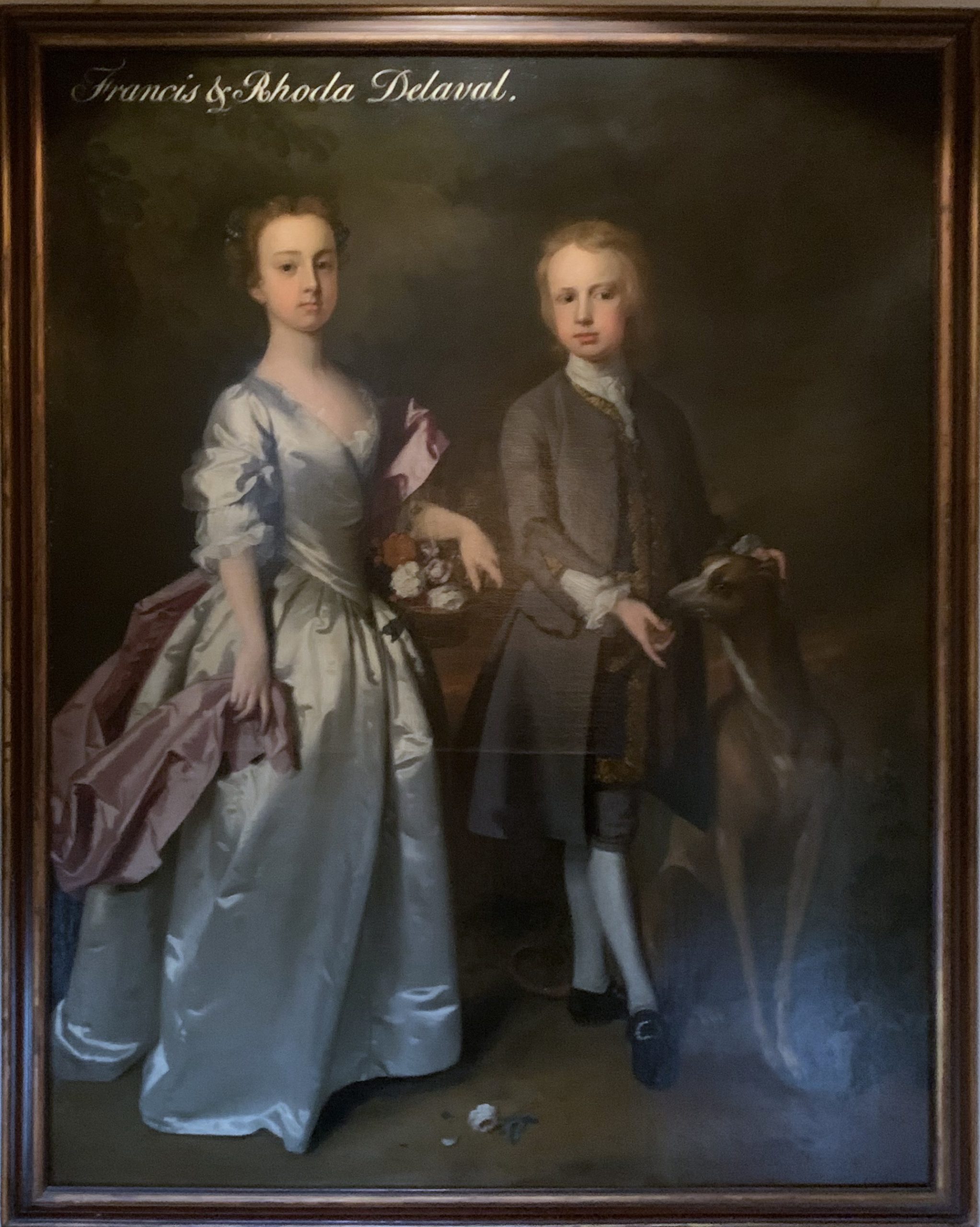
The two eldest children of Captain Francis Blake Delaval (1692 – 1752) and Rhoda Apreece (d.1759), daughter of Robert Apreece and Sarah Hussey. Rhoda’s marriage in 1751 to Edward Astley, later 4th Bt. (1729 – 1802) of Melton Constable, ultimately brought Seaton Delaval into the Astley family. She was a talented artist, taught by Pond, who had been brought to Seaton Delaval by her father. Rhoda died in childbirth, having borne him three sons and a daughter. On her death, her husband went to live with his children at Melton Constable. Their son, Jacob (1756 – 1817) inherited the Delaval estates in 1814. Rhoda left various letters dating to the years after her marriage, which provide insight into C18th society life in Northumberland. Her brother Francis was the character behind many of the practical jokes, for which the ‘Gay Delavals’ were famous. Early on he was lured by London and, according to Walpole, an Italian lady called the ‘Tedeschi’ (probably the Venetian opera singer, Caterina Tedeschi), although, having found her ‘in flagrante’, he was driven to horsewhipping her lover. He kept an illegitimate cousin, Betty Roach, as his long-term mistress in London, and she bore him two children, Francis and Frances [!]. She had been sent to Seaton Delaval on the death of her guardians in the hope of a sheltered upbringing. She later married an Irish Baronet, Sir Henry Echlin, but still smitten with Francis, left him, only to spend her later years alone. Francis led an idle life, centred around the theatre and theatrical circles, accumulating vast debts in the process. In order to settle his debts, he married, on 10 March 1750, Isabella, the widowed daughter of 6th Earl of Thanet. Some sixty years of age and going senile, and – more importantly – with a reputed fortune, she was seemingly well-placed to solve his financial problems. Her fortune was not, however, as handsome as he had hoped. Nevertheless, in ‘celebration’ of the marriage, in 1752 Francis spent £1500 to hire the Drury Lane Theatre, where the Delavals staged a production of Othello, Sir Francis playing the eponymous hero. Isabella later sued Francis for committing adultery with Betty Roach, but lost the case, eventually dying in obscurity. By October 1766 Francis had had his own private theatre in St. James’s Street fitted out by Richard Edgeworth. The family staged The Fair Penitent, with the family taking part, as well the Duke of York, who played the seducer, Lothario. He managed to be elected as an MP for various different seats, but did little work. However, in 1758, he enlisted in the army, finding himself part of an expeditionary force ordered to attack the Brittany coast at St Malo. He was the first to storm the beach, but his bravery was not entirely merited – there was no opposition to greet him! For being the first Grenadier to storm the beach he was awarded a knighthood. Having left the army soon after, the story, did however, provide him with a tale to dine out on. He succeeded his father in 1752, at which point he invited some four thousand people to watch fire eaters, rope walkers and conjurers performing at Seaton Delaval. Although he lived in London, he spent considerable time there, especially in 1765 when he rebuilt the stable block, which he had likened to Lord Hoptoun’s, with stone divisions of the stalls. Debts continued to amount, such that Francis gave up most of his inheritance in return for an annual allowance, and his brother John was left in control of some of the estates, of which he had entire control by 1770. On 7th August 1771, after a huge meal, he collapsed and died at the age of 44. within hours, creditors were besieging the house. His funeral, at Seaton Delaval, fittingly, became a public spectacle. (for full biographies see M. Green, The Delavals. A Family History, Newcastle, pp.44 ff. & 49 ff.)
Provenance: accepted in lieu of tax by H.M.Treasury and transferred to the National Trust in 2009
Marks & Inscriptions: Top left, in flowing white script: Francis & Rhoda Delaval
Text from National Trust website
Object description
Type: Easel painting
Location: Seaton Delaval Hall, Northumberland
Material: Oil on canvas
Artist: attributed to Jeremiah Davison (c.1695 – after 1750) and Joseph van Aken (c. 1699 – 1749), Joseph Highmore (1692 – 1780)
Date: circa 1735
Image Details
Date: 21 May 2023
Camera body: iPhone Xs
Lens: Wide Camera 26mm ƒ/1.8
Focal Length: 26mm
Aperture: ƒ/1.8
Shutter Speed: 1/20s
ISO: 640
Licensing: Image of a National Trust asset. This image cannot be licensed.