
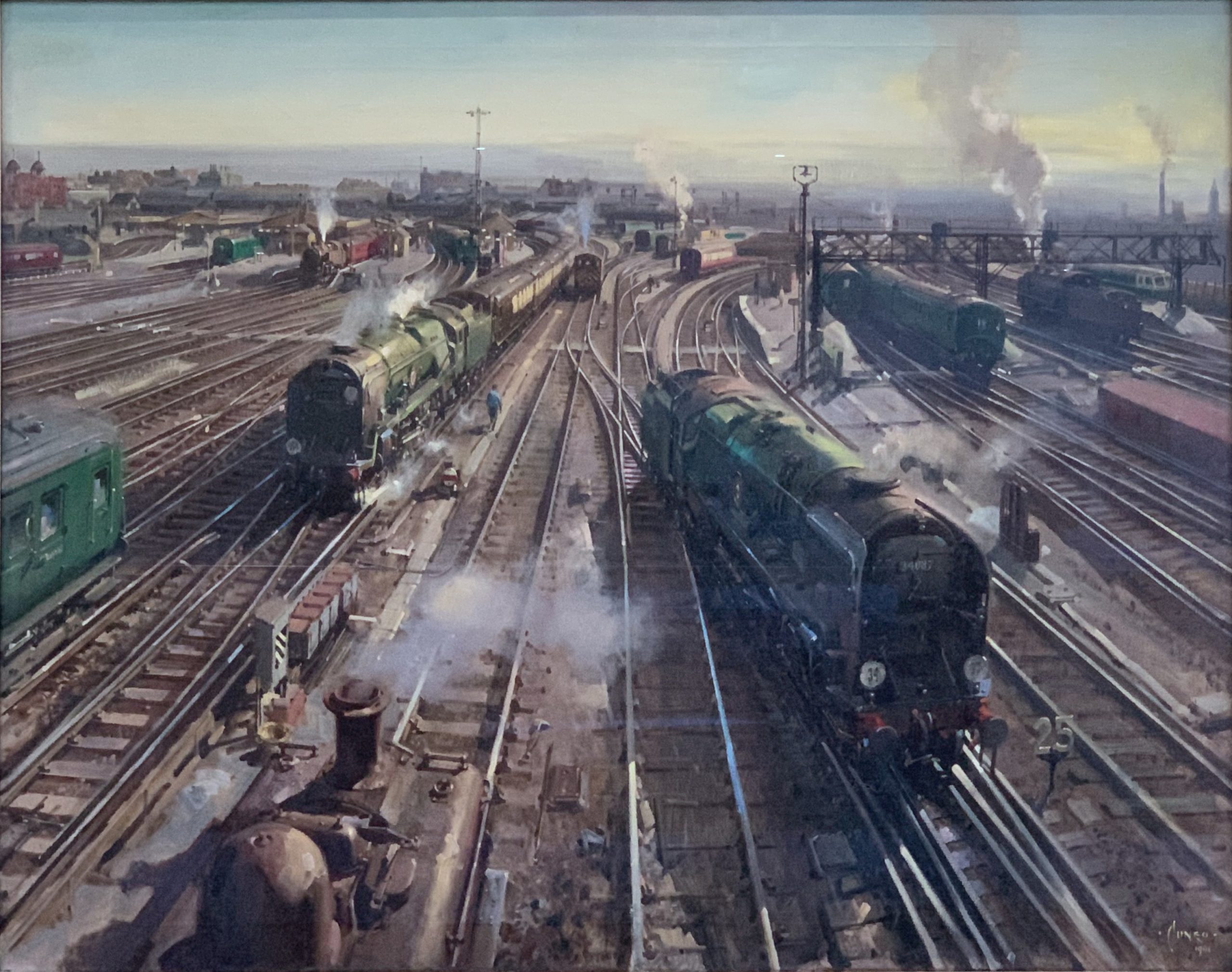
Most of this canvas was painted in the open, high above the junction.
Tit] was all but torn from the easel by wind and when an engine passed beneath, cinders would stick to the wet paint.
Cuneo always strived for accuracy. He repainted all but two of the trains after errors were pointed out by local signallers.
At the time steam engines were being phased out. He subtitled this piece “Twilight of steam and the world’s busiest railway junction’.
Terence Cuneo (1907-96) was an artist of exceptional skill, range and popularity.
He depicted military history, state and public occasions, industry and technology, wildlife, and even portraiture. Today he is best known for his railway paintings.
As a child he sketched steam locomotives, before becoming an illustrator of boys’ books and magazines.
His big break came with commissions to create posters for the London, Midland & Scottish Railway, London & North Eastern Railway and British Railways.
Cuneo received many commissions in the final days of his beloved steam. Steam services were retired from the national passenger network by 1968.
Object description
Type: Easel painting
Location: National Railway Museum, York
Material: Oil on canvas
Artist: Terence Cuneo (1907-96)
Date: 1961
Image Details
Date: 17 September 2026
Camera body: iPhone Xs
Lens: Telephoto Camera 52mm ƒ/2.4
Focal Length: 52mm
Aperture: ƒ/2.4
Shutter Speed: 1/60s
ISO: 200
Licensing: Image of a Science Museum Group Collection asset. This image cannot be licensed.