
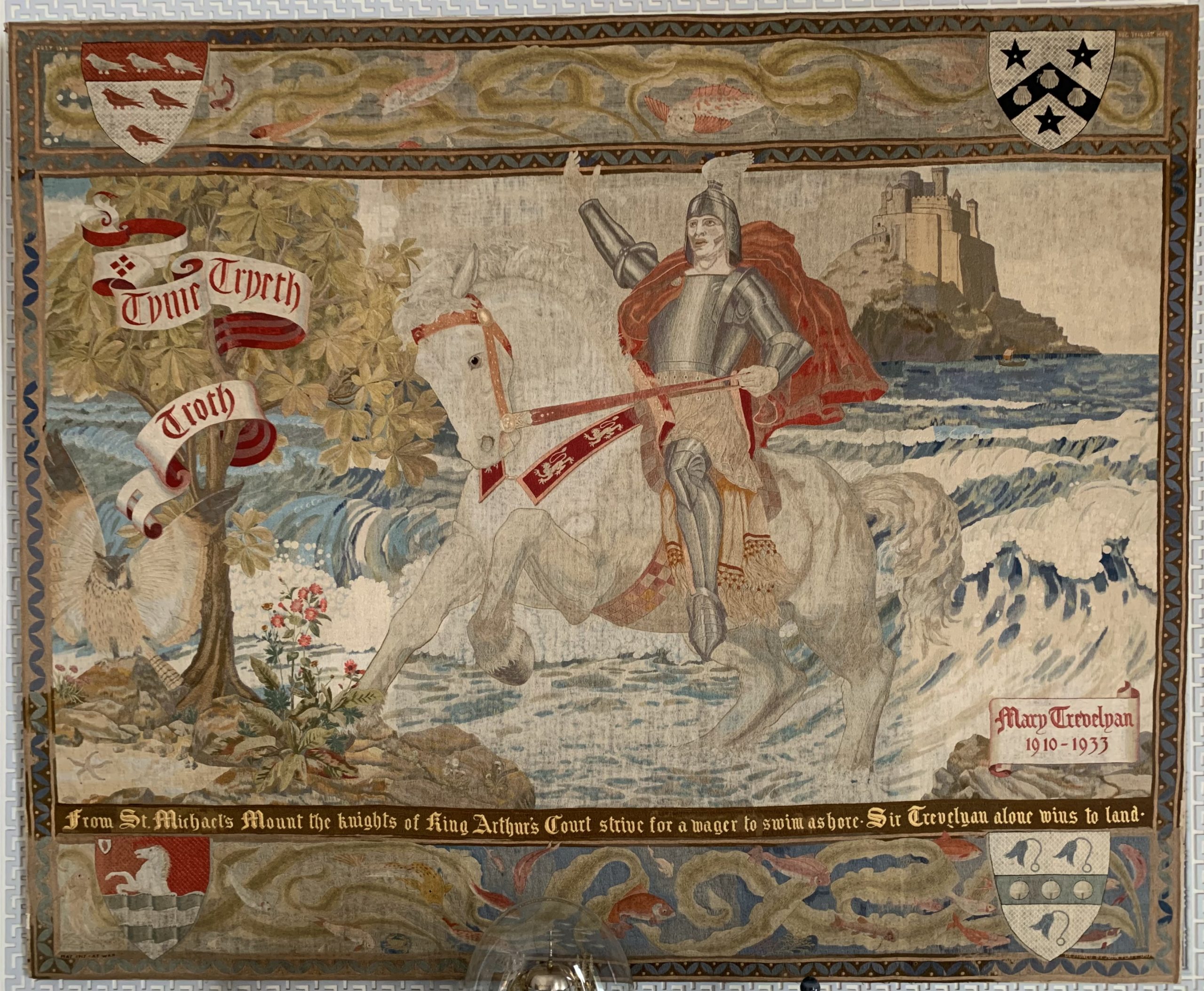
Lady Mary (Molly) started work on this panel on 6th July 1910, beginning at the top left corner. This border and the bottom border were worked on a little frame held on her knee.
In the first week of the first Labour Government, Sir Charles became president of the Board of Education and joined Ramsay MacDonald’s cabinet.
Mary added the initials JRM and the date 1924 on the top of the red scroll around the tree. When Sir Charles resigned in 1931, a band of his green and white election colours was worked on the tip of the scroll bearing Lady Trevelyan’s name.
Other family events are recorded; the birth of Lady Mary’s fourth child Marjorie in 1913 is shown by her initials within the knight’s helmet.
The birth of her youngest child, Geoffrey, in 1920 is shown by the initials GWT on the front fold of the saddle-cloth.
Lady Trevelyan was not satisfied with her work on the knight’s face; the model was Sir Charles Trevelyan, her husband. So she asked her father’s sister, Florence Johnson, a skilled embroiderer, to work the face for her. This was done on a separate frame then sewn down on the top of the first face; the rim of the helmet forms the joint between the two pieces.
The lower border was begun during the war, the date being marked in black on the edge of the border, “May 1917 at War”.
The main body of the work was done on a large standing frame in three separate sections, the centre (the horseman and the horse) first, the chestnut tree and the castle.
The top border was completed during the first week of the World War One in 1914, while the armistice of 1918 is recorded in the Trevelyan shield, with a line of gold on one of the waves from which the horse is rising.
The Peace Treaty in 1919 is shown by a white mark on the horse’s red collar. It would have been gold if the Treaty had been more to the Trevelyan’s satisfaction.
The red flag on the little boat records the 1931 election when Sir Charles lost his seat and retired from Parliament.
The knight’s plume is modelled on a seagull’s wing and the cloud behind his head inspired by a Titian painting in the National Gallery.
Before being set up at Wallington the embroidery was exhibited at many Women’s Institutes and exhibitions throughout the country, including London.
The design was by John Edgar Platt, later Principal of the Edinburgh School of Art. Mr Platt was only 19 when he designed this work.
If you’re interested in embroidery you may have noticed the change in shade of the yarns. The left part of the lower border, which was worked during the First World War, is in English wools which have faded, the dye wasn’t as good as the French wools used for the greater part of the work.
Object description
Type: Embroidery
Location: Wallington Hall, Northumberland
Material: Wool
Artist: Lady Mary (Molly) Trevelyan
Date: 1910
Image Details
Date: 11 September 2026
Camera body: iPhone Xs
Lens: Wide Camera 26mm ƒ/1.8
Focal Length: 26mm
Aperture: ƒ/1.8
Shutter Speed: 1/60s
ISO: 250
Licensing: Image of a National Trust asset. This image cannot be licensed.