
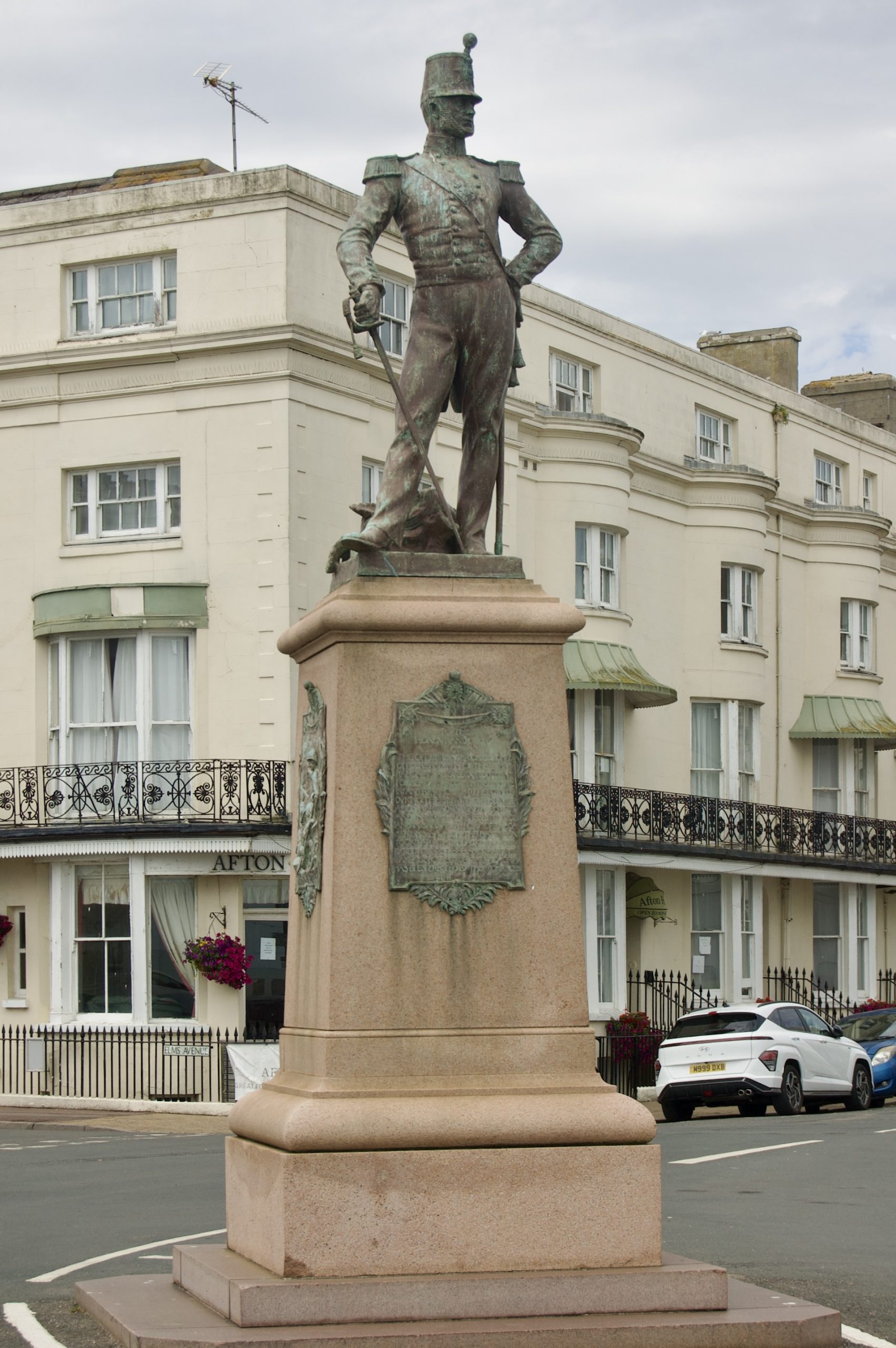
Royal Sussex Memorial in Cavendish Place, Eastbourne.
A pink granite obelisk in two sections with bronze plaques on all sides on a two-stepped granite octagonal base, set in the junction of the road. The south-west and north-east sides have pictorial reliefs of soldiers in action. The south-east and north-west faces have inscribed plaques. It is surmounted by a statue which represents a young officer of the 2nd Battalion of the Royal Sussex Regiment, clad in the uniform worn prior to the Indian Mutiny; he has a drawn sword downward-facing in his right hand, his left hand is resting on his hip. The uniform is of the Bengal Regiment, one of the old regiments of the East India Company.
From Wikipedia:
The Royal Sussex Memorial is a war memorial in Eastbourne, East Sussex, on the English south coast. It commemorates the Royal Sussex Regiment’s casualties from various campaigns around the turn of the 20th century. Sculpted by William Goscombe John, it was unveiled in 1906 and is now a Grade II* listed building.
The monument stands on the seafront, at the junction of Cavendish Place and Elms Avenue, opposite the entrance to Eastbourne Pier. It consists of a sculpture of a soldier on a stone pedestal. The soldier is a young officer in the uniform the 107th (Bengal Infantry) Regiment of Foot, which became the 2nd Battalion, Royal Sussex Regiment in 1881. The officer’s sword is drawn and held in his right hand at waist height pointing to his feet; his left hand rests on his hip. His uniform is that worn by the regiment prior to reforms which stemmed from the 1857 Indian Mutiny. The statue is 1.9 metres (6 feet 3 inches) tall and stands on a pedestal 3 metres (9.8 feet) high. The pedestal has bronze plaques on all four sides. The two on the sides contain reliefs of the regiment in action and two and those on the front and rear bear dedicatory inscriptions.
The dedication on the front reads “Royal Sussex Regiment: To the honour and glory of the officers, non-commissioned officers, and men of the 2nd Battalion, Royal Sussex Regiment, formerly 107 Regiment Bengal Infantry, who lost their lives during the service of the battalion abroad in Malta, Egypt, and India from 1882 to 1902, and in special memory of the campaigns in which the battalion took part: The Black Mountain Expedition of 1888 and the Tirah Campaign of 1897–98, this memorial has been erected by their comrades”.[1] The rear plaque contains the dedication “2nd Royal Sussex Regiment: Roll of officers, non-commissioned officers, and men who died while the battalion was on foreign tour of service from 21 July to 11 Dec. 1902”, followed by a list of names. The pedestal is pink granite in two parts—a base and an obelisk.
The memorial was sculpted by William Goscombe John and the metalwork cast by A. B. Burton. It was unveiled on 7 February 1906 by Henry Fitzalan-Howard, 15th Duke of Norfolk, who was an officer in the regiment and the Lord Lieutenant of Sussex. He was accompanied by a major from the regiment, which also provided a guard of honour. The soldiers were from the regiment’s headquarters at Roussillon Barracks in Chichester, and arrived in Eastbourne on a special train
The statue is a Grade II* listed building, first listed in 1971. Listed building status provides legal protection from unauthorised demolition or modification and is applied to structures of historical and architectural importance.
Object description
Type: Statue
Location: Cavendish Place, Eastbourne
Material: Bronze & granite
Artist: A. B. Burton (active 1874–1939) and William Goscombe John (1860–1952)
Date: 1906
Image Details
Date: 30 June 2026
Camera body: Nikon D50
Lens: Nikkor AF-S DX 18-55mm ƒ3.5-5.6G ED
Focal Length: 55mm
Aperture: ƒ/8
Shutter Speed: 1/500s
ISO: 200
Licence: Creative Commons Attribution-NonCommercial-NoDerivatives 4.0 International