
From Wikipedia
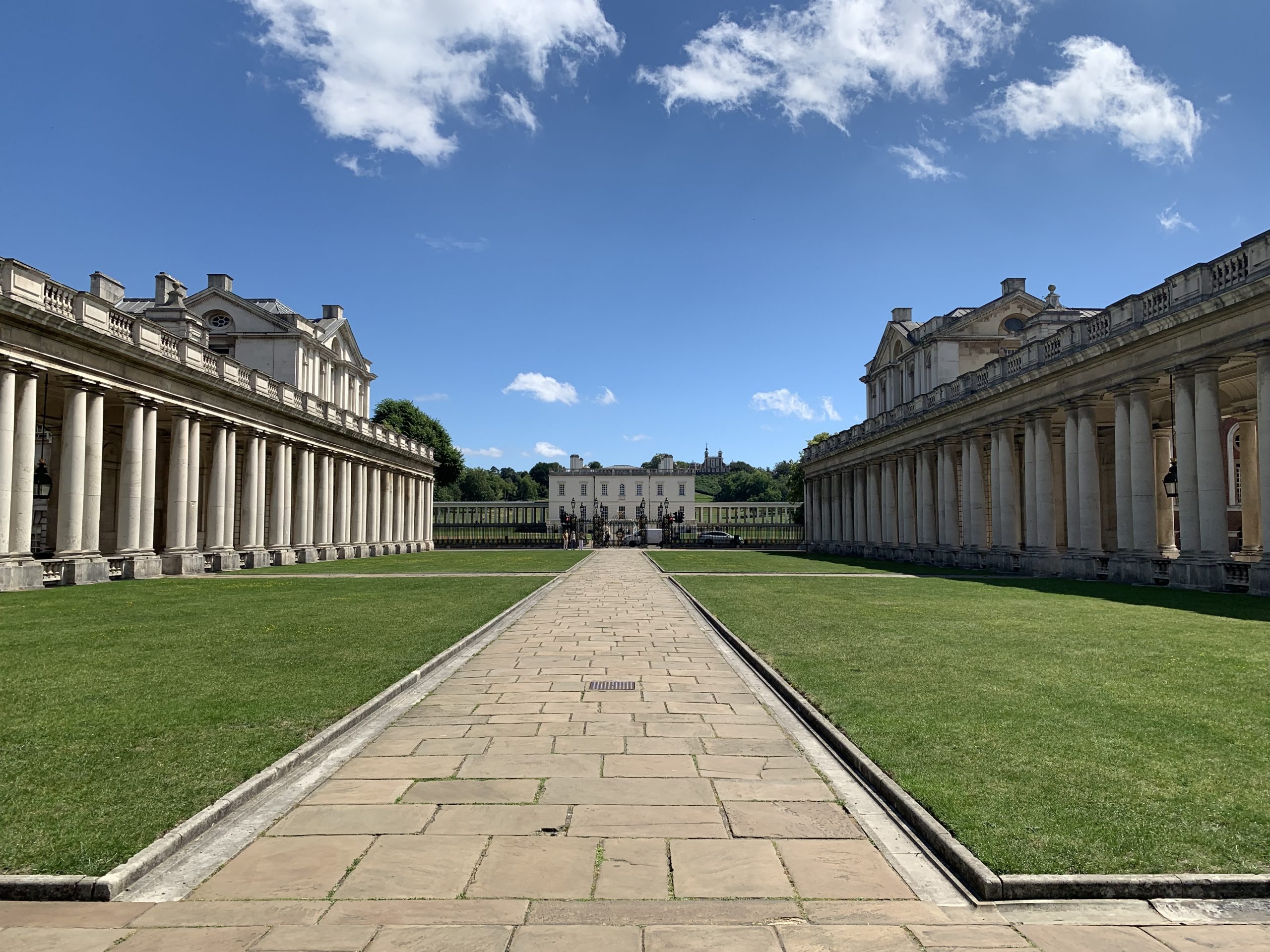
The Old Royal Naval College are buildings that serve as the architectural centrepiece of Maritime Greenwich, a World Heritage Site in Greenwich, London on the River Thames. Described by the United Nations Educational, Scientific and Cultural Organisation (UNESCO) as being of “outstanding universal value” and the site is reckoned to be the “finest and most dramatically sited architectural and landscape ensemble in the British Isles”. Formerly the site of a royal palace, the old college was originally constructed to serve as the Royal Navy’s Greenwich Hospital, designed by Christopher Wren, and built between 1696 and 1712. The hospital closed in 1869 and so between 1873 and 1998 the buildings were used as a training establishment for the Royal Naval College, Greenwich. Wren incorporated the older Queen’s House into the layout design, particularly in maintaining the long axial view for the House to the river. The site is now managed by the Greenwich Foundation for the Old Royal Naval College, established in 1997 to conserve the buildings and grounds and convert them into a cultural destination.
From Wikipedia
Queen’s House is a former royal residence in the London borough of Greenwich, which presently serves as a public art gallery. It was built between 1616 and 1635 on the grounds of the now demolished Greenwich Palace, a few miles downriver from the City of London. In its current setting, it forms a central focus of the Old Royal Naval College with a grand vista leading to the River Thames, a World Heritage Site called, Maritime Greenwich. The Queen’s House architect, Inigo Jones, was commissioned by Queen Anne of Denmark and her successor as queen consort, Queen Henrietta Maria. The House was a royal retreat and place to display and enjoy the artworks the queens had commissioned; this included the ceiling in the Great Hall that featured a work by Orazio Gentileschi titled Allegory of Peace and the Arts.
Queen’s House is one of the most important buildings in British architectural history, due to it being the first consciously classical building to have been constructed in the country. It was Jones’s first major commission after returning from his 1613–1615 grand tour of Roman, Renaissance, and Palladian architecture in Italy. Some earlier English buildings, such as Longleat and Burghley House, had made borrowings from the classical style, but the structure of these buildings was not informed by an understanding of classical precedents. Queen’s House would have appeared revolutionary during this period. Although it diverges from the mathematical constraints of Palladio, Jones is often credited with the introduction of Palladianism with the construction of the Queen’s House. Jones’ unique architecture of the Queen’s House also includes features like the Tulip Stairs, an intricate wrought iron staircase that holds itself up, and the Great Hall, a perfect cube.
After its brief use as a home for royalty, the Queen’s House was incorporated into use for the complex of the expanding Royal Hospital for Seamen, and maintaining its clear axial view down to the river was largely responsible for the dramatic layout of the later English Baroque hospital. Neoclassical colonnades wings and buildings were also added to the House in the early nineteenth century for a Seaman’s school. Today the House is both a Grade I listed building and a scheduled monument; a status that includes the 115-foot-wide (35 m) axial vista to the River Thames. The House has returned to the display of artwork, it now serves as part of the National Maritime Museum and is used to display parts of its substantial collection of maritime paintings and portraits.
Image details
Date: 17 June 2026
Camera body: iPhone Xs
Lens: Wide Camera 26mm ƒ/1.8
Focal Length: 26mm
Aperture: ƒ/1.8
Shutter Speed: 1/2,833s
ISO: 25
Licence: Creative Commons Attribution-NonCommercial-NoDerivatives 4.0 International