
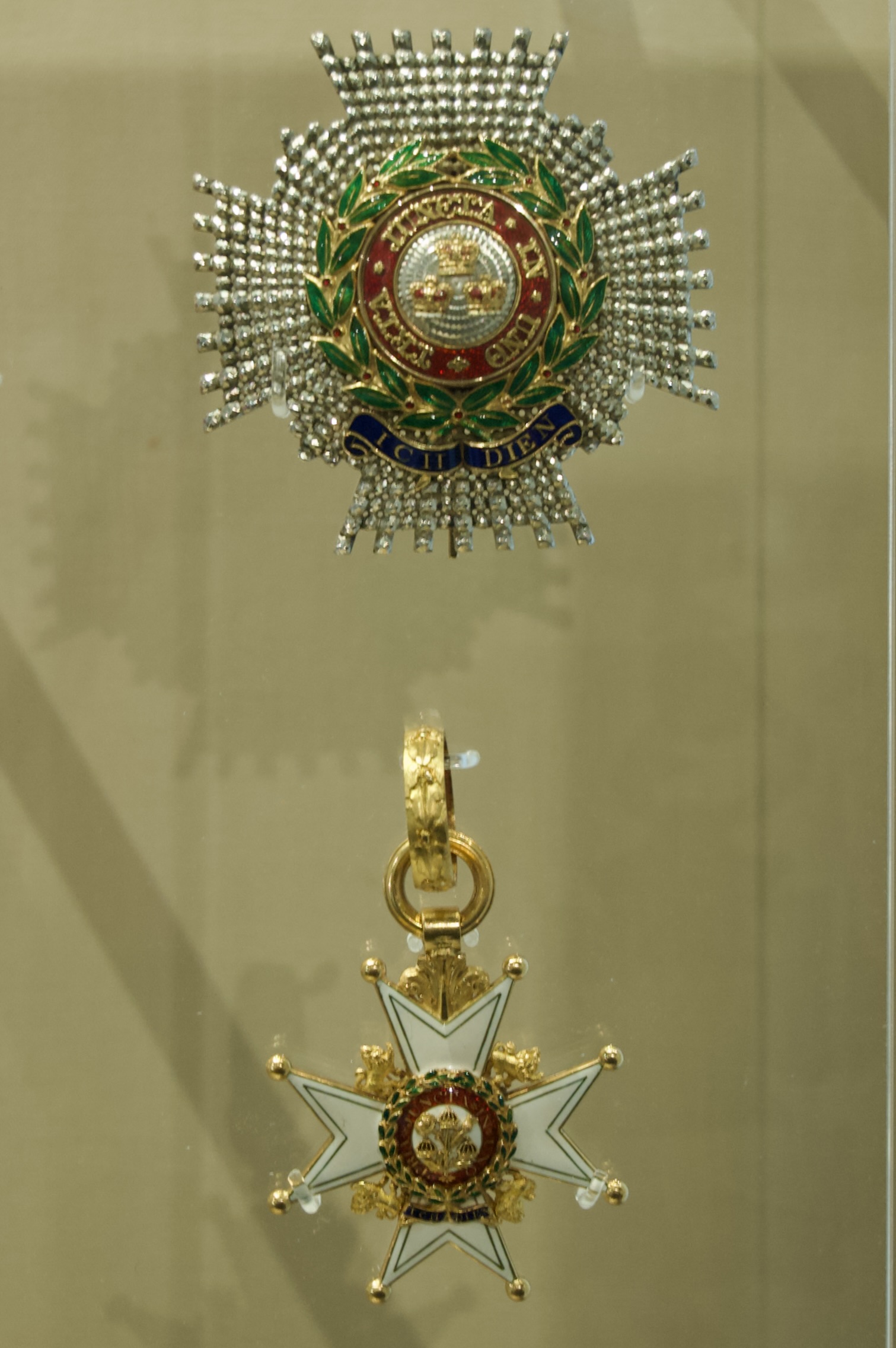
Star and neck badge of the Most Honourable Order of the Bath in the Regimental Museum of the Argyll and Sutherland Highlanders, Stirling Castle, Stirling, Scotland
Awarded to Colonel Sir William Douglas KCB
William Douglas was an unrivalled leader and commander in the Regiment’s history. He joined the gist in 1798 and was Commanding Officer from 1808 to 1818. He led the gist in six of the battles recorded on The Colours.
He commanded the gist through most of the Peninsular War, in France and the Low Countries. He was wounded at the Battles of Orthes and Toulouse. His actions at the capture of Cambrai were mentioned in dispatches.
In 1815, The Duke of Wellington awarded Douglas the Army Gold Cross with clasps ‘Nivelle’ and ‘Pyrenees’ (one of only 163 ever awarded) and the silver Waterloo Medal. He was appointed a Knight Commander of the Most Honourable Order of the Bath for gallantry aged 35.
From Wikipedia:
The Most Honourable Order of the Bath is a British order of chivalry founded by King George I on 18 May 1725. Recipients of the Order are usually senior military officers or senior civil servants, and the monarch awards it on the advice of His Majesty’s Government. The name derives from an elaborate medieval ceremony for preparing a candidate to receive his knighthood, of which ritual bathing (as a symbol of purification) was an element. While not all knights went through such an elaborate ceremony, knights so created were known as “knights of the Bath”.
George I constituted the Knights of the Bath as a regular military order. He did not revive the order, which did not previously exist, in the sense of a body of knights governed by a set of statutes and whose numbers were replenished when vacancies occurred.
The Order consists of the Sovereign of the United Kingdom (currently King Charles III), the Great Master (currently William, Prince of Wales), and three Classes of members:
Knight Grand Cross (GCB) or Dame Grand Cross (GCB);
Knight Commander (KCB) or Dame Commander (DCB); and
Companion (CB).
Members belong to either the Civil Division or the Military Division. Knight Companion (KB), the order’s only class prior to 1815, is no longer an option. Commonwealth citizens who are not subjects of the British monarch and foreign nationals may be made honorary members.
The Order of the Bath is the fourth most senior of the British orders of chivalry, after the Order of the Garter, the Order of the Thistle, and the (dormant) Order of St Patrick.
Image details
Date: 1 February 2026
Camera body: Nikon D50
Lens: Nikkor AF-S DX 18-55mm ƒ3.5-5.6G ED
Focal Length: 55mm
Aperture: ƒ/5.6
Shutter Speed: 1/25s
ISO: 800
Licensing: Creative Commons Attribution-NonCommercial-NoDerivatives 4.0 International