
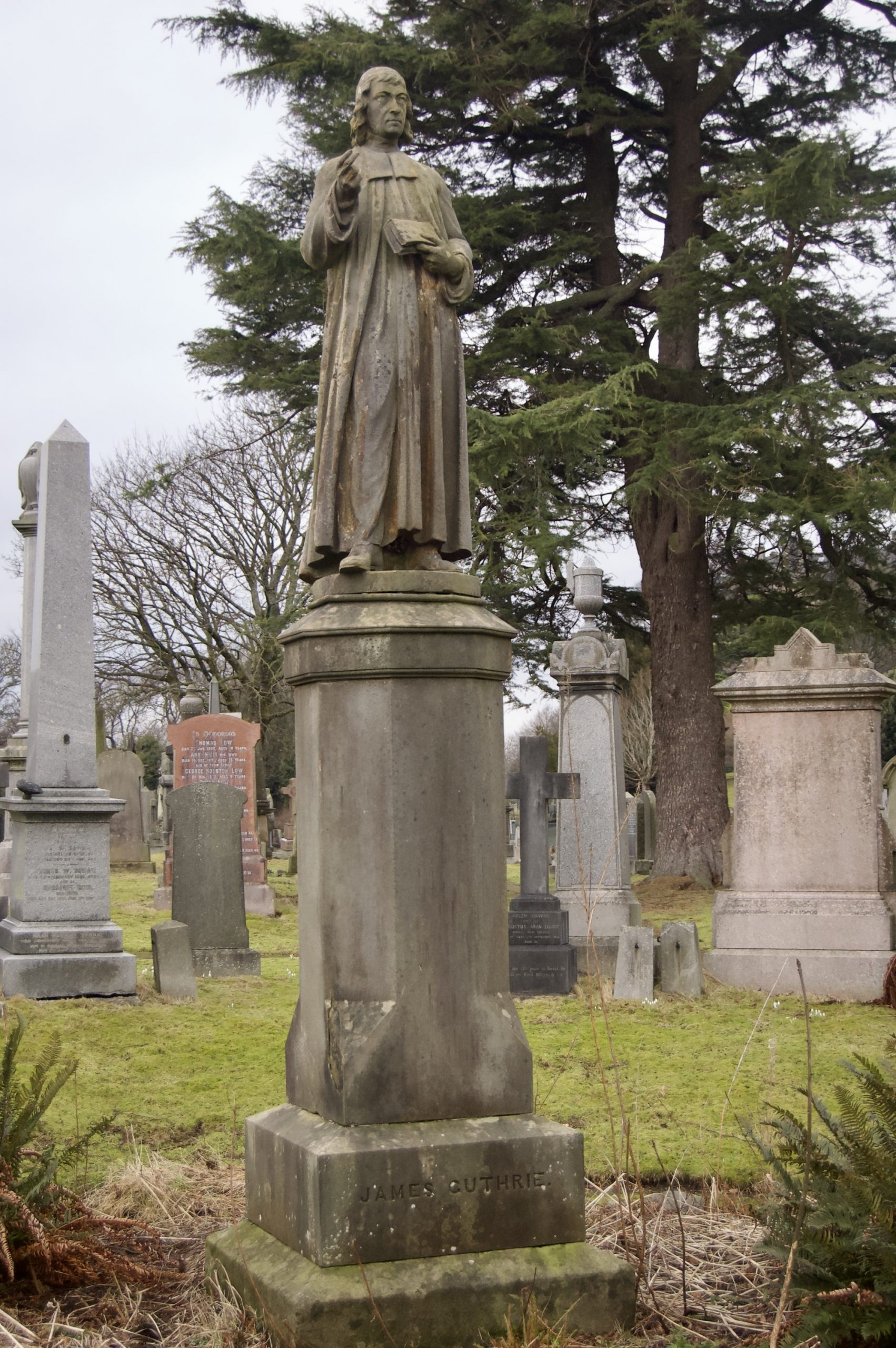
James Guthrie by Alexander Handyside Ritchie in the Old Town cemetery, Stirling, Scotland
From Wikipedia:
James Guthrie (c. 1612 – 1 June 1661), was a Scottish Presbyterian minister. Cromwell called him “the short man who would not bow.” He was theologically and politically aligned with Archibald Johnston, whose illuminating 3 volume diaries were lost until 1896, and not fully published until 1940. He was exempted from the general pardon at the restoration of the monarchy, tried on 6 charges, and hanged in Edinburgh.
James Guthrie was born about 1612 and said to be son of Guthrie of that ilk. He graduated with an M.A. from St. Andrew’s University. He subsequently became a regent in St Leonard’s College, St Andrews. He was one of those whom the Assembly, 16 December 1638, found ready to supply vacancies. He was not ordained until a few years later when he was called to Lauder in 1642, where he stayed for 7 years. He was selected with three others to wait upon Charles I at Newcastle in 1646 with a letter from the Assembly. He preached before Parliament on 10 January 1649, and was thanked by it. He was appointed a commissioner for visiting the Universities of St Andrews and Edinburgh that year. He was translated and admitted to the Church of the Holy Rude in Stirling in November 1650. He took an active and leading part in the business of the Church, and by a small majority in the Assembly got General John Middleton, afterwards the Earl of Middleton, excommunicated, announcing the sentence from his own pulpit, notwithstanding an appeal by the King. He and Bennett, his colleague, were required by His Majesty and the Committee of Estates to repair to Perth, 19 February 1651, to answer for preaching against the Public Resolutions agreed to by Church and State in order to a levy, but they refused.
He was deposed by the Assembly, 30 July following, for having joined in the Protestation against the lawfulness of that Assembly. He and others holding similar views thereupon formed a separate Church under the protection of Cromwell. Along with others of the Protesting brethren, having met in Edinburgh to draw up a congratulatory address and supplication to Charles II, he was seized and imprisoned in Edinburgh Castle 23 August 1660. His stipend was sequestrated 25 September, and he was removed to the prison of Dundee 20 October, from thence to Stirling and again to Edinburgh, where he was tried before Parliament, 25 May 1661, found guilty of treason, sentenced to death 28th, hanged at the Cross of Edinburgh on 1 June 1661. His head was placed on the Netherbow Port. The sentence of forfeiture was rescinded by Parliament 22 July 1690, and his skull, after being a public spectacle for about twenty-eight years, was removed by Alexander Hamilton, then a student at the university, who afterwards succeeded the Holy Rude Church in Stirling. From his determined support of Presbyterian principles, Guthrie was named siccar foot (the Scots term for a sure-footed person), the avowed leader of the Protesters, and their secretary and champion. He married Jane (buried in Greyfriars, 15 March 1673), who was the daughter of Ramsay of Sheilhill, and had issue – William, died on the eve of being licensed at Edinburgh April 1674; Sophia, who, along with her mother, was in 1666 banished to a lonely prison in Shetland for having in their possession a copy of John Brown’s Apologeticall Relation of the Particular Sufferings of the Faithful Ministers and Professors of the Church of Scotland.
From Wikipedia:
Ritchie was born in Musselburgh in 1804, the son of James Ritchie, a local brickmaker and ornamental plasterer, and his wife Euphemia. The father in turn was the son of a fisherman and amateur sculptor.
After studying architecture he turned to sculpture. In 1823 he studied under Samuel Joseph at the Edinburgh School of Arts. He briefly also studied anatomy at Dr. John Barclay’s Anatomy School in 1822. He studied in Rome under Bertel Thorvaldsen from 1826 to 1830, under the sponsorship of Walter, 5th Duke of Buccleuch. A favourite of Thorvaldsen he was awarded a gold medal under his tutorship.[1] In 1830 he returned to Musselburgh where he held a studio for 12 years, then opened a sculpture studio at 92 Princes Street, Edinburgh in 1842. He had a yard at 4 East Broughton Place where most of the work was done. Ritchie trained other sculptors such as John Rhind here.
His brother John Ritchie assisted him on some works, working from the same studio. He also worked with and trained John Rhind, Alexander Munro and George Anderson Lawson.
He was elected an Associate of the Royal Scottish Academy in 1846. In 1854, he moved his studio to Mound Place in the centre of Edinburgh, living nearby at 92 Princes Street. He retired in 1861, but maintained a studio at Coates Place in Edinburgh, where he held a final exhibition in 1862. He returned to his family home at Herkes Loan, Musselburgh and spent his final years in the care of his sister Euphemia. He had no wish for riches and they lived frugally.
He died on 24 April 1870, leaving £6 10s 6d in his will. He is buried in the churchyard of St Michael in Inveresk just outside Musselburgh. He lies to the east side of the south entrance path, facing away from the path. He had no family and the grave is very humble. It is marked as being erected by his “brother sculptors WB and JR” presumed to be William Brodie and John Rhind.
It is presumed he was descended from the local farming family, the Handasydes, of whom Archibald Handasyde was a stonemason responsible for the carving of a sundial on the session house of St. Michaels in 1785.
Object description
Type: Statue, monument
Location: Old Town Cemetery, Stirling
Material: Stone
Artist: Alexander Handyside Ritchie (1804-1870)
Date: 1859
Image details
Date: 1 February 2026
Camera body: Nikon D50
Lens: Nikkor AF-S DX 18-55mm ƒ3.5-5.6G ED
Focal Length: 38mm
Aperture: ƒ/4.8
Shutter Speed: 1/500s
ISO: 800
Licensing: Creative Commons Attribution-NonCommercial-NoDerivatives 4.0 International