
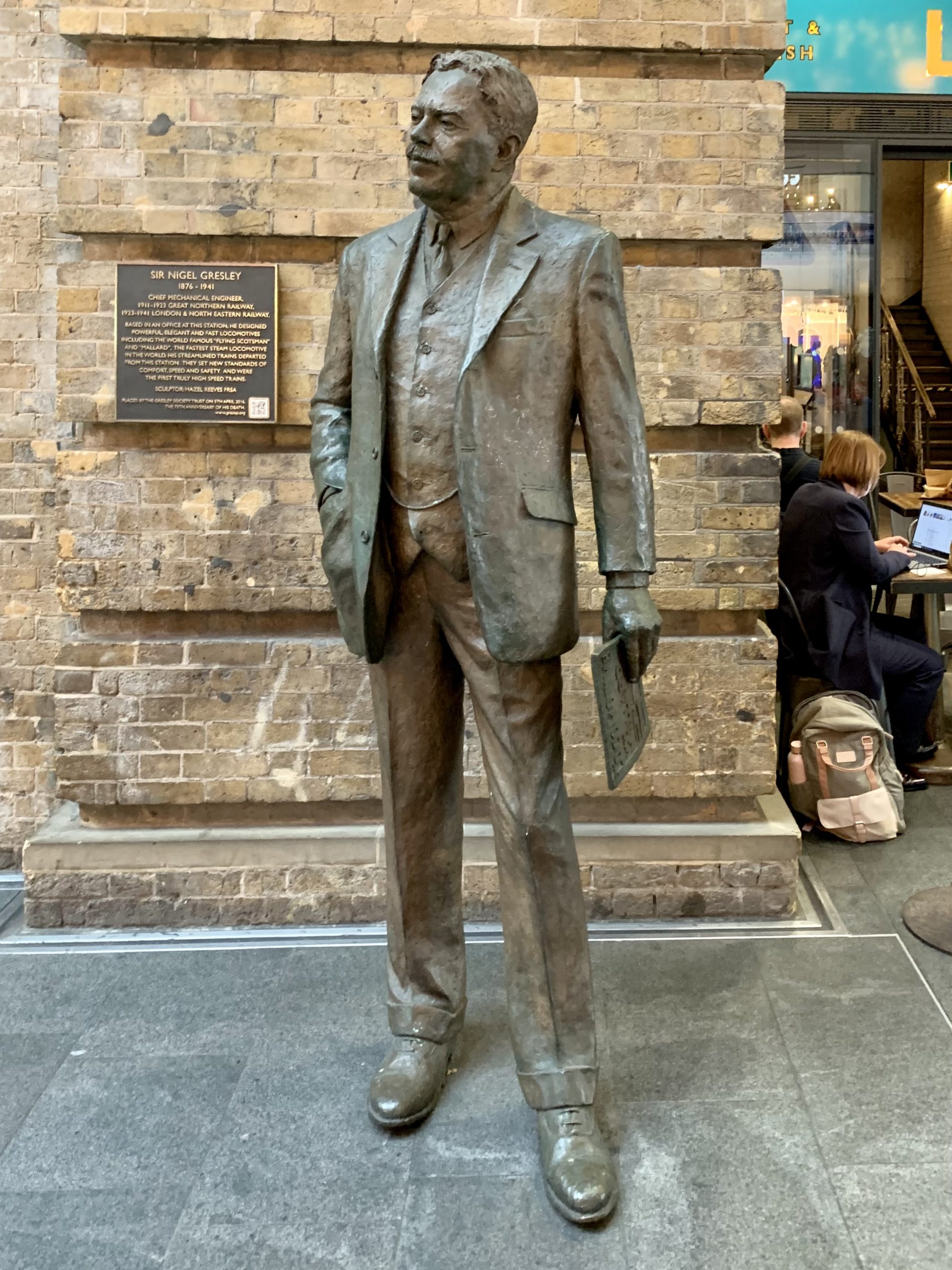
“Sir Nigel Gresley” by Hazel Reeves at King’s Cross Railway Station, London, England
From Wikipedia:
Sir Herbert Nigel Gresley CBE (19 June 1876 – 5 April 1941) was a British railway engineer. He was one of Britain’s most famous steam locomotive engineers, who rose to become Chief Mechanical Engineer (CME) of the London and North Eastern Railway (LNER). He was the designer of some of the most famous steam locomotives in Britain, including the LNER Class A1 and LNER Class A4 4-6-2 Pacific engines. An A1 Pacific, Flying Scotsman, was the first steam locomotive officially recorded over 100 mph in passenger service, and an A4, No. 4468 Mallard, still holds the record for being the fastest steam locomotive in the world (126 mph).
Gresley’s engines were considered elegant, both aesthetically and mechanically. His invention of a three-cylinder design with only two sets of Walschaerts valve gear, the Gresley conjugated valve gear, produced smooth running and power at lower cost than would have been achieved with a more conventional three sets of Walschaerts gear.
Gresley was born in Edinburgh, Scotland, during his mother’s visit there to see a gynaecologist, but was raised in England at Netherseal, Derbyshire, a member of a cadet branch of a family long seated at Gresley, Derbyshire. After attending school in Sussex and at Marlborough College, Gresley served his apprenticeship at the Crewe works of the London and North Western Railway, afterwards becoming a pupil under John Aspinall at Horwich of the Lancashire and Yorkshire Railway (L&YR). After several minor appointments with the L&YR he was made Outdoor Assistant in the Carriage and Wagon Department in 1901; in 1902 he was appointed Assistant Works Manager at Newton Heath depot, and Works Manager the following year.
He became Assistant Superintendent of the Carriage and Wagon Department of the L&YR in 1904 and a year later moved to the Great Northern Railway (GNR) as Carriage and Wagon Superintendent. He succeeded Henry A. Ivatt as CME of the GNR on 1 October 1911. At the 1923 Grouping, he was appointed CME of the newly formed LNER (the post had originally been offered to the ageing John G. Robinson; Robinson declined and suggested the much younger Gresley).
During the 1930s, Sir Nigel Gresley lived at Salisbury Hall, near St Albans in Hertfordshire. Gresley developed an interest in breeding wild birds and ducks in the moat including Mallard ducks.[3] The Hall still exists today as a private residence and is adjacent to the de Havilland Aircraft Museum, with its links to the design of the famous Mosquito aircraft during World War II.
In 1936, Gresley designed the 1,500 V DC locomotives for the proposed electrification of the Woodhead Line between Manchester and Sheffield. The Second World War forced the postponement of the project, which was completed in the early 1950s. Edgar Claxton was Gresley’s assistant throughout this project, working on power supply, equipment and systems, besides carrying out the trials.
Gresley was appointed CBE in 1920 for services during the First World War and was knighted in the 1936 Birthday Honours by King Edward VIII. Also in the latter year, Gresley was awarded an honorary DSc by Manchester University and presided over the IMechE.
Gresley died on 5 April 1941, after a short illness, and was buried in the Churchyard Extension of St Peter’s Church, Netherseal, Derbyshire. At this time, Gresley was serving as a Lieutenant Colonel in the Royal Engineers Railway Staff Corps.
He was succeeded as the LNER CME by Edward Thompson.
Object description
Type: Sculpture
Location: King’s Cross Railway Station, London
Material: Bronze
Artist: Hazel Reeves
Date: 2016
Image details
Date: 10 December 2025
Camera body: iPhone Xs
Lens: Wide Camera 26mm ƒ/1.8
Focal Length: 26mm
Aperture: ƒ/1.8
Shutter Speed: 1/33s
ISO: 320
Licence: Creative Commons Attribution-NonCommercial-NoDerivatives 4.0 International
