
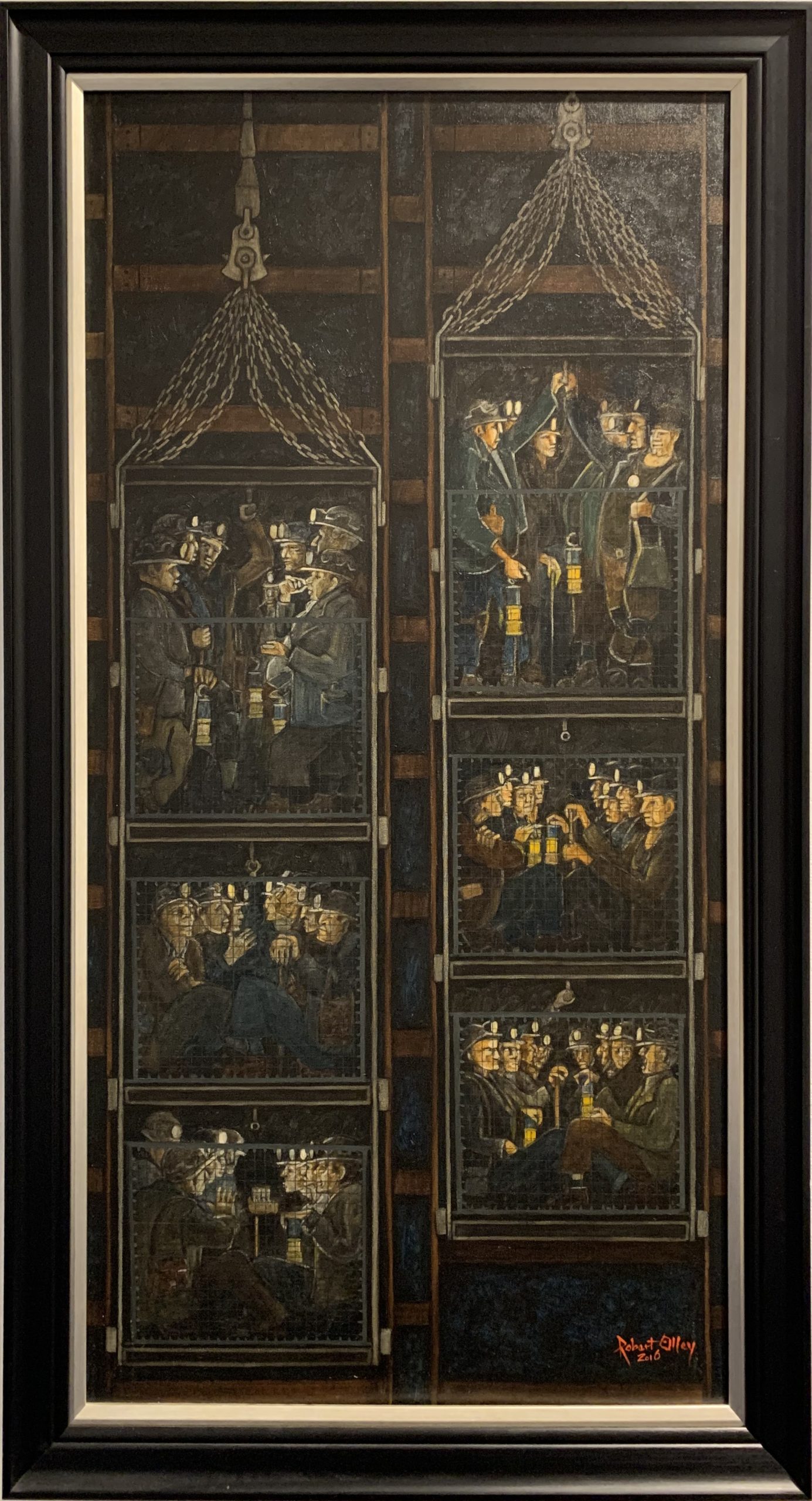
“The Shaft” by Robert Olley. South Shields Museum, England
Going down a mine shaft in a metal box for the first time is a daunting experience and is nothing like using an elevator in a hotel or office block. The cage usually has three or four open-ended decks with metal gates on either side and carries eight men to a deck. Only the top deck is high enough to stand upright in, so men in the lower decks must adopt a crouching position. The cages are guided by greased vertical wooden rails called “skeets”. The cages rattle past each other half way up the shaft. Both are suspended on a single wire rope about two inches (5cm) thick attached to four chains on the top of each cage, and there are also four safety chains as a back-up. Both cages can travel at around 3o feet per second. However there are two speeds, one faster for coal drawing and the other for man riding.
In time much more powerful winding engines would be capable of handling much heavier loads at faster speeds. Westoe Colliery for example had three decks capable of carrying fifty men to a cage.
By law, following the 1862 disaster at Hartley Colliery, Northumberland, all collieries must have two shafts. Powerful fans draw air into the mine via the “Down” shaft. The air circulates round the mine workings then is drawn out of the pit by the extraction fans in the “Up” shaft.
Object description
Type: Easel painting
Location: South Shields Museum & Art Gallery, Tyne & Wear
Material: Oil on canvas
Artist: Robert Olley (b. 1940)
Date: 2016
Image details
Date: 25 September 2025
Camera body: iPhone Xs
Lens: Wide Camera 26mm ƒ/1.8
Focal Length: 26mm
Aperture: ƒ/1.8
Shutter Speed: 1/50s
ISO: 400
Licence: Image of a North East Museums asset. This image cannot be licensed.