
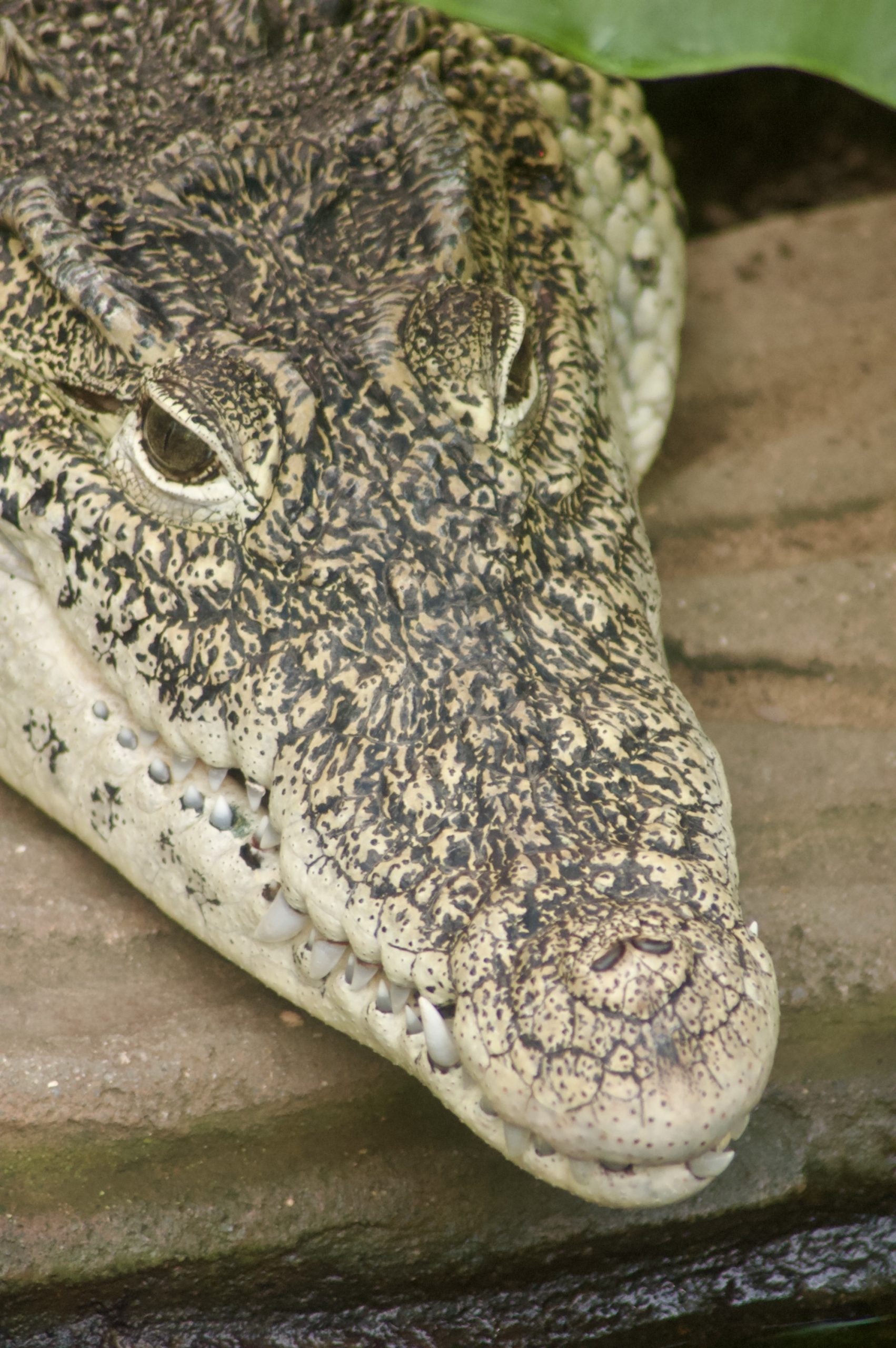
Cuban crocodile at Paignton Zoo, Devon, England.
From Wikipedia
The Cuban crocodile (Crocodylus rhombifer) is a small-medium species of crocodile endemic to Cuba. Typical length is 2.1–2.3 m (6 ft 11 in – 7 ft 7 in) and typical weight 70–80 kg (150–180 lb). Large males can reach as much as 3.5 m (11 ft) in length and weigh more than 215 kg (474 lb).
The Cuban crocodile is of interest to biologists for its unique physical and behavioral traits. Long- and strong-legged, it is the most terrestrial of extant crocodiles. Its preferred habitat comprises freshwater and brackish water environments, such as mangrove swamps, coastal lagoons, estuaries, marshes, floodplains, and river deltas. There, the adults feed on fish, turtles and small mammals, while the young eat invertebrates and smaller fish. Mating occurs between May and July. Captive animals have displayed cooperative hunting behavior, and can be taught tricks, suggesting intelligence.
The Cuban crocodile is listed as critically endangered on the IUCN Red List. Once spread across the Caribbean, its range has dwindled to only the Zapata Swamp, due to hunting by humans. Captive breeding projects are in place to help the species recover. The species’ fossil record reveals it had at one point a greater range, with fossil remains being found in the Bahamas, Hispaniola and the Cayman Islands.
Image details
Date: 19 September 2025
Camera body: Nikon D50
Lens: Tamron 70.0-300.0 mm f/4.0-5.6
Focal Length: 280mm
Aperture: ƒ/5.3
Shutter Speed: 1/160s
ISO: 800
Licence: Creative Commons Attribution-NonCommercial-NoDerivatives 4.0 International