
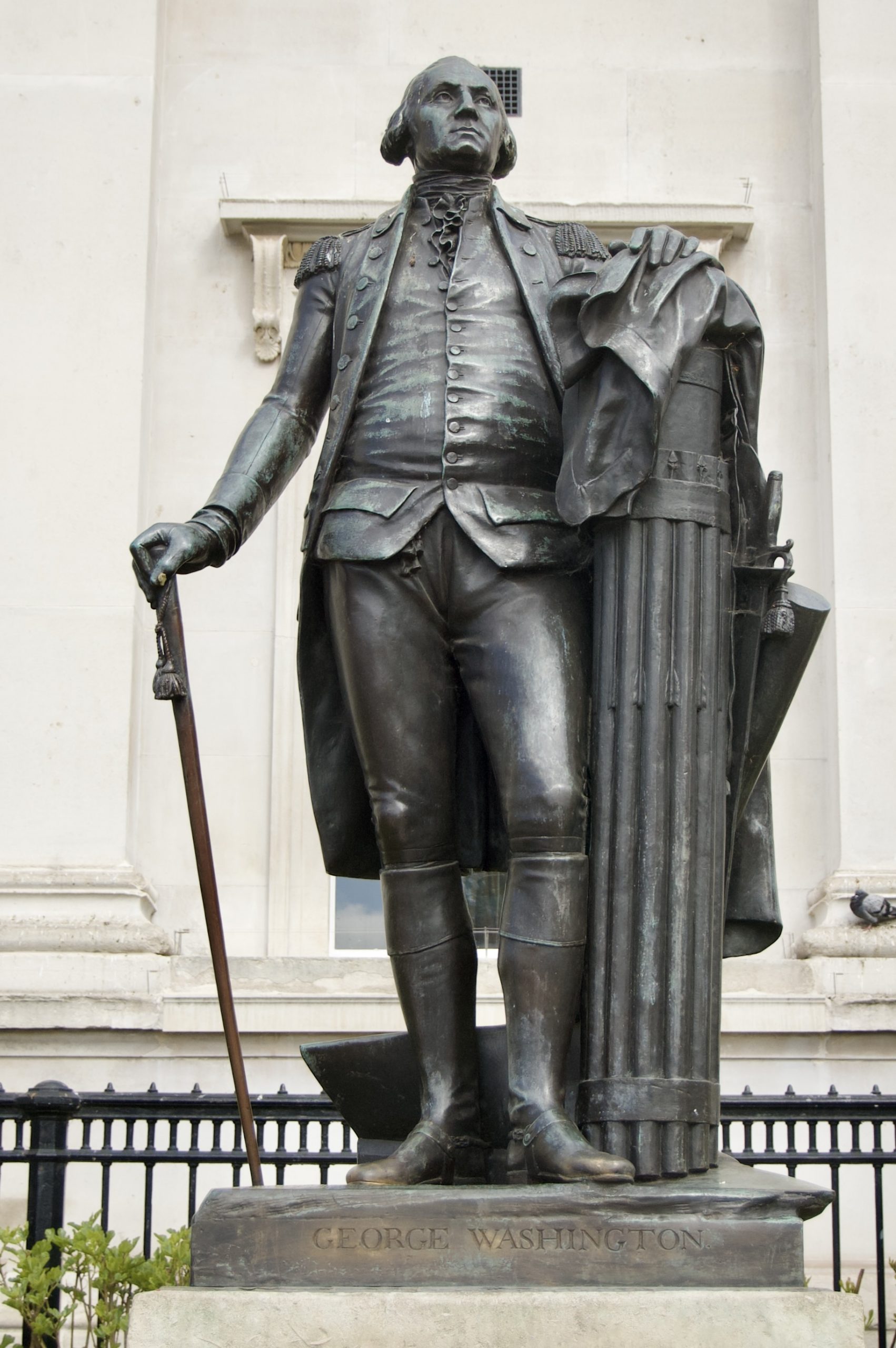
This status is located in Trafalgar Square, London.
It is from a cast of the original statue in the Virginia State Capitol, and is sited on top of soil from Virginia, as George Washington vowed never to set foot on British soil.
From Wikipedia:
George Washington is a statue by the French sculptor Jean-Antoine Houdon from the late 18th century. Based on a life mask and other measurements of George Washington taken by Houdon, it is considered one of the most accurate depictions of the subject. The original sculpture is located in the rotunda of the Virginia State Capitol in Richmond, Virginia, and it has been copied extensively, with one copy standing in the United States Capitol Rotunda.
The date given for the sculpture varies. It was commissioned by the Virginia General Assembly in 1784, begun in 1785, signed “1788”, completed in 1791 or 1792, and delivered in 1796.
Description
The original statue is carved from Carrara marble, weighing 18 tons. It depicts a standing life-sized Washington. In his right hand is a cane, his left arm rests on a fasces on which is slung his cape and sword, and at the back is a plow.He is shown wearing his military uniform, as Washington wished to be depicted in contemporary attire, rather than that of antiquity popular in Neo-classical sculpture.
With its selection of objects both civilian (the plow and cane) and military (the fasces, sword, and uniform), the statue has been interpreted as invoking the imagery and ideal of an Ancient Roman dictator, Cincinnatus, with whom Washington has been compared in his decision to retire from public life following the Revolutionary War. Washington was elected president of The Society of the Cincinnati in 1783. At the time of the statue’s commission, Washington had not yet served in the Constitutional Convention and would not become President of the United States until 1789.
Chief Justice John Marshall, a contemporary of Washington’s said of the work, “Nothing in bronze or stone could be a more perfect image than this statue of the living Washington.”
Houdon original
During the design process, Houdon produced this plaster bust of Washington in 1786. He later revised it before making the final statue. (National Portrait Gallery)
In 1784, the Virginia General Assembly commissioned a statue of George Washington “to be of the finest marble and the best workmanship,” necessitating a European craftsman. The Governor of Virginia gave the responsibility of selecting the artist to Thomas Jefferson, then ambassador to France, who together with Benjamin Franklin recommended that Jean-Antoine Houdon, the most famous sculptor of the day, execute the work.
Unsatisfied to work from a drawing of Washington by Charles Willson Peale sent for the project, and lured by a potential commission for an equestrian monument by the Congress of the Confederation, Houdon agreed to travel to the United States to work directly from Washington. His voyage was conditional on his life being insured for the trip, asking “that ten thousand livres be paid to his family should he die during the voyage”. On July 28, 1785, (or, July 22, 1785) Houdon sailed with Benjamin Franklin and “two of his workmen” from Southampton, England, arriving in Philadelphia, Pennsylvania on September 14.
In early October 1785, Houdon along with three assistants stayed at Washington’s plantation Mount Vernon, taking detailed measurements of Washington’s arms, legs, hands and chest and making a life mask of his face. By December, Houdon had returned to France.
Though inscribed with the date “1788”, it was completed in France in 1791 or 1792 (depending on the source). It was finally delivered to Richmond in 1796 and placed in the rotunda on May 14, 1796. Various explanations for the delay in its delivery have been given, including the French Revolution and untimely payments to Houdon, though most sources agree that the continued construction of the new Virginia State Capitol prevented its installation until the time it arrived.
The equestrian monument that originally attracted Houdon to America was never commissioned. The 1783 resolution authorizing such a statue would eventually be fulfilled in 1860 when Clark Mills’s equestrian statue of George Washington was installed at Washington Circle.
In the early 21st century the statue, together with the life mask and bust created by Houdon during the design process, were used as part of a forensic reconstruction of George Washington at various ages undertaken by Mount Vernon.
In the early 20th century (1908 or 1909), the Commonwealth of Virginia commissioned a new cast to be added to the National Statuary Hall Collection. It is now one of six state statues located in the United States Capitol rotunda in Washington, D.C.
In 1910 an act of the general Assembly of Virginia stated, “That the permission and authority of the State of Virginia be …. granted to the Gorham Manufacturing Company …. to make further copies or reproductions of the Houdon statue of George Washington from the molds now in possession of said company… belonging to the State of Virginia, for any National, State, Territorial, County of Municipal Government …… for any university, college, school, library, art gallery, or other educational institution: for any patriotic society ….. related to the history and achievements of George Washington.” Each copy was to be stamped with the great seal of Virginia and the phrase, “Copied from the original by Houdon…” Gorham was to pay the state $500 for every statue made. The Virginia legislature banned future taking of molds, and so the subsequent casts were made from existing molds.
Object description
Type: Monument > Statue
Location: Trafalgar Square, London WC2
Material: Bronze, stone
Artist: Jean-Antoine Houdon (1741 – 15 July 1828)
Date: 1924
Listed: Grade II
Image details
Date: 10 April 2025
Camera body: Nikon D50
Lens: Nikkor AF-S DX 18-55mm ƒ3.5-5.6G ED
Focal Length: 46mm
Aperture: ƒ/5.3
Shutter Speed: 1/800s
ISO: 400
Licence: Creative Commons Attribution-NonCommercial-NoDerivatives 4.0 International