
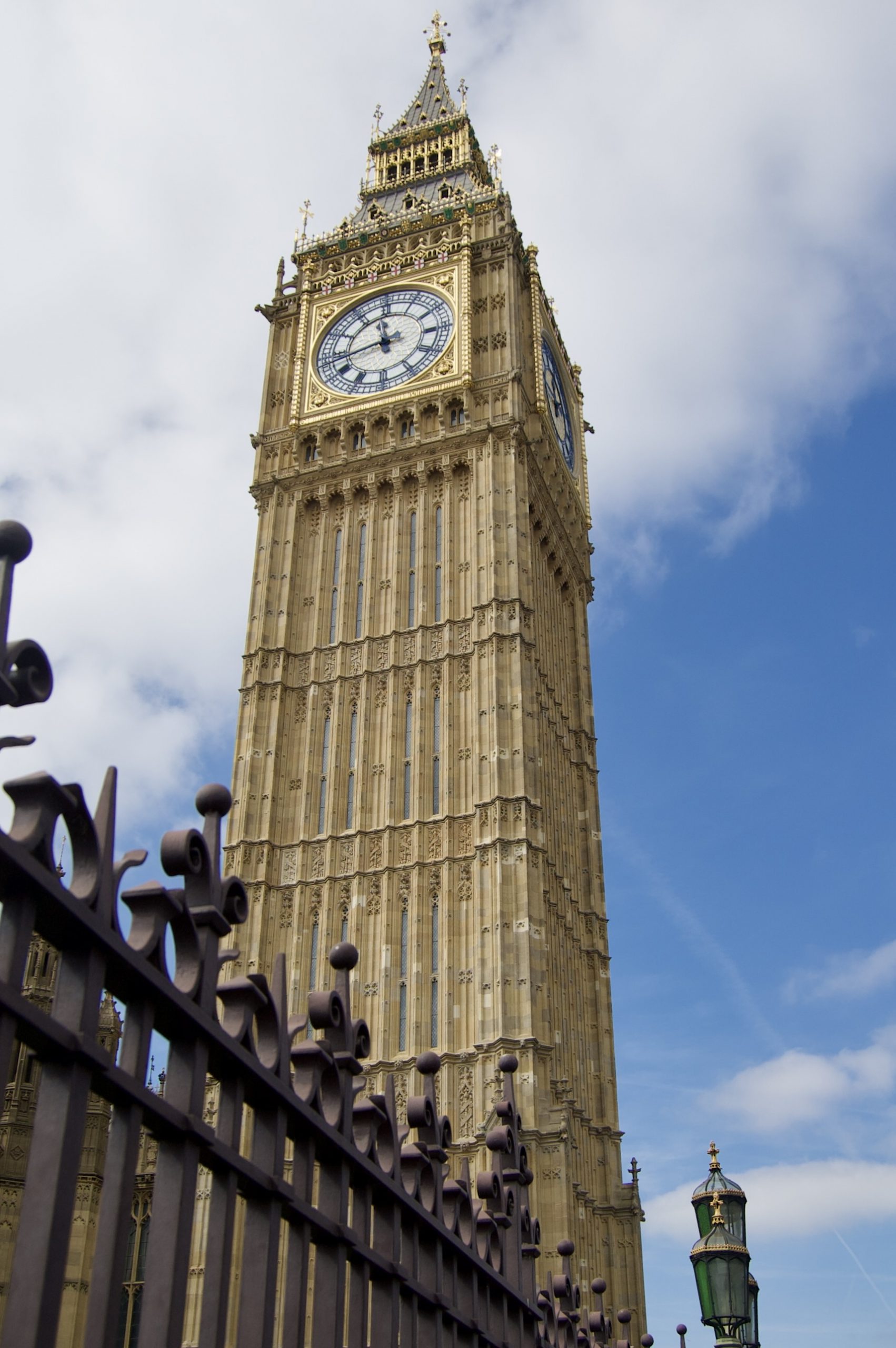
From Wikipedia
Big Ben is the nickname for the Great Bell of the Great Clock of Westminster, and, by extension, for the clock tower itself, which stands at the north end of the Palace of Westminster in London, England. Originally named the Clock Tower, it was renamed Elizabeth Tower in 2012 to mark the Diamond Jubilee of Queen Elizabeth II. The clock is a striking clock with five bells.
It was designed by Sir Charles Barry and Augustus Pugin in the Perpendicular Gothic and Gothic Revival styles and was completed in 1859. It is elaborately decorated with stone carvings and features symbols related to the four countries of the United Kingdom and the Tudor dynasty. A Latin inscription celebrates Queen Victoria, under whose reign the palace was built. It stands 316 feet (96 m) tall, and the climb from ground level to the belfry is 334 steps. Its base is square, measuring 40 feet (12 m) on each side. The dials of the clock are 22.5 feet (6.9 m) in diameter.
The clock uses its original mechanism and was the largest and most accurate four-faced striking and chiming clock in the world upon its completion.[6] It was designed by Edmund Beckett Denison and George Airy, the Astronomer Royal, and constructed by Edward John Dent and Frederick Dent. It is known for its reliability, and can be adjusted by adding or removing pre-decimal pennies from the pendulum. The Great Bell was cast by the Whitechapel Bell Foundry and weighs 13.5 long tons (13.7 tonnes; 15.1 short tons). Its nickname derives from that of the tall Sir Benjamin Hall, who oversaw its installation. There are four quarter bells, which chime on the quarter hours.
Big Ben is a British cultural icon. It is a prominent symbol of Britain and parliamentary democracy, and is often used in the establishing shot of films set in London. It has been part of a Grade I listed building since 1970, and in 1987 it was designated by UNESCO as a World Heritage Site. The clock and tower were renovated between 2017 and 2021, during which the bells remained silent (with a few exceptions).
Elizabeth Tower, originally named the Clock Tower, and popularly known as “Big Ben”, was built as a part of Charles Barry’s design for a new Palace of Westminster after the old palace was largely destroyed by fire on 16 October 1834. Although Barry was the chief architect of the neo-gothic palace, he turned to Augustus Pugin for the design of the Clock Tower, which resembles earlier designs by Pugin, including one for Scarisbrick Hall, a country house in Lancashire. Construction of the tower began on 28 September 1843. The building contractors were Thomas Grissell and Morton Peto. An inscribed trowel in the Parliamentary Archives records that Emily, sister of Peto’s daughter-in-law, was given the honour of laying the first stone. It was Pugin’s last design before his descent into mental illness and death in 1852, and Pugin himself wrote, at the time of Barry’s last visit to him to collect the drawings, “I never worked so hard in my life for Mr Barry for tomorrow I render all my designs for finishing his bell tower and it is beautiful”.
Completed in 1859, the tower is designed in Pugin’s Gothic Revival style and is 316 feet (96.3 m) high, making it the third-tallest clock tower in Britain. Its dials (at the centre) are 180 feet (54.9 m) above ground level. Its base is square, measuring 40 feet (12.2 m) on each side, resting on concrete foundations 12 feet (3.7 m) thick. It was constructed using bricks clad on the exterior with sand-coloured Anston limestone from South Yorkshire, topped by a spire covered in hundreds of cast iron roof-tiles. There is a spiral staircase with 290 stone steps up to the clock room, followed by 44 to reach the belfry, and an additional 59 to the top of the spire.
Above the belfry and the Ayrton Light are 52 shields decorated with national emblems of the four countries of the UK: the red and white rose of the Tudor dynasty of England, the thistle of Scotland, shamrock of Northern Ireland, and leek of Wales. They also feature the pomegranate of Catherine of Aragon, first wife of the Tudor king Henry VIII; the portcullis, symbolising both Houses of Parliament; and fleurs-de-lis, a legacy from when English monarchs claimed to rule France.
A ventilation shaft running from ground level up to the belfry, which measures 16 feet (4.9 m) by 8 feet (2.4 m), was designed by David Boswell Reid, known as “the grandfather of air-conditioning”. It was intended to draw cool, fresh air into the Palace of Westminster; in practice this did not work and the shaft was repurposed as a chimney until around 1914. The 2017–2021 conservation works included the addition of a lift in the shaft.
Its foundations rest on a layer of gravel, below which is London Clay. Owing to this soft ground, the tower leans slightly to the north-west by roughly 230 mm (9.1 in) over 55 m height, giving an inclination of approximately 1⁄240. This includes a planned maximum of 22 mm increased tilt due to tunnelling for the Jubilee Line Extension. In the 1990s thousands of tons of concrete were pumped into the ground underneath the tower to stabilise it during construction of the Westminster section of the Jubilee line of the London Underground. It leans by about 500 mm (20 in) at the finial. Experts believe the leaning will not be a problem for another 4,000 to 10,000 years.
Image details
Date: 10 April 2025
Camera body: Nikon D50
Lens: Nikkor AF-S DX 18-55mm ƒ3.5-5.6G ED
Focal Length: 20mm
Aperture: ƒ/5
Shutter Speed: 1/1,250s
ISO: 200
Licence: Creative Commons Attribution-NonCommercial-NoDerivatives 4.0 International