
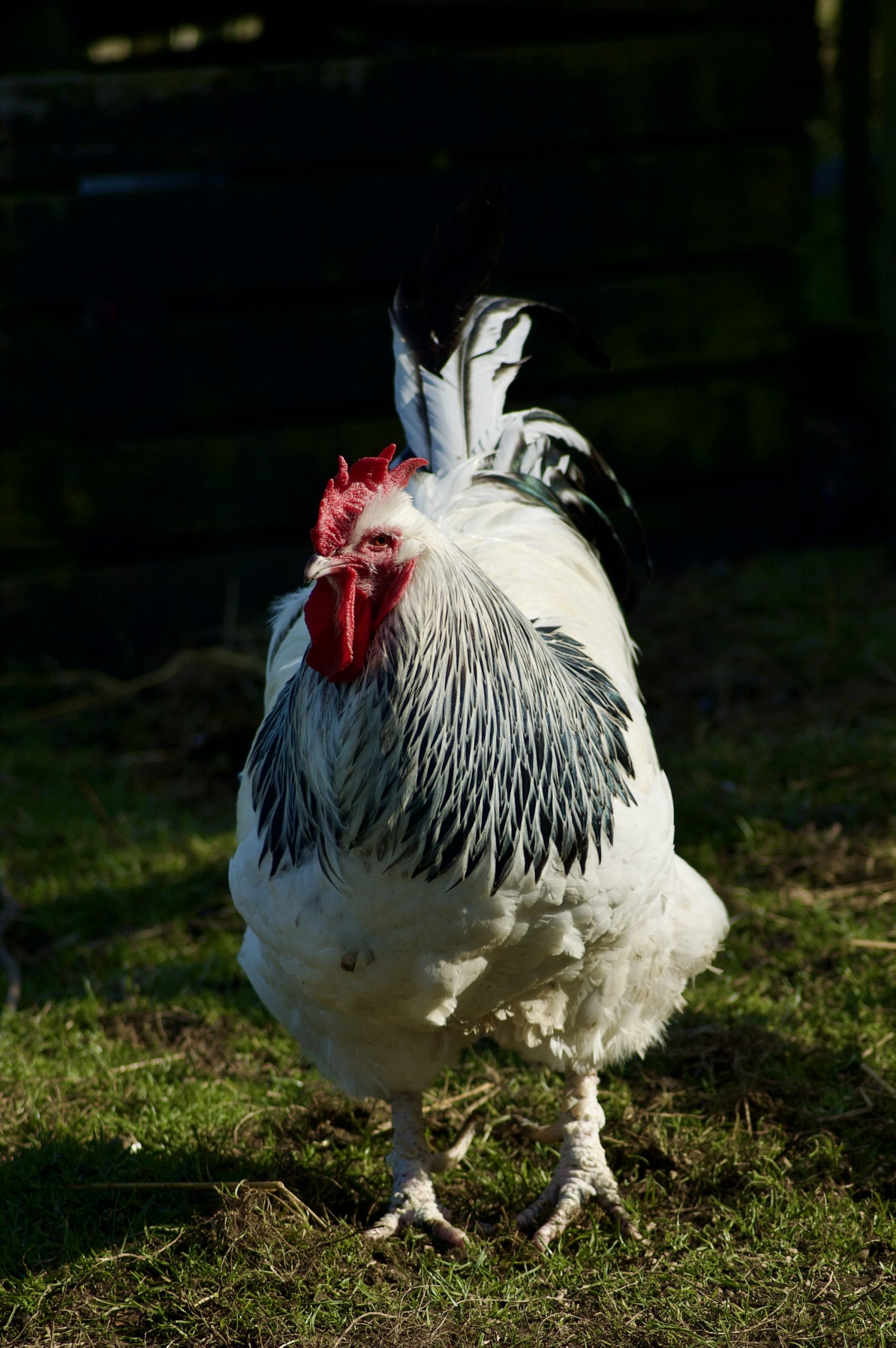
A light Sussex hen at Beamish Museum, Co. Durham, England
From Wikipedia:
The Sussex is a British breed of dual-purpose chicken, reared both for its meat and for its eggs. Eight colours are recognised for both standard-sized and bantam fowl. A breed association, the Sussex Breed Club, was organised in 1903.
The Sussex originates in the historic county of Sussex, in south-east England. It is among the oldest of British chicken breeds: birds described as “Old Sussex or Kent Fowl” were shown at the first poultry show at London Zoo in 1845. The Sussex was not included in the first poultry standard, the Standard of Excellence in Exhibition Poultry of William Bernhardt Tegetmeier, in 1865. The breed standard for the Sussex was drawn up in 1902, with three colour varieties, the light, the red and the speckled. Of these, the speckled was the oldest. The development of the light variety was probably influenced by Oriental breeds such as the Brahma and Cochin, and also by the silver-grey Dorking. The red was originally black-breasted; it and the brown may have been influenced by Indian Game. The buff variety appeared in the 1920s, and was followed by the white, a sport from the light. The most recent variety is the silver.
In the early part of the twentieth century, until the advent of commercial hybrid strains at about the time of the Second World War, the Sussex and the Rhode Island Red were the two principal meat breeds in the United Kingdom. Utility strains of the Sussex developed, with better productive capabilities but smaller and less well marked than was expected for exhibition purposes.
Image details
Date: 9 March 2025
Camera body: Nikon D50
Lens: Tamron 70.0-300.0 mm f/4.0-5.6
Focal Length: 140mm
Aperture: ƒ/5
Shutter Speed: 1/1,250s
ISO: 200
Licence: Creative Commons Attribution-NonCommercial-NoDerivatives 4.0 International