
From Wikipedia:
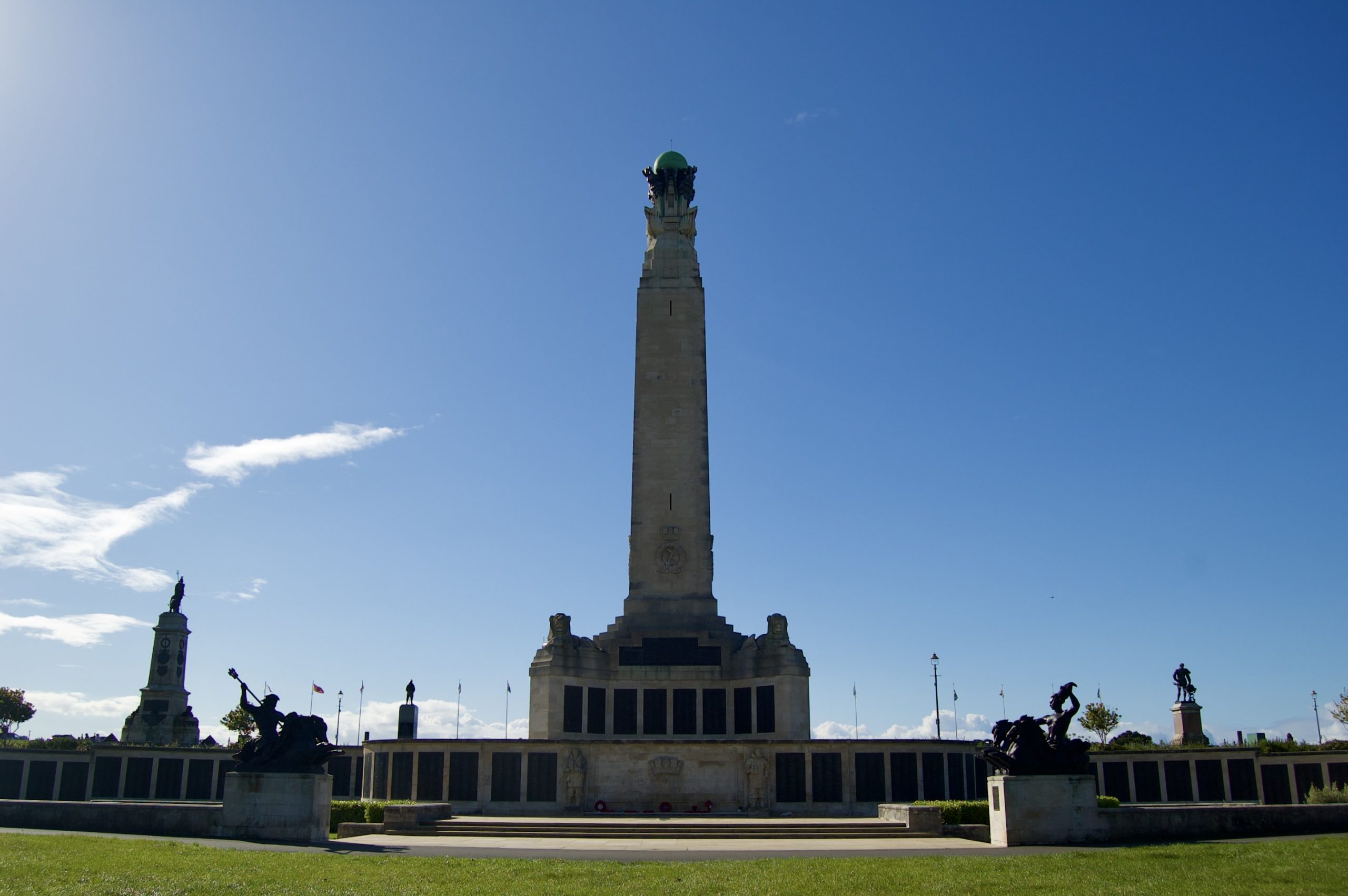
The Plymouth Naval Memorial is a war memorial in Plymouth, Devon, England which is dedicated to British and Commonwealth sailors who were lost in World War I and World War II with no known grave.
After World War I, the Royal Navy wanted to find a way to commemorate sailors and Royal Marines who had died at sea and had no known grave. An Admiralty committee recommended building memorials at the three main naval ports in Great Britain – Plymouth, Chatham, and Portsmouth. The memorials at all three sites were designed by Sir Robert Lorimer with sculpture by Henry Poole.
During World War II, the cable of a runaway barrage balloon struck the globe at the top of the memorial, leaving a large dent which has remained ever since.
Following World War II, the naval memorials were expanded to commemorate the dead from that war. Sir Edward Maufe performed the architectural design for the expansion at Plymouth, and the sculpture was by Charles Wheeler and William McMillan.[1] The work was carried out by Martyns
The Plymouth memorial also bears the names of sailors from Australia, South Africa, and India. The Plymouth Naval Memorial commemorates 7,251 sailors of World War I and 15,933 of World War II.
Other memorials in Halifax and Victoria in Canada, Auckland, New Zealand, Mumbai, India, Chittagong, Bangladesh, and Hong Kong commemorate sailors who came from those parts of the Commonwealth. The Newfoundland Memorial at Beaumont Hamel in France bears the names of 229 Newfoundland sailors lost at sea during World War I.
The memorial is maintained by the Commonwealth War Graves Commission. It became a Grade II listed building in 1975, upgraded to Grade II* in 1998, and was further upgraded to Grade I in May 2016 for the centenary of the Battle of Jutland.
Image details
Date: 12 September 2024
Camera body: Nikon D50
Lens: Nikkor AF-S DX 18-55mm ƒ3.5-5.6G ED
Focal Length: 18mm
Aperture: ƒ/5.6
Shutter Speed: 1/1,600s
ISO: 200
Licence: Creative Commons Attribution-NonCommercial-NoDerivatives 4.0 International