
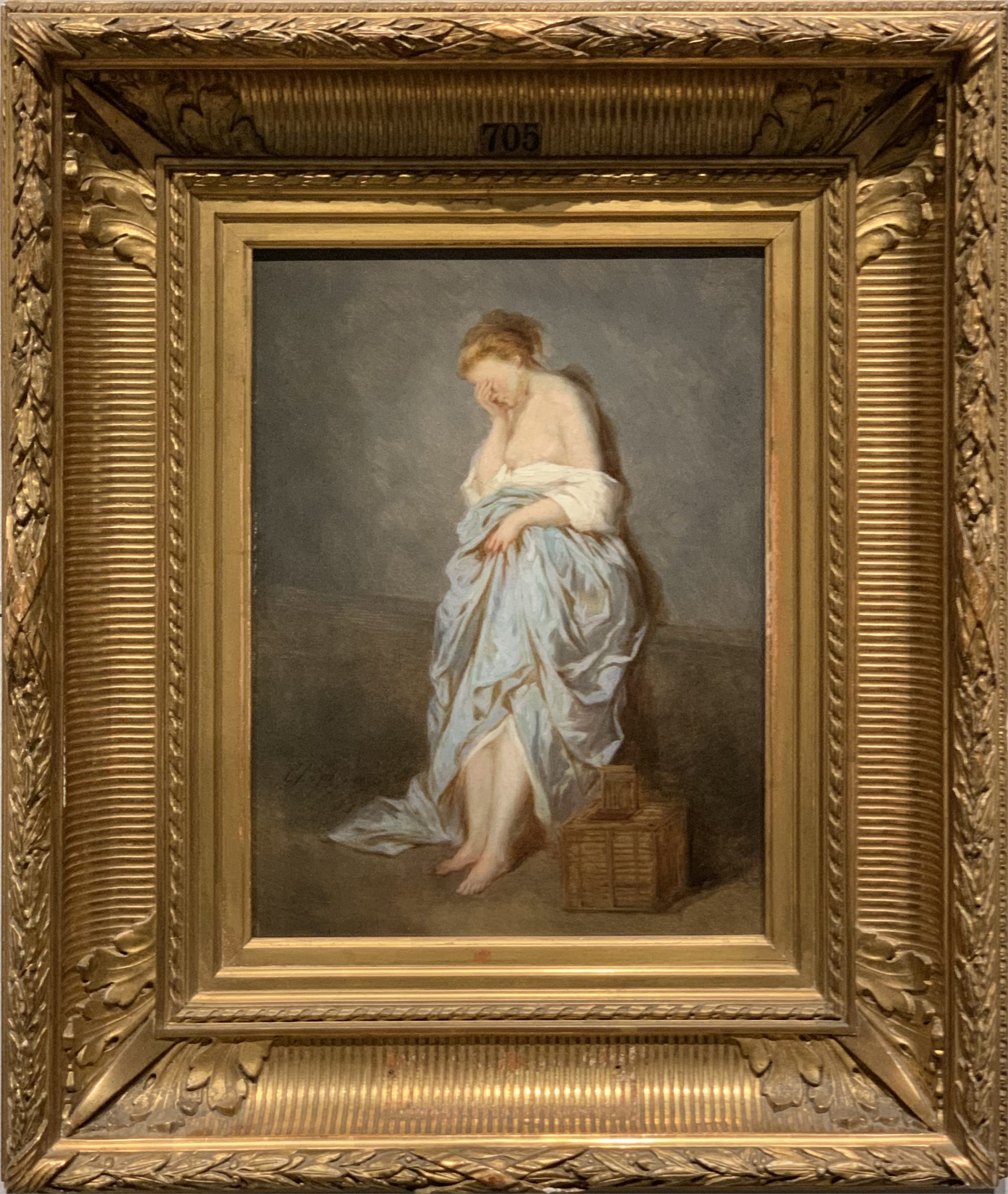
A young girl stands leaning against a bare wall with her head bowed, covering her face. An upturned birdcage sits beside her with the door wide open. This metaphor appears frequently in paintings of this period and symbolises a loss of virginity; now the cage door has been opened the bird has flown and is lost forever,
The Victorians loved euphemism. Real meanings were often hidden under symbols that discreetly cloaked subjects they considered to be of a delicate nature, The bird in the cage analogy references the social and sexual structure of Victorian society, moralising against female sexual gratification and perpetuating distinct gender differentiations,
As contemporary viewers, might we consider Chaplin’s use of this trope with a different, more critical, lens?
We’re aware of the detrate surrounding the social construction of firinity and know that, as a society, we frame Virginity differently for men and women. To our contemporary thinking, Chaplin’s virginal bird might be a social construct used to mark ‘before and ‘after’ and more ominously, a toot used to rate the chastity of women and the experience el men,
Object description
Type: Easel painting
Location: Bowes Museum, Barnard Castle, County Durham
Material: Oil on panel
Artist: Charles Chaplin (1825-1891)
Date: 19th century
Image Details
Date: 12 May 2024
Camera body: iPhone Xs
Lens: Telephoto Camera 52mm ƒ/2.4
Focal Length: 52mm
Aperture: ƒ/2.4
Shutter Speed: 1/33s
ISO: 500
Licensing: Image of a Bowes Museum asset. This image cannot be licensed.