
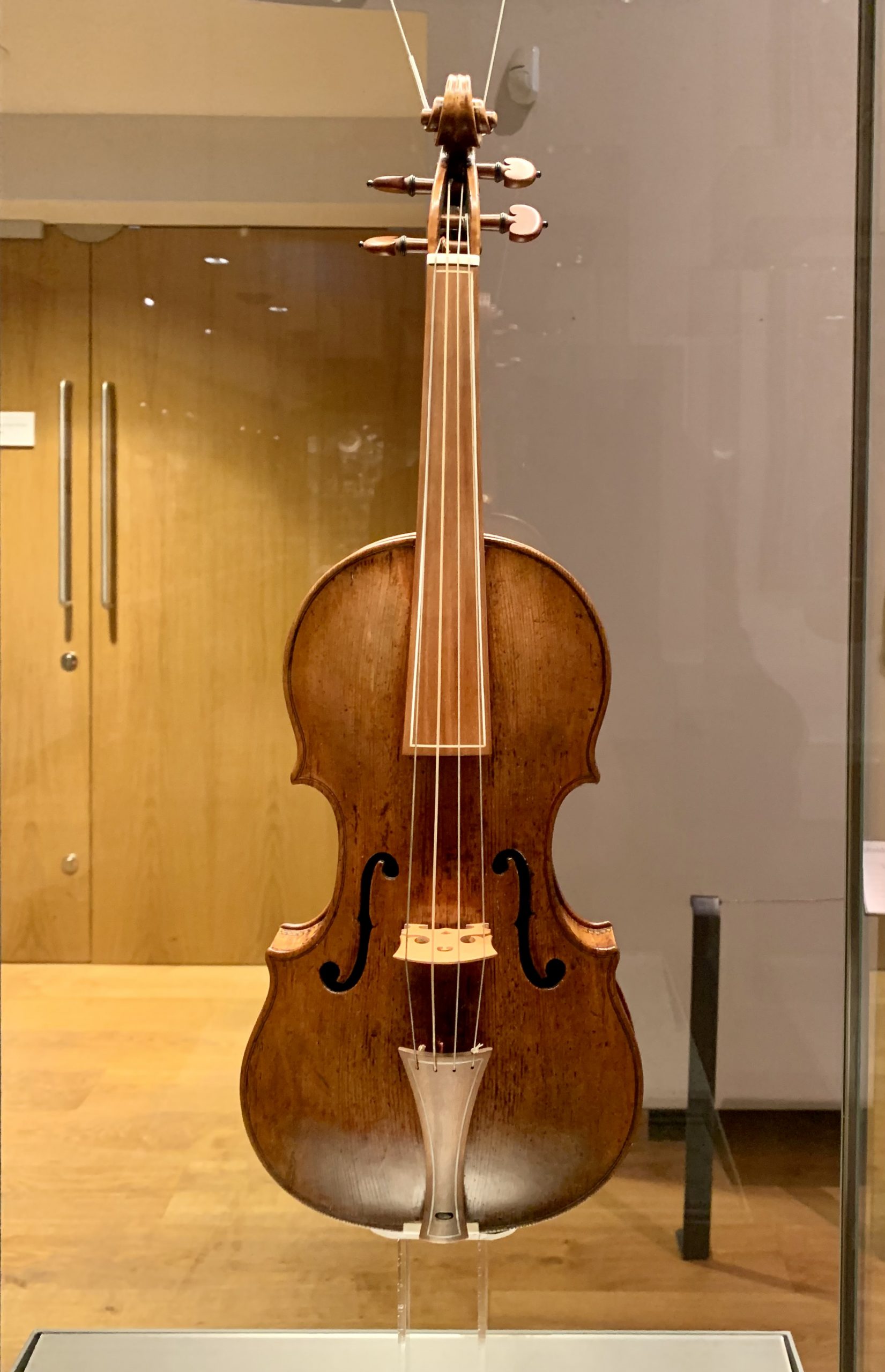
A violin in the Ashmolean Museum, Oxford.
This small instrument, made in 1564, is the earliest known dated violin. The motto on the sides, PIETATE ET IUSTITIA (by piety and justice), and the emblems on the back identify it as one of a set of instruments commissioned from Andrea Amati for the court of the French king. Charles IX (1550-74).
The pattern for the modern violin was probably set by Andrea Amati in 16th-century Cremona. His workshop, taken over by his sons, Girolamo and Antonio, and then by Girolamo’s son, Nicolo Amati, made Cremona the centre of the violin world.
Provenance: Presented by W. E. Hill & Sons.
From Wikipedia
Born in Cremona, Girolamo was the youngest son of Andrea Amati and brother of Antonio Amati. Girolamo worked, probably from 1575, with his brother, in his father’s workshop. With the latter, he refined his construction technique and style. For about ten years, they co-signed their works with their Latinized names: “Antonius & Hieronymus Amati”.
Girolamo slightly increased the size of his instruments, compared to those of his father.
His son, Nicolò Amati (1596-1684), whom he trained in the workshop, was the master of Andrea Guarneri and possibly of Antonio Stradivari and Francesco Rugeri.
Object description
Type: Musical instrument
Location: Ashmolean Museum, Oxford
Material: Wood
Artist: Girolamo Amati (c. 1561-1630)
Date: 1592
Image Details
Date: 28 March 2024
Camera body: iPhone Xs
Lens: Wide Camera 26mm ƒ/1.8
Focal Length: 26mm
Aperture: ƒ/1.8
Shutter Speed: 1/33s
ISO: 400
Licensing: Image of an Ashmolean Museum asset. This image cannot be licensed.