
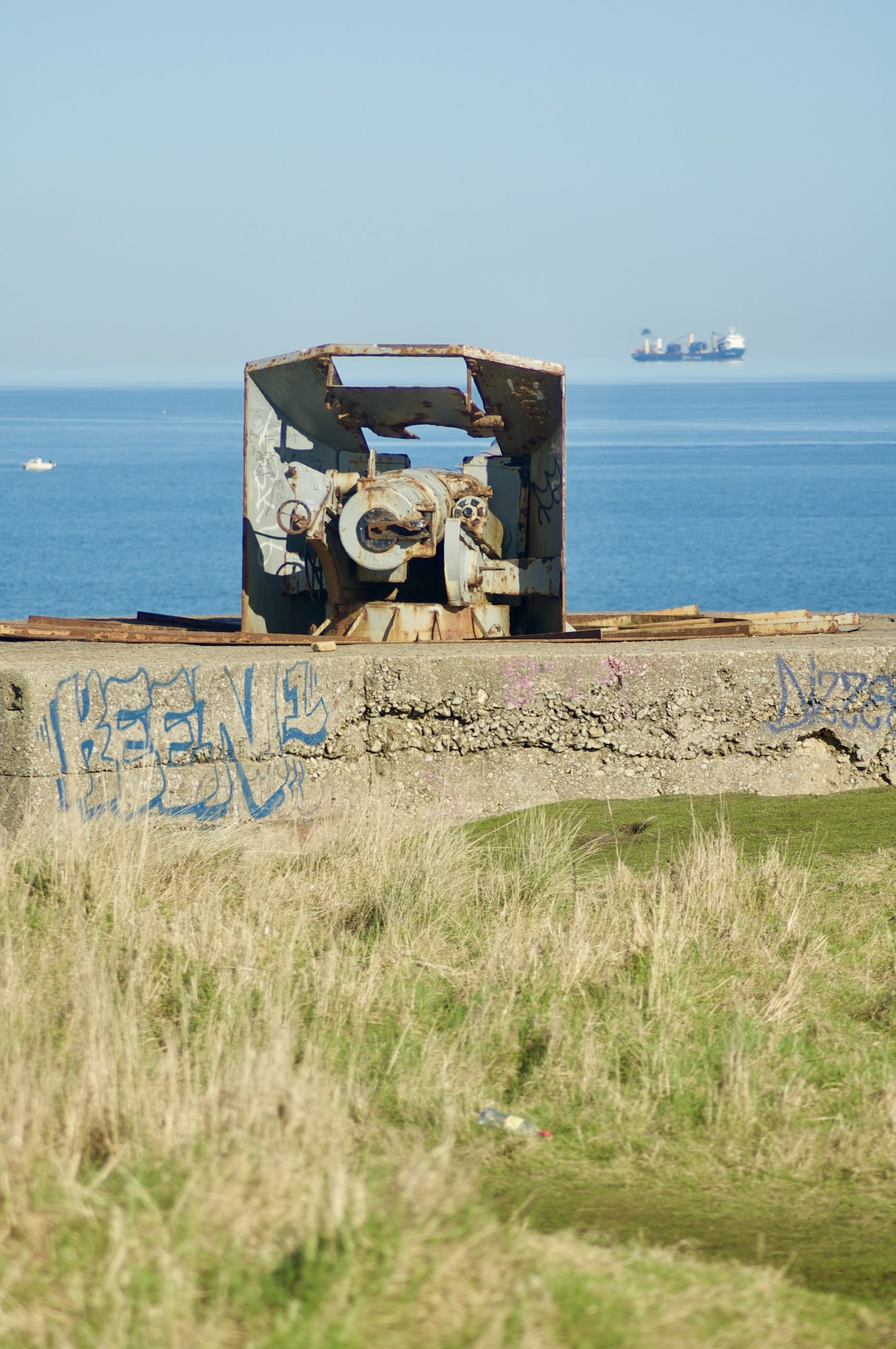
Superior mirage of a ship on the horizon viewed from Trow Point, South Shields, England, with the Trow Point gun in the foreground.
From Wikipedia
A mirage is a naturally occurring optical phenomenon in which light rays bend via refraction to produce a displaced image of distant objects or the sky. The word comes to English via the French (se) mirer, from the Latin mirari, meaning “to look at, to wonder at”.
Mirages can be categorised as “inferior” (meaning lower), “superior” (meaning higher) and “Fata Morgana”, one kind of superior mirage consisting of a series of unusually elaborate, vertically stacked images, which form one rapidly changing mirage.
In contrast to a hallucination, a mirage is a real optical phenomenon that can be captured on camera, since light rays are actually refracted to form the false image at the observer’s location. What the image appears to represent, however, is determined by the interpretive faculties of the human mind. For example, inferior images on land are very easily mistaken for the reflections from a small body of water. A superior mirage is one in which the mirage image appears to be located above the real object. A superior mirage occurs when the air below the line of sight is colder than the air above it. This unusual arrangement is called a temperature inversion. During the daytime, the normal temperature gradient of the atmosphere is cold air above warm air. Passing through the temperature inversion, the light rays are bent down, and so the image appears above the true object, hence the name superior.
Superior mirages are quite common in polar regions, especially over large sheets of ice that have a uniform low temperature. Superior mirages also occur at more moderate latitudes; however, in those cases, they are weaker and tend to be less smooth and stable. For example, a distant shoreline may appear to tower and look higher (and, thus, perhaps closer) than it really is. Because of the turbulence, there appear to be dancing spikes and towers. This type of mirage is also called the Fata Morgana, or hafgerðingar in the Icelandic language.
A superior mirage can be right-side up or upside-down, depending on the distance of the true object and the temperature gradient. Often, the image appears as a distorted mixture of up and down parts.
Since the earth is round, if the downward bending curvature of light rays is about the same as the curvature of Earth, light rays can travel large distances, including from beyond the horizon. This was observed and documented in 1596, when a ship in search of the Northeast passage became stuck in the ice at Novaya Zemlya, above the Arctic Circle. The Sun appeared to rise two weeks earlier than expected; the real Sun was still visible below the horizon, but its light rays followed the curvature of Earth. This effect is often called a Novaya Zemlya mirage. For every 111.12 kilometres (69.05 mi) that light rays travel parallel to Earth’s surface, the Sun will appear 1° higher on the horizon. The inversion layer must have just the right temperature gradient over the whole distance to make this possible.
In the same way, ships that are so far away that they should not be visible above the geometric horizon may appear on or even above the horizon as superior mirages. This may explain some stories about flying ships or coastal cities in the sky, as described by some polar explorers. These are examples of so-called Arctic mirages, or hillingar in Icelandic.
If the vertical temperature gradient is +12.9 °C (23.2 °F) per 100 meters/330 feet (where the positive sign means the temperature increases at higher altitudes) then horizontal light rays will just follow the curvature of Earth, and the horizon will appear flat. If the gradient is less (as it almost always is), the rays are not bent enough and get lost in space, which is the normal situation of a spherical, convex “horizon”.
In some situations, distant objects can be elevated or lowered, stretched or shortened with no mirage involved.
Image details
Date: 24 February 2024
Camera body: Nikon D50
Lens: Tamron 70.0-300.0 mm f/4.0-5.6
Focal Length: 125mm
Aperture: ƒ/5
Shutter Speed: 1/1,250s
ISO: 200
Licence: Creative Commons Attribution-NonCommercial-NoDerivatives 4.0 International