
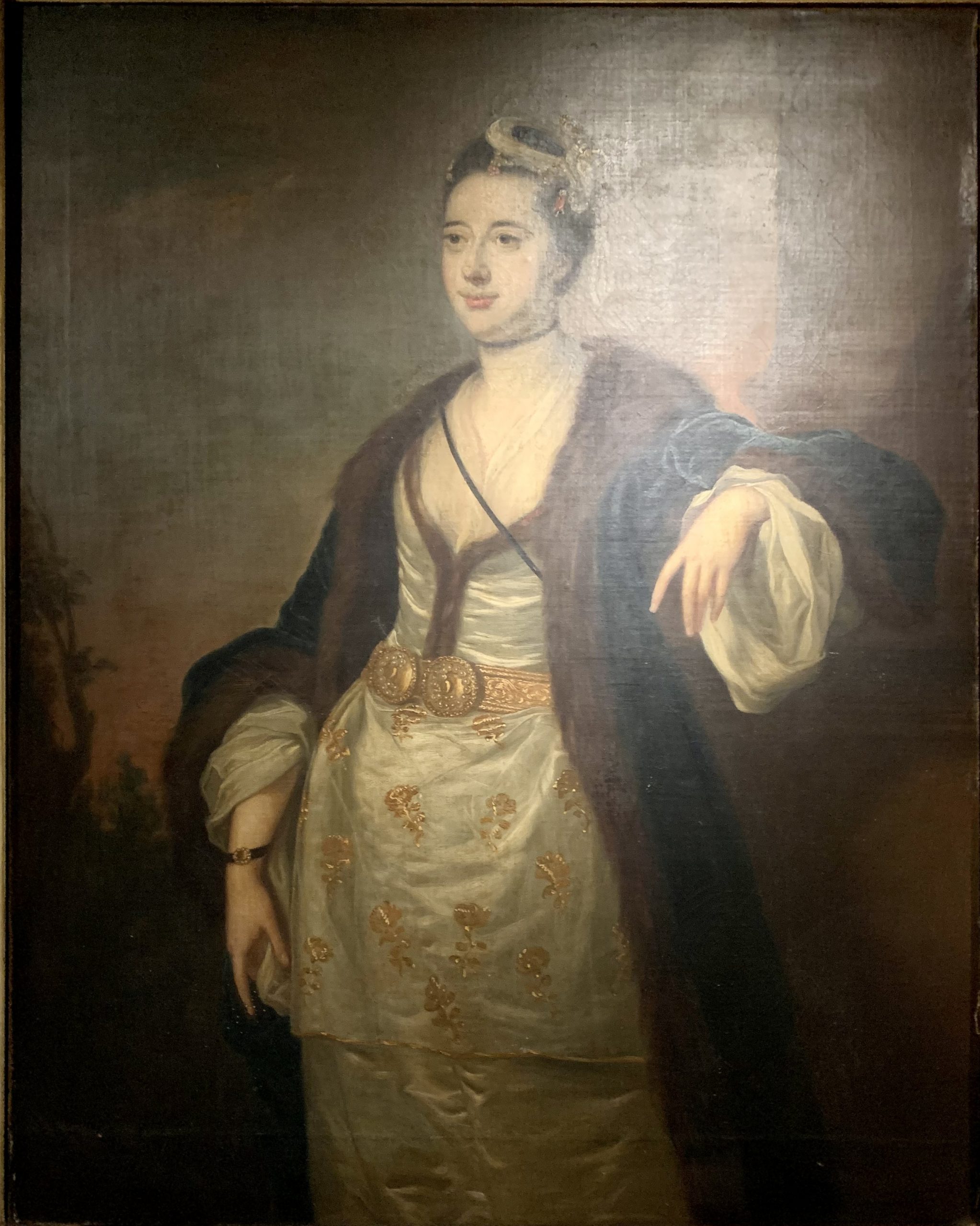
Eldest daughter of Captain Francis Blake Delaval (1692 – 1752) and Rhoda Apreece (d.1759), daughter of Robert Apreece and Sarah Hussey. Her marriage in 1751 to Edward Astley, later 4th Bt. (1729 – 1802) of Melton Constable, ultimately brought Seaton Delaval into the Astley family. She was a talented artist, taught by Pond, who had been brought to Seaton Delaval by her father. Rhoda died in childbirth, having borne him three sons and a daughter. On her death, her husband went to live with his children at Melton Constable. Their son, Jacob (1756 – 1817) inherited the Delaval estates in 1814. Rhoda left various letters dating to the years after her marriage, which provide insight into C18th society life in Northumberland (see M.Green, The Delavals. A Family History, Newcastle, p.44 ff.). If the frame tablet is to be believed, it is conceivable that in 1768, the sitter would have been Anne Milles, whom Sir Edward Astley married in 1759. However, stylistically, the picture seems much earlier, particularly when compared with Cotes’s portrait of Sir Edward, signed and dated 1769. Anthony Mould has suggested that it was painted in the 1750s, which would fit with the identification of the sitter as Rhoda Delaval, his first wife, who died in 1757. Moreover, the sitter bears many parallels with Pond’s portrait of Rhoda, also at Seaton Delaval: the same shape of face, setting of the eyes and brows, and fullness of the lips. The attribution is more perplexing. Anthony Mould had initially suggested Reynolds in the 1750s, but this is precluded by his actual portrait of the sitter. He noted that close-up it was close to Cotes, but probably working in the manner of Reynolds. Sotheby’s attribution to Knapton, who trained Cotes, seems plausible. He had painted the most famous series of mid 18th century fancy dress portraits, that of members of the Dilettanti Society, but they – and all his pictures – are higher toned than this. Cotes thus emerges as the likeliest candidate after all.
Provenance: accepted in lieu of tax by H.M.Treasury and transferred to the National Trust in 2009
Marks & inscriptions: Bottom left: indistinctly: ? pinxit
Text from National Trust website
Object description
Type: Easel painting
Location: Seaton Delaval Hall, Northumberland
Material: Oil on canvas
Artist: attributed to Francis Cotes (1726 – 1770), attributed to George Knapton (1698 – 1778)
Date: circa 1756
Image Details
Date: 29 September 2023
Camera body: iPhone Xs
Lens: Wide Camera 26mm ƒ/1.8
Focal Length: 26mm
Aperture: ƒ/1.8
Shutter Speed: 1/30s
ISO: 640
Licensing: Image of a National Trust asset. This image cannot be licensed.