
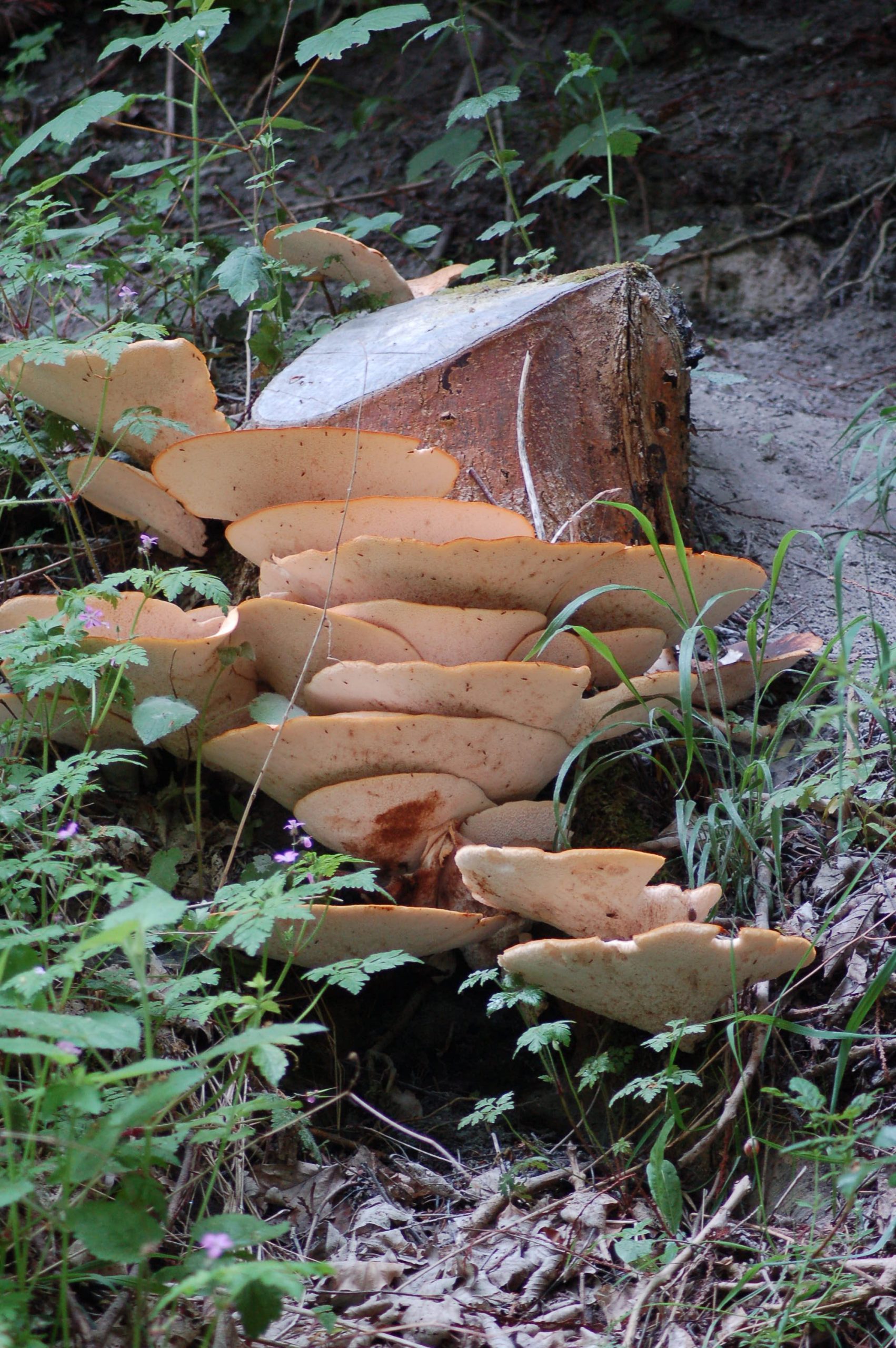
Bracket fungus at Wylam, Northumberland, England
From Wikipedia
Polypores, also called bracket or shelf fungi, are a morphological group of basidiomycete-like gilled mushrooms and hydnoid fungi that form large fruiting bodies called conks, which are typically woody, circular, shelf- or bracket-shaped, with pores or tubes on the underside.
Conks lie in a close planar grouping of separate or interconnected horizontal rows. Brackets can range from only a single row of a few caps, to dozens of rows of caps that can weigh several hundred pounds. They are mainly found on trees (living and dead) and coarse woody debris, and may resemble mushrooms. Some form annual fruiting bodies while others are perennial and grow larger year after year. Bracket fungi are typically tough and sturdy and produce their spores, called basidiospores, within the pores that typically make up the undersurface.
Most polypores inhabit tree trunks or branches consuming the wood, but some soil-inhabiting species form mycorrhiza with trees. Polypores and the related corticioid fungi are the most important agents of wood decay, playing a very significant role in nutrient cycling and aiding carbon dioxide absorption by forest ecosystems. Several polypore species are serious pathogens of plantation trees and are major causes of timber spoilage.
As polypores are much more diverse in old natural forests with abundant dead wood than in younger managed forests or plantations, a number of species have declined drastically and are under threat of extinction due to logging and deforestation. Polypores are used in traditional medicine, and they are actively studied for various industrial applications.
Image details
Date: 4 June 2023
Camera body: Nikon D50
Lens: Tamron 70.0-300.0 mm f/4.0-5.6
Focal Length: 116mm
Aperture: ƒ/4.2
Shutter Speed: 1/200s
ISO: 800
Licence: Creative Commons Attribution-NonCommercial-NoDerivatives 4.0 International