
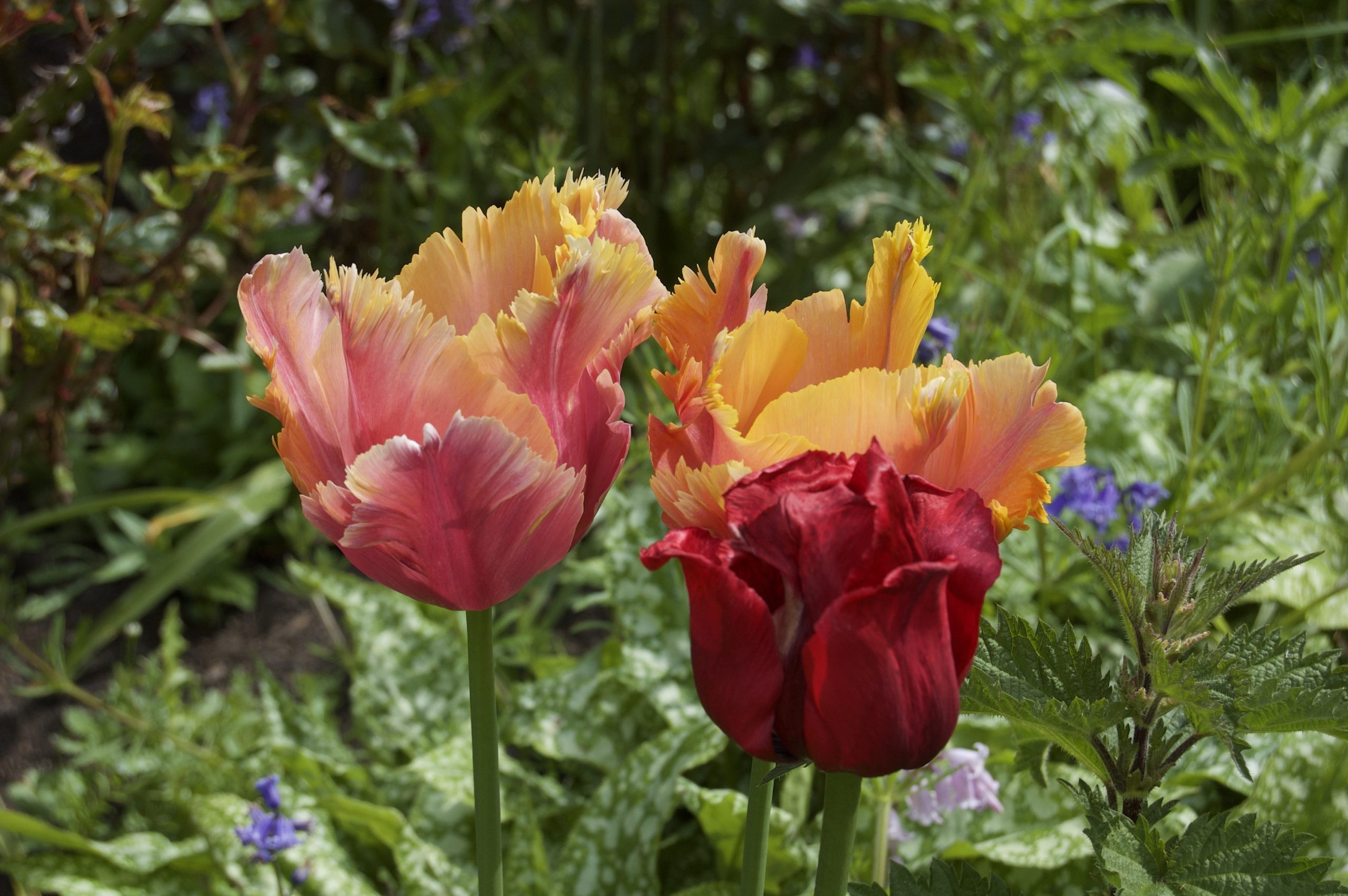
Fringed tulips at Seaton Delaval Hall, Northumberland, England
From Wikipedia
Tulips are spring-blooming perennial herbaceous bulbiferous geophytes in the Tulipa genus. Their flowers are usually large, showy, and brightly coloured, generally red, orange, pink, yellow, or white. They often have a different coloured blotch at the base of the tepals, internally. Because of a degree of variability within the populations and a long history of cultivation, classification has been complex and controversial. The tulip is a member of the lily family, Liliaceae, along with 14 other genera, where it is most closely related to Amana, Erythronium, and Gagea in the tribe Lilieae.
There are about 75 species, and these are divided among four subgenera. The name “tulip” is thought to be derived from a Persian word for turban, which it may have been thought to resemble by those who discovered it. Tulips were originally found in a band stretching from Southern Europe to Central Asia, but since the seventeenth century have become widely naturalised and cultivated (see map). In their natural state, they are adapted to steppes and mountainous areas with temperate climates. Flowering in the spring, they become dormant in the summer once the flowers and leaves die back, emerging above ground as a shoot from the underground bulb in early spring.
Growing wild over much of the Near East and Central Asia, tulips had probably been cultivated in Persia from the 10th century. By the 15th century, tulips were among the most prized flowers; becoming the symbol of the later Ottomans. Tulips were cultivated in Byzantine Constantinople as early as 1055 but they did not come to the attention of Northern Europeans until the sixteenth century, when Northern European diplomats to the Ottoman court observed and reported on them. They were rapidly introduced into Northern Europe and became the subject of an investment bubble during the Dutch tulip mania of 1634–1637. Tulips were frequently depicted in Dutch Golden Age paintings, and have become associated with the Netherlands, the major producer for world markets, ever since.
In the seventeenth-century Netherlands, during the time of the tulip mania, an infection of tulip bulbs by the tulip breaking virus created variegated patterns in the tulip flowers that were much admired and valued. While truly broken tulips are not cultivated anymore, the closest available specimens today are part of the group known as the Rembrandts – so named because Rembrandt painted some of the most admired breaks of his time.
Breeding programmes have produced thousands of hybrid and cultivars in addition to the original species (known in horticulture as botanical tulips). They are popular throughout the world, both as ornamental garden plants and as cut flowers.
Div. 7: Fringed (Crispa) – cup or goblet-shaped blossoms edged with spiked or crystal-like fringes, sometimes called “tulips for touch” because of the temptation to “test” the fringes to see if they are real or made of glass. Perennials with a tendency to naturalize in woodland areas, growing 45–65 cm (18–26 inches) tall and blooming in late season.
Image details
Date: 21 May 2023
Camera body: Nikon D50
Lens: Nikkor AF-S DX 18-55mm ƒ3.5-5.6G ED
Focal Length: 23mm
Aperture: ƒ/7.1
Shutter Speed: 1/1,600s
ISO: 200
Licence: Creative Commons Attribution-NonCommercial-NoDerivatives 4.0 International