
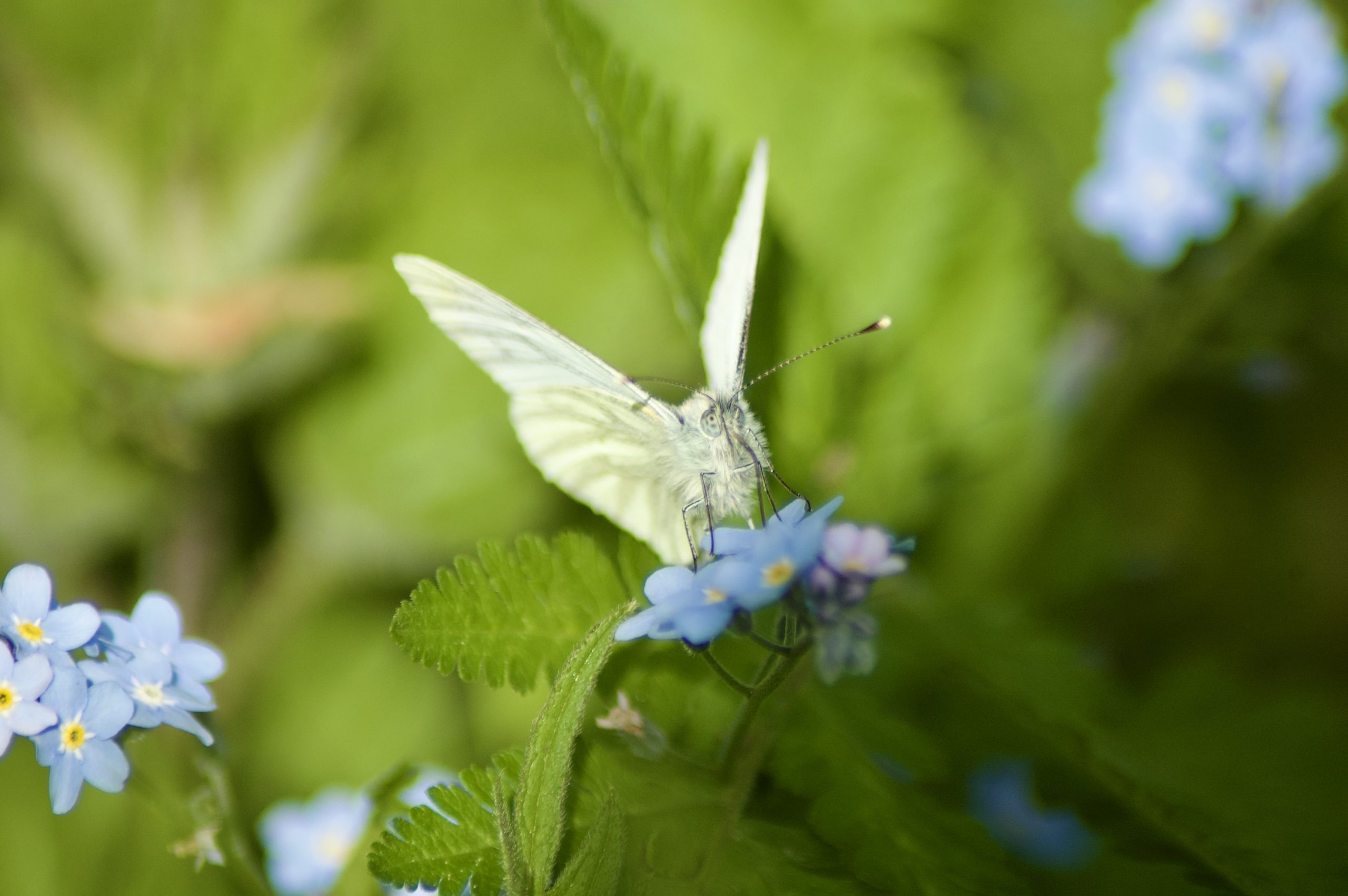
A green-veined white butterfly at Wylam, Northumberland, England
From Wikipedia
The green-veined white (Pieris napi) is a butterfly of the family Pieridae.
A circumboreal species widespread across Europe and Asia, including the Indian subcontinent, Japan, the Maghreb and North America. It is found in meadows, hedgerows and woodland glades but not as often in gardens and parks like its close relatives the large and small whites, for which it is often mistaken. Like other “white” butterflies, the sexes differ. The female has two spots on each forewing, the male only one. The veins on the wings of the female are usually more heavily marked. The underside hindwings are pale yellow with the veins highlighted by black scales giving a greenish tint, hence green-veined white. Unlike the large and small whites, it rarely chooses garden cabbages to lay its eggs on, preferring wild crucifers. Males emit a sex pheromone that is perceptible to humans, citral, the basic flavor-imparting component of lemon peel oil.
Some authors consider the mustard white and West Virginia white of North America to be conspecific with P. napi or consider P. napi to be a superspecies. Despite this, the American butterflies, unlike P. napi, cannot successfully use garlic mustard as a host plant. Females will lay eggs on it, mistaking this non-native species for a compatible native mustard, resulting in the death of the offspring. Classification is also an issue concerning the European dark-veined white.
Image details
Date: 8 May 2022
Camera body: Nikon D50
Lens: Tamron 70.0-300.0 mm f/4.0-5.6
Focal Length: 300mm
Aperture: ƒ/5.6
Shutter Speed: 1/1,000s
ISO: 320
Licence: Creative Commons Attribution-NonCommercial-NoDerivatives 4.0 International