
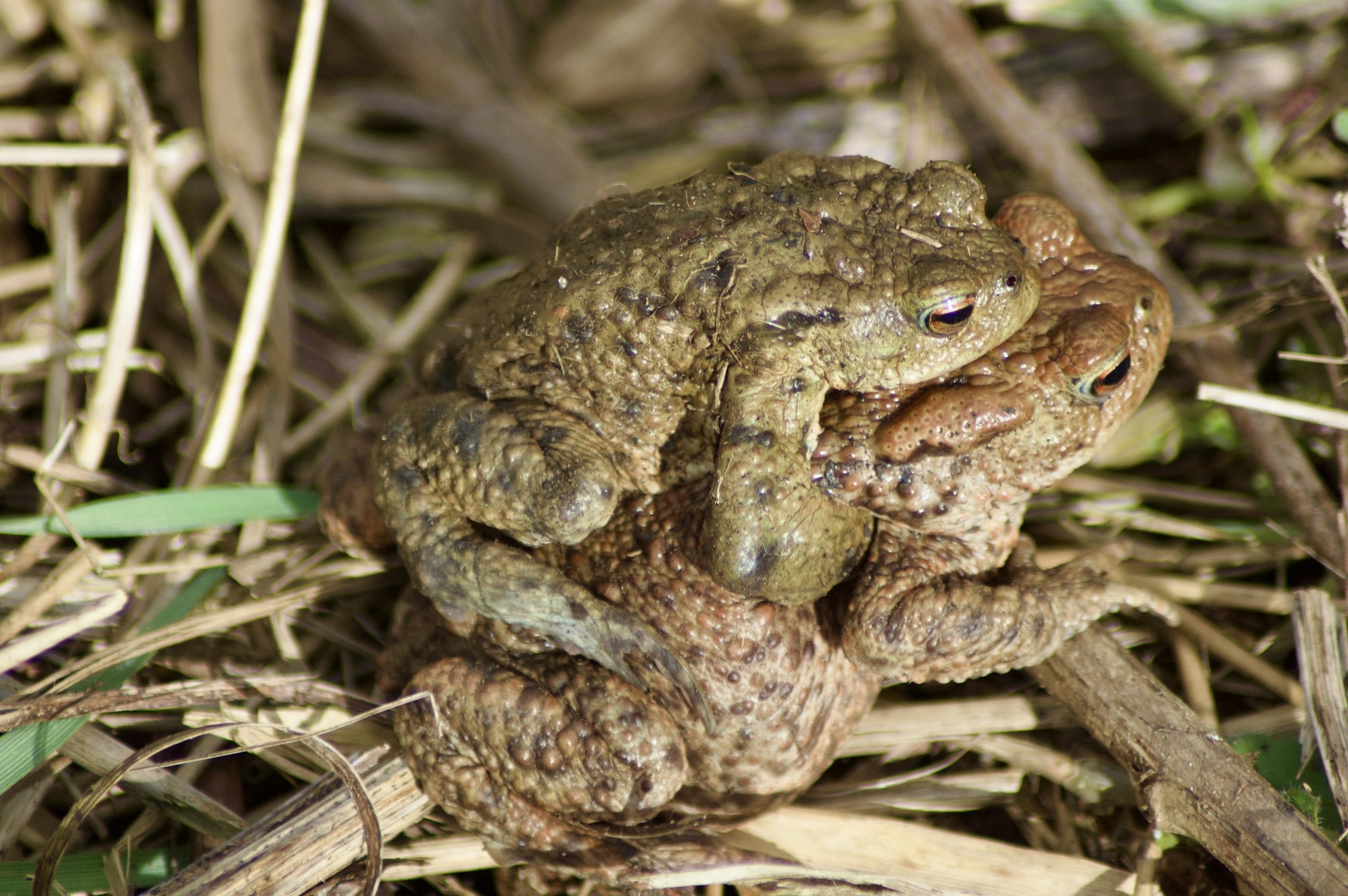
Common toads mating in Wylam, England.
From Wikipedia:
The common toad, also known as European toad or simply the toad in Anglophone parts of Europe (Bufo bufo, from Latin bufo “toad”), is a toad found throughout most of Europe (excluding Ireland, Iceland, parts of Scandinavia, and some Mediterranean islands), western North Asia and a small part of Northwest Africa. It belongs to a group of closely related species descended from a common ancestral line of toads and forming a species complex. The toad is an inconspicuous animal, usually lying hidden during the day. It becomes active at dusk, hunting the invertebrates on which it feeds at night. It moves with a slow, ungainly walk or by jumping short distances, and has greyish-brown skin covered with wart-like lumps.
Although toads are usually solitary animals, large numbers of them converge on certain breeding ponds during the breeding season, where the males compete to mate with the females. The females lay their eggs in gelatinous strings in the water, which later hatch into tadpoles. After several months of growth and development, the tadpoles sprout limbs and undergo metamorphosis to become tiny toads. The juveniles then leave the water and remain largely terrestrial for the rest of their lives.
The common toad appears to be in decline in some areas, but is currently classified as being of “least concern” on the IUCN Red List of Threatened Species. It is under threat due to habitat loss, particularly the drainage of its breeding grounds, and some toads are killed on roads during their annual migrations. The toad has long been associated with witchcraft in popular culture and literature.
Image details
Date: 20 March 2021
Camera body: Nikon D50
Lens: Tamron 70.0-300.0 mm f/4.0-5.6
Focal Length: 300mm
Aperture: ƒ/5.6
Shutter Speed: 1/1,000s
ISO: 360
Licence: Creative Commons Attribution-NonCommercial-NoDerivatives 4.0 International