
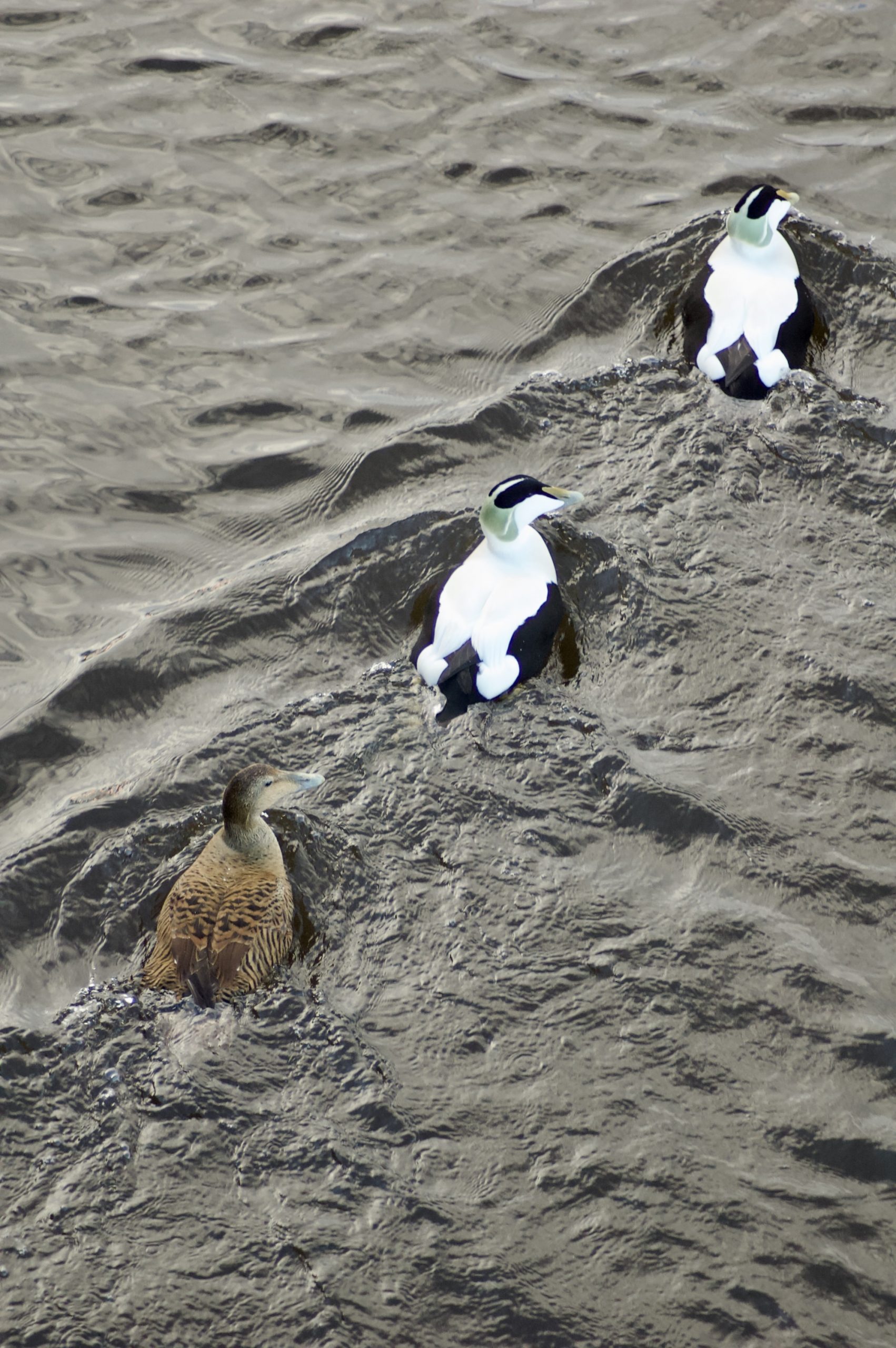
Three eider (one female, two male) at Amble, England
From Wikipedia
The common eider (pronounced /ˈaɪ.dər/) (Somateria mollissima), also called St. Cuthbert’s duck or Cuddy’s duck, is a large (50–71 cm (20–28 in) in body length) sea-duck that is distributed over the northern coasts of Europe, North America and eastern Siberia. It breeds in Arctic and some northern temperate regions, but winters somewhat farther south in temperate zones, when it can form large flocks on coastal waters. It can fly at speeds up to 113 km/h (70 mph).
The eider’s nest is built close to the sea and is lined with eiderdown, plucked from the female’s breast. This soft and warm lining has long been harvested for filling pillows and quilts, but in more recent years has been largely replaced by down from domestic farm-geese and synthetic alternatives. Although eiderdown pillows or quilts are now a rarity—typically being marketed as luxury goods—eiderdown harvesting continues and is sustainable, as it can be done after the ducklings leave the nest with no harm to the birds.
Image Details
Date: 19 January 2020
Camera body: Nikon D50
Lens: Tamron 70.0-300.0 mm f/4.0-5.6
Focal Length: 105mm
Aperture: ƒ/4.2
Shutter Speed: 1/400s
ISO: 800
Licensing: Creative Commons Attribution-NonCommercial-NoDerivatives 4.0 International