
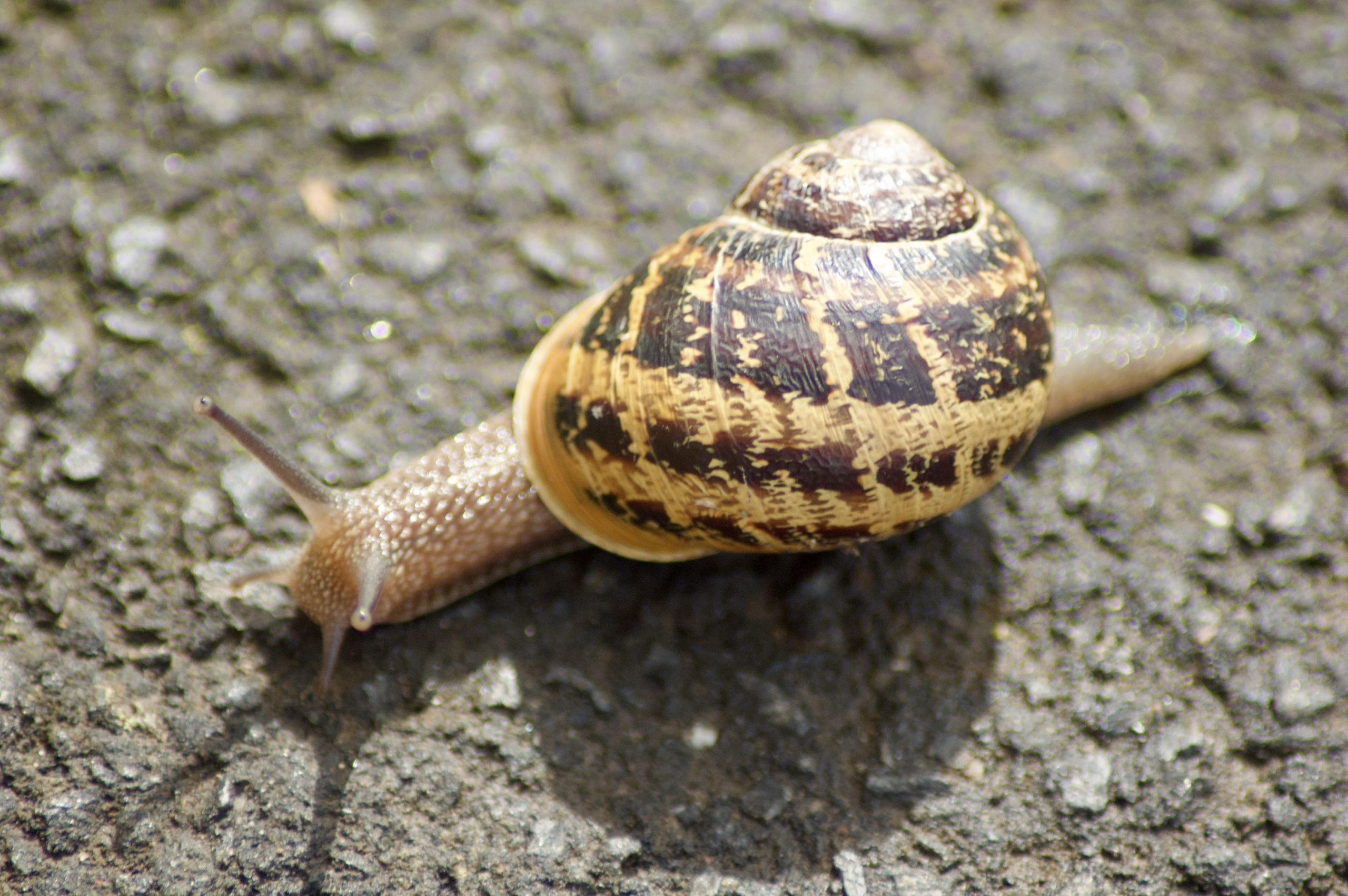
A common garden snail in North Shields, England
From Wikipedia:
Cornu aspersum (syn. Helix aspersa, Cryptomphalus aspersus), known by the common name garden snail, is a species of land snail in the family Helicidae, which includes some of the most familiar land snails. Of all terrestrial molluscs, this species may well be the most widely known. It was classified under the name Helix aspersa for over two centuries, but the prevailing classification now places it in the genus Cornu.
The Garden Snail is relished as a food item in some areas, but it is also widely regarded as a pest in gardens and in agriculture, especially in regions where it has been introduced accidentally, and where snails are not usually considered to be a menu item.
Cornu aspersum in warm regions commonly emerges in moist weather in winter.
The adult bears a hard, thin calcareous shell 25–40 millimetres (1–1+5⁄8 in) in diameter and 25–35 millimetres (1–1+3⁄8 in) high, with four or five whorls. The shell is variable in coloring and shade of color, but generally it has a reticulated pattern of dark brown, brownish-golden, or chestnut with yellow stripes, flecks, or streaks (characteristically interrupted brown colour bands). The aperture is large and characteristically oblique, its margin in adults is whitish and reflected.
The body is soft and slimy, brownish-grey, and able to be retracted entirely into the shell, which the animal does when inactive or threatened. When injured or badly irritated the snail produces a defensive froth of mucus that might repel some enemies or overwhelm aggressive small ants and the like. It has no operculum; during dry or cold weather it seals the aperture of the shell with a thin membrane of dried mucus; the term for such a membrane is epiphragm. The epiphragm helps the snail retain moisture and protects it from small predators such as some ants.
The snail’s quiescent periods during heat and drought are known as aestivation; its quiescence during winter is known as overwintering. When overwintering, Cornu aspersum avoids the formation of ice in its tissues by altering the osmotic components of its blood (or haemolymph); this permits it to survive temperatures as low as −5 °C (23 °F). During aestivation, the mantle collar has the ability to change its permeability to water. The snail also has an osmoregulatory mechanism that prevents excessive absorption of water during hibernation. These mechanisms allow Cornu aspersum to avoid either fatal desiccation or hydration during months of either kind of quiescence.
During times of activity the snail’s head and “foot” emerge. The head bears four tentacles; the upper two are larger and bear eye-like light sensors, and the lower two are tactile and olfactory sense organs. The snail extends the tentacles by internal pressure of body fluids, and retracts all four tentacles into the head by invagination when threatened or otherwise retreating into its shell. The mouth is located beneath the tentacles, and contains a chitinous radula with which the snail scrapes and manipulates food particles.
The shell of Cornu aspersum is almost always right-coiled, but exceptional left-coiled specimens are also known; see Jeremy (snail) for an example.
Image details
Date: 19 August 2018
Camera body: Nikon D50
Lens: Tamron 70.0-300.0 mm f/4.0-5.6
Focal Length: 300mm
Aperture: ƒ/5.6
Shutter Speed: 1/500s
ISO: 400
Licence: Creative Commons Attribution-NonCommercial-NoDerivatives 4.0 International