
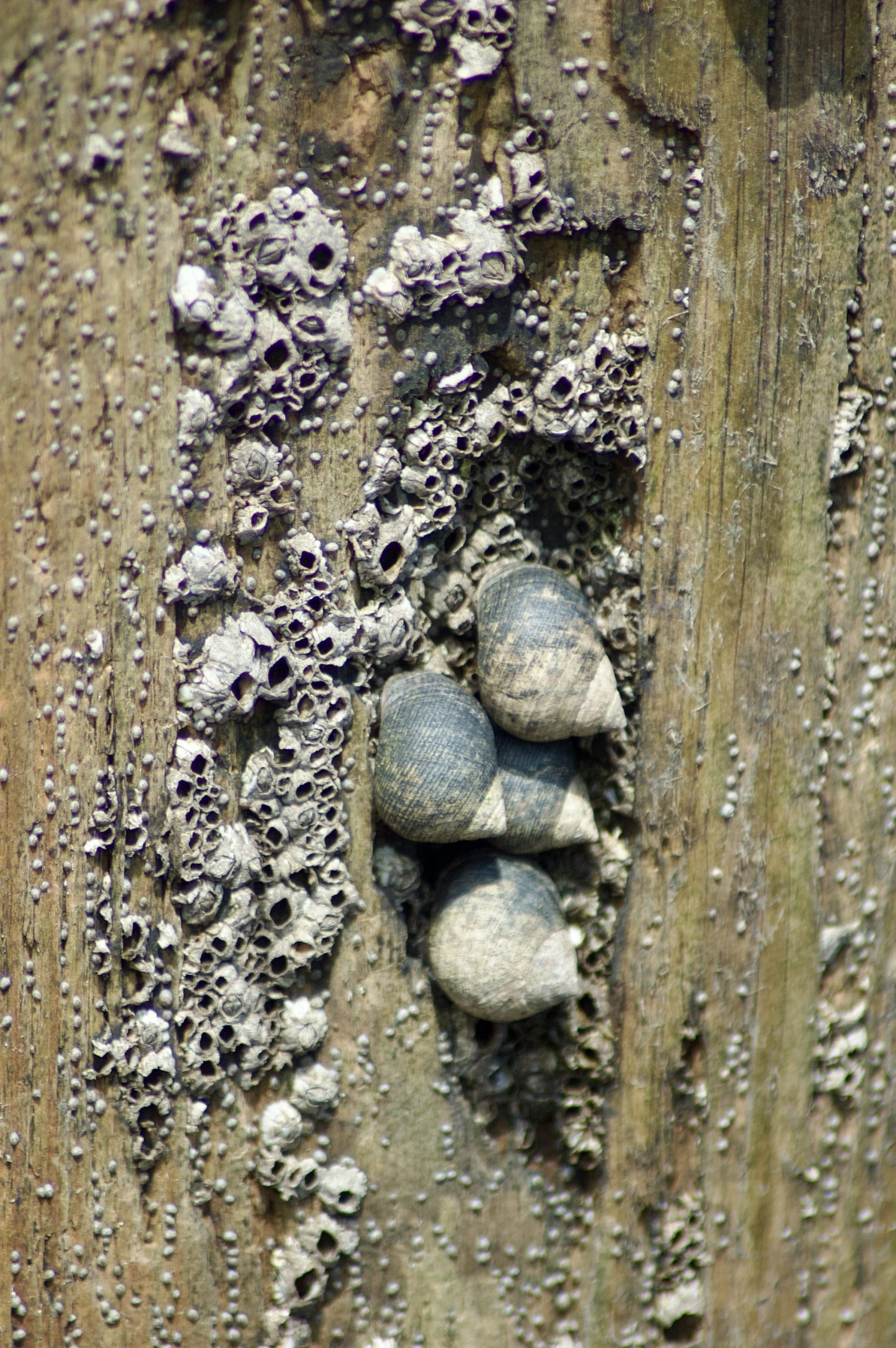
Barnacles & periwinkles on Lloyd’s Jetty in the Tyne at North Shields, England
From Wikipedia:
Barnacles are arthropods of the subclass Cirripedia in the subphylum Crustacea. They are related to crabs and lobsters, with similar nauplius larvae. Barnacles are exclusively marine invertebrates; many species live in shallow and tidal waters. Some 2,100 species have been described.
Barnacle adults are sessile; most are suspension feeders with hard calcareous shells, but the Rhizocephala are specialized parasites of other crustaceans, with reduced bodies. Barnacles have existed since at least the mid-Carboniferous, some 325 million years ago.
In folklore, barnacle geese were once held to emerge fully formed from goose barnacles. Both goose barnacles and the Chilean giant barnacle are fished and eaten. Barnacles are economically significant as biofouling on ships, where they cause hydrodynamic drag, reducing efficiency.
From Wikipedia:
The common periwinkle or winkle (Littorina littorea) is a species of small edible whelk or sea snail, a marine gastropod mollusc that has gills and an operculum, and is classified within the family Littorinidae, the periwinkles.
This is a robust intertidal species with a dark and sometimes banded shell. It is native to the rocky shores of the northeastern, and introduced to the northwestern, Atlantic Ocean.
The shell is broadly ovate, thick, and sharply pointed except when eroded. The shell contains six to seven whorls with some fine threads and wrinkles. The color varies from grayish to gray-brown, often with dark spiral bands. The base of the columella is white. The shell lacks an umbilicus. The white outer lip is sometimes checkered with brown patches. The inside of the shell is chocolate brown.
The width of the shell ranges from 10 to 12 millimetres (3⁄8 to 1⁄2 in) at maturity, with an average length of 16 to 38 mm (5⁄8 to 1+1⁄2 in). Shell height can reach up to 30 to 52 mm (1+1⁄8 to 2 in), The length is measured from the end of the aperture to the apex. The height is measured by placing the shell with the aperture flat on a surface and measuring vertically.
L. littorea can be highly variable in phenotype, with several different morphs known. Its phenotypic variations may be indicative of speciation, as opposed to phenotypic plasticity. This is of particular importance to evolutionary biology, as it may represent an opportunity to observe a transitional phase in the evolution of an organism.
Image details
Date: 7 June 2018
Camera body: Nikon D50
Lens: Tamron 70.0-300.0 mm f/4.0-5.6
Focal Length: 300mm
Aperture: ƒ/5.6
Shutter Speed: 1/800s
ISO: 400
Licence: Creative Commons Attribution-NonCommercial-NoDerivatives 4.0 International