
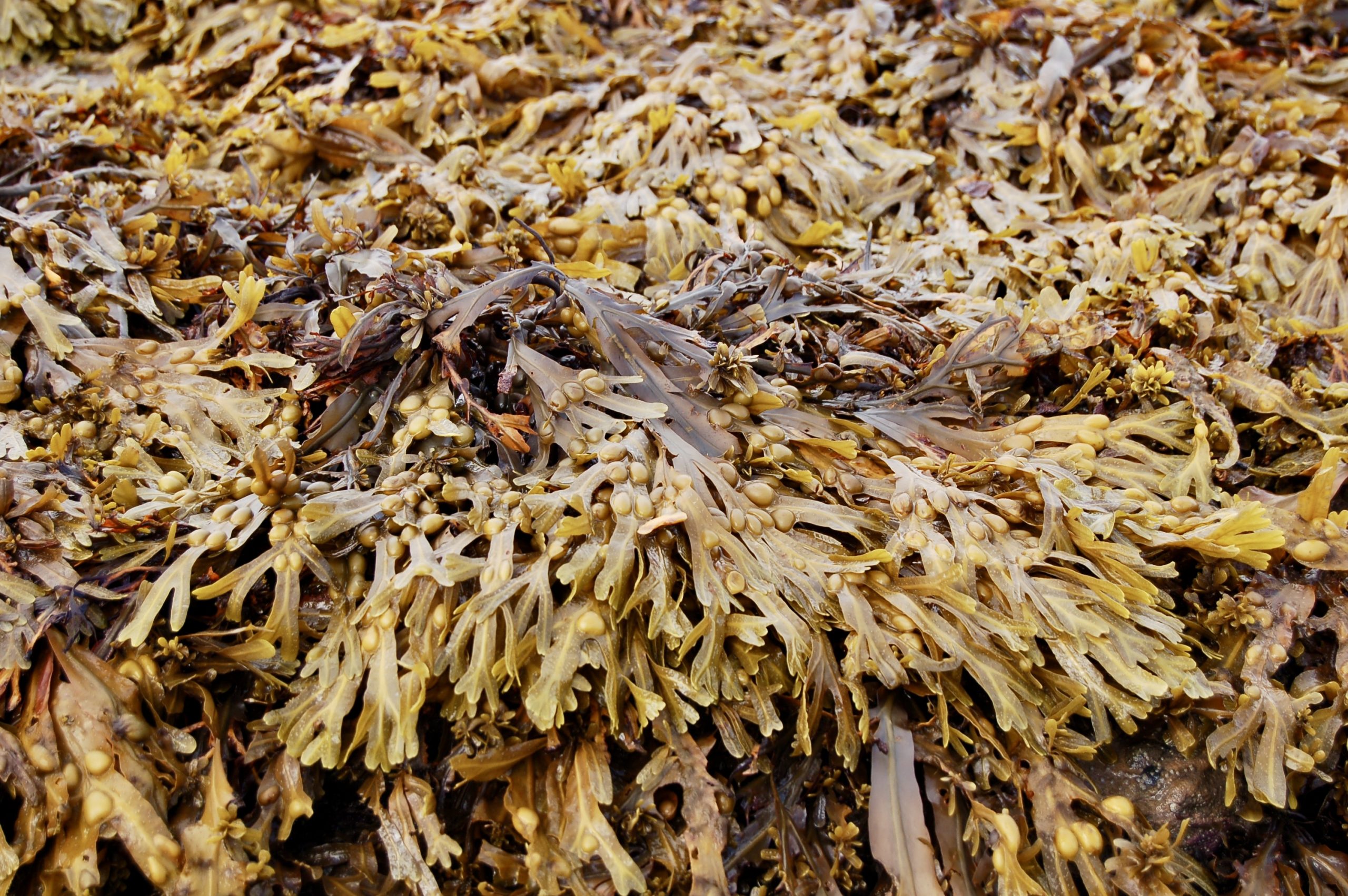
Bladderwrack on St Mary’s Island, Whitley Bay, Tyne & Wear
From Wikipedia
Fucus vesiculosus, known by the common names bladderwrack, black tang, rockweed, sea grapes, bladder fucus, sea oak, cut weed, dyers fucus, red fucus and rock wrack, is a brown alga a seaweed found on the coasts of the North Sea, the western Baltic Sea and the Atlantic and Pacific Oceans. It was the original source of iodine, discovered in 1811, and was used extensively to treat goitre.
The fronds of F. vesiculosus grow to 150 cm (59 in) long and 2.5 cm (1 in) wide and have a prominent midrib throughout. It is typically attached by a basal disc-shaped holdfast but can also be unattached. It has almost spherical air bladders, which are usually paired one on either side of the mid-rib but may be absent in young plants. The margin is smooth and the frond is dichotomously branched. It is sometimes confused with Fucus spiralis with which it hybridises and is similar to Fucus serratus.
Image Details
Date: 28 August 2017
Camera body: Nikon D50
Lens: Nikkor AF-S DX 18-55mm ƒ3.5-5.6G ED
Focal Length: 48mm
Aperture: ƒ/6.3
Shutter Speed: 1/160s
ISO: 200
Licence: Creative Commons Attribution-NonCommercial-NoDerivatives 4.0 International