
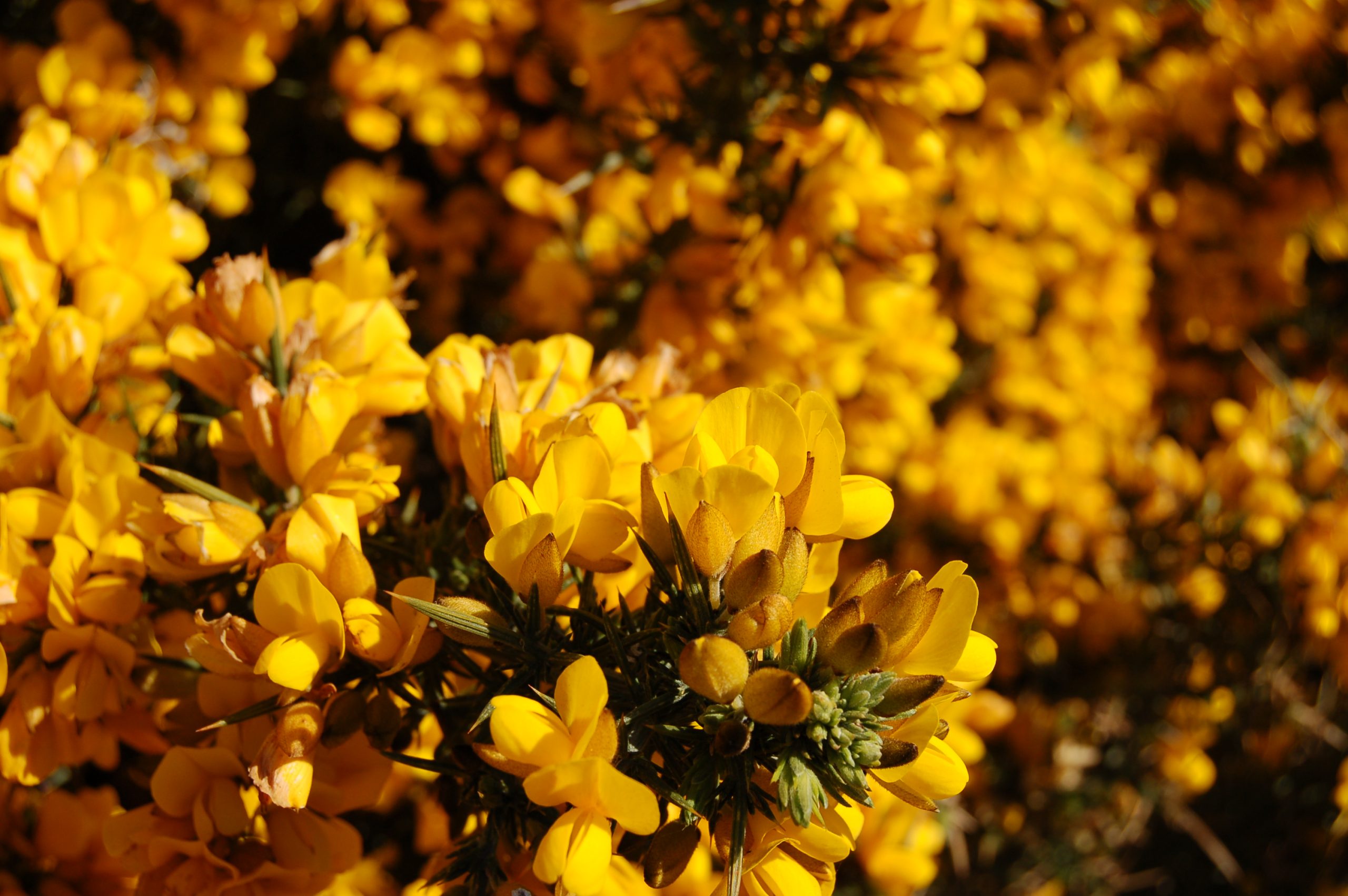
Gorse near Craster, Northumberland
From Wikipedia
Ulex europaeus, commonly known as gorse, common gorse, furze or whin, is a species of flowering plant native to Western Europe.
Growing to 4.5 metres (10 ft) tall, it is an evergreen shrub. The young stems are green, with the shoots and leaves modified into green spines, 1–3 centimetres (1⁄2–1+1⁄4 in) long. Young seedlings produce normal leaves for the first few months; these are trifoliate, resembling a small clover leaf.
The solitary flowers are yellow, 1–2 cm (1⁄2–3⁄4 in) long, with the pea-flower structure typical of the Fabaceae; they are produced throughout the year, but mainly over a long period in spring. They are coconut-scented. The fruit is a legume (pod) 2 cm (3⁄4 in) long, dark purplish-brown, partly enclosed by the pale brown remnants of the flower; the pod contains 2–3 small blackish, shiny, hard seeds, which are ejected when the pod splits open in hot weather. Seeds remain viable for 30 years.
Like many species of gorse, it is often a fire-climax plant, which readily catches fire but re-grows from the roots after the fire; the seeds are also adapted to germinate after scorching by fire. It has a tap root, lateral and adventitious roots. An extremely tough and hardy plant, it survives temperatures down to −20 °C (−4 °F). It can live for about thirty years.
Image Details
Date: 5 May 2017
Camera body: Nikon D50
Lens: Nikkor AF-S DX 18-55mm ƒ3.5-5.6G ED
Focal Length: 38mm
Aperture: ƒ/8
Shutter Speed: 1/640s
ISO: 200
Licence: Creative Commons Attribution-NonCommercial-NoDerivatives 4.0 International